
It all comes from the same field: what food buyers need from farm data
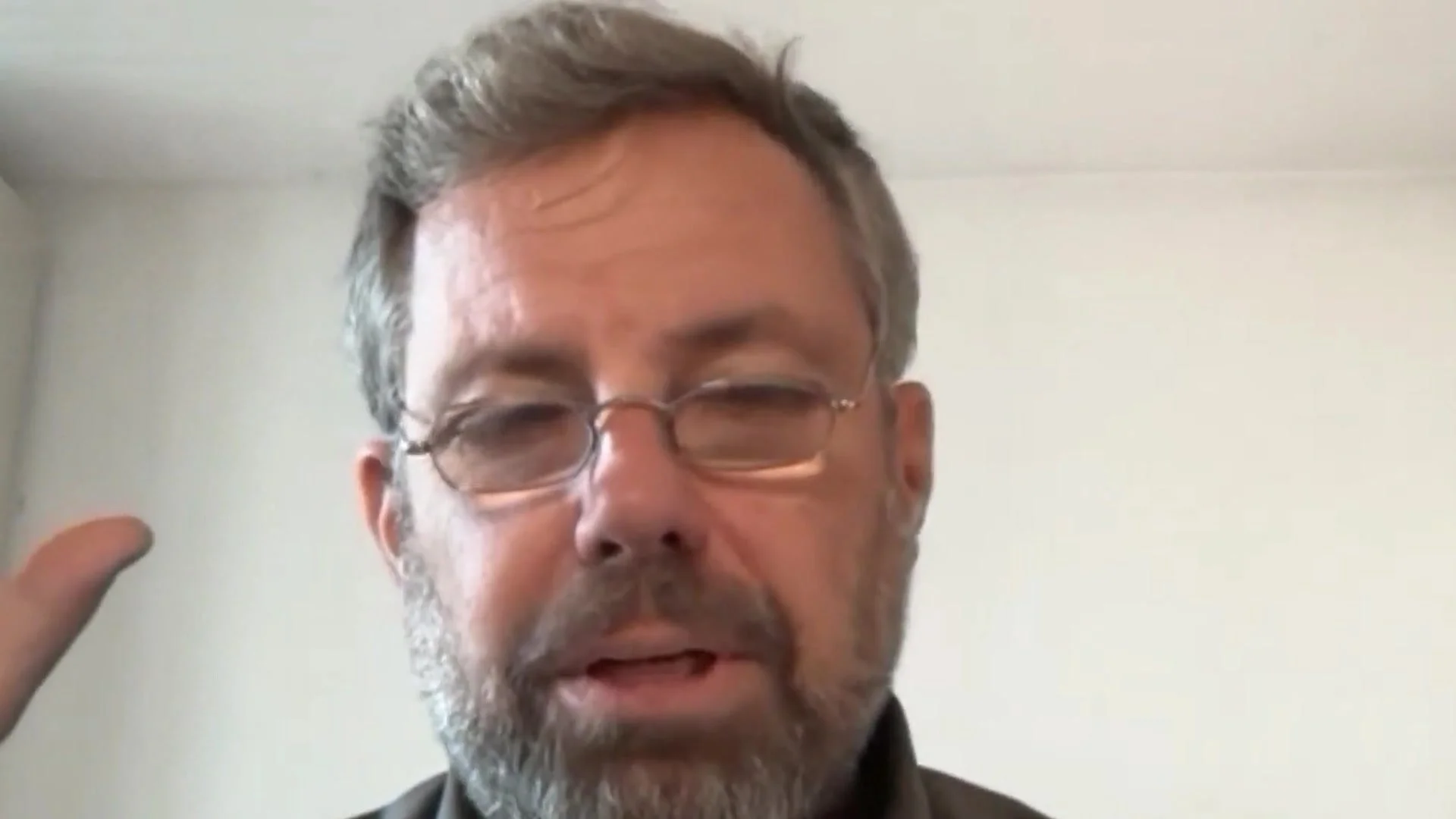
Our webcast The First Mile by Finches, Episode 2: Dr. Matthias Nachtmann, Chairman of Friends of Digital Farming, on why the data a food buyer wants is usually already sitting on a farm, and why it so rarely arrives. Recorded in German on October 2, 2026. Quotes are translated into English and lightly edited for length.
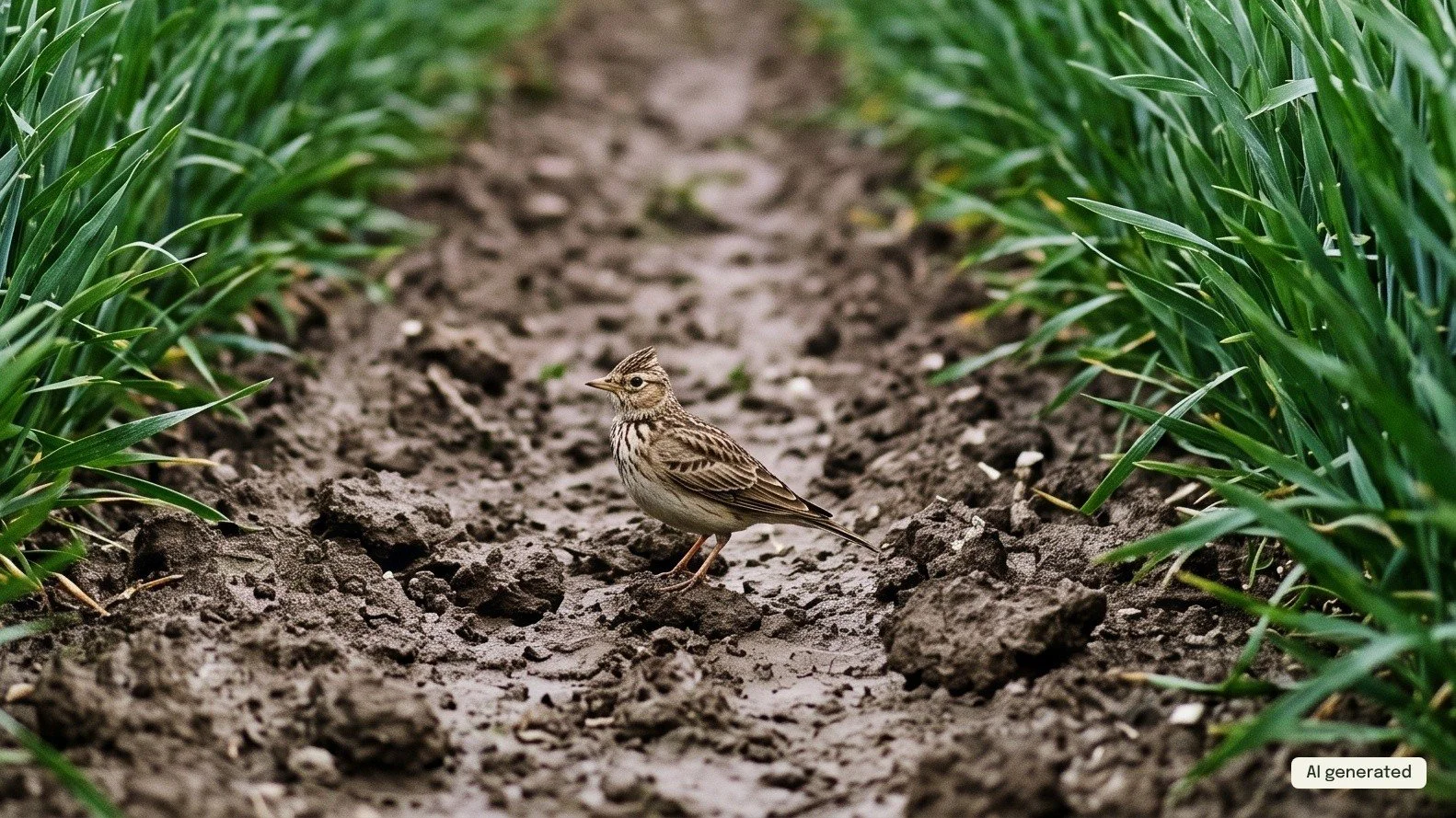
In the spring of 2020, wheat growers in the southern Palatinate tried an experiment that ran from their fields to a bakery shelf. It leaned on two things farm technology could already do: satellite images show where a field yields poorly, and a modern seed drill can be told to plant nothing at all in a given spot. So in each hectare the growers left two small squares of bare ground, about 20 square meters apiece, set away from the tramlines so that a fox walking the tractor tracks wouldn't find them.
The squares were for the skylark. The bird nests on the ground, and in a dense stand of winter wheat it has nowhere to land. Give it an unsown patch and it has a runway, and the odds of raising a brood go up. A local mill took the grain, a bakery in the region baked it, and the bread went on sale for about 10 cents more than a regular loaf. The idea was simple: shoppers would pay a small premium, and the premium would pay the farmers for the land they gave up.
Matthias Nachtmann was on the team that pitched it to the baker, and he calls it his favorite failed business model. The fields were easy. The proof was not.
"If you want to scale it, how do you show the larks are actually there? You have to put somebody out there with binoculars. The project spent 4,500 euros on monitoring."
Two years later the price premium was gone, dropped as too much work and too hard to explain, and the farmers were being paid for their skylark plots another way. The lesson Nachtmann took from it runs through everything he said in our conversation: a business model scales only if the evidence it depends on can be produced reliably and at a reasonable cost. Biodiversity can be captured and modeled in digital form too, he says. What the skylark bread lacked was an affordable way to show that the plots were doing anything for the birds.
The receiving hand
Nachtmann's family roots are in farming in the Palatinate. He studied agriculture and went on to earn his doctorate, and for 25 years he has worked where farming, digital technology and sustainability meet. He founded and chairs Friends of Digital Farming, a nonprofit association that brings together farmers, companies and researchers, and much of his work is about getting farm data to flow along the whole value chain, from the field to the companies that buy the crop. He spent years at BASF working on business models for digital farming and sustainability, and today he serves on boards and advises agtech companies, Pessl Instruments among them. He called in from Landau in der Pfalz.
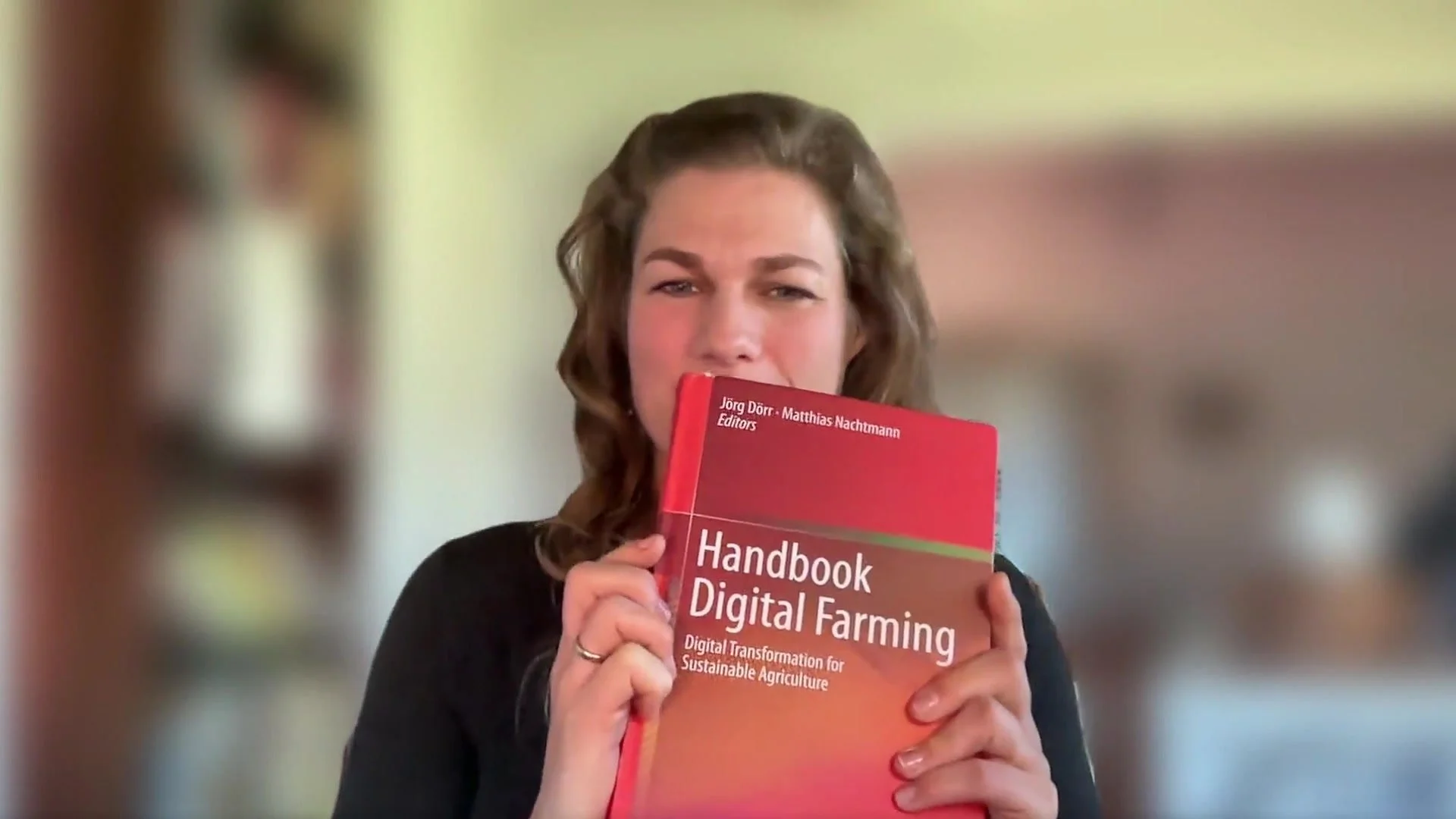
In 2022 he and Jörg Dörr, who holds the chair for digital farming at RPTU Kaiserslautern-Landau, published the Handbook Digital Farming with Springer. A German edition followed in 2024. The book started from a buyer's question: if a food manufacturer or retailer buys raw materials and goes looking for data, where would it find which data? The copy Catharina held up to the camera had made it all the way to Uruguay.
We asked what he would cut from a new edition. Nothing, he said, after giving the question real thought. What he would add is a chapter of translation.
Farmers have a name for the companies that take their crops: the receiving hand. For a long time, the receiving hand mostly wanted the crop. Supply security, compliance and sustainability reporting changed that. Buyers now want to know how a raw material was produced and how next year's yields are likely to develop, and the people asking have rarely had to put those questions to a farmer.
"If your product is half a pig carcass or a silo full of flour, you're not used to asking farmers these things. 'So where do I get your nitrogen data?'"
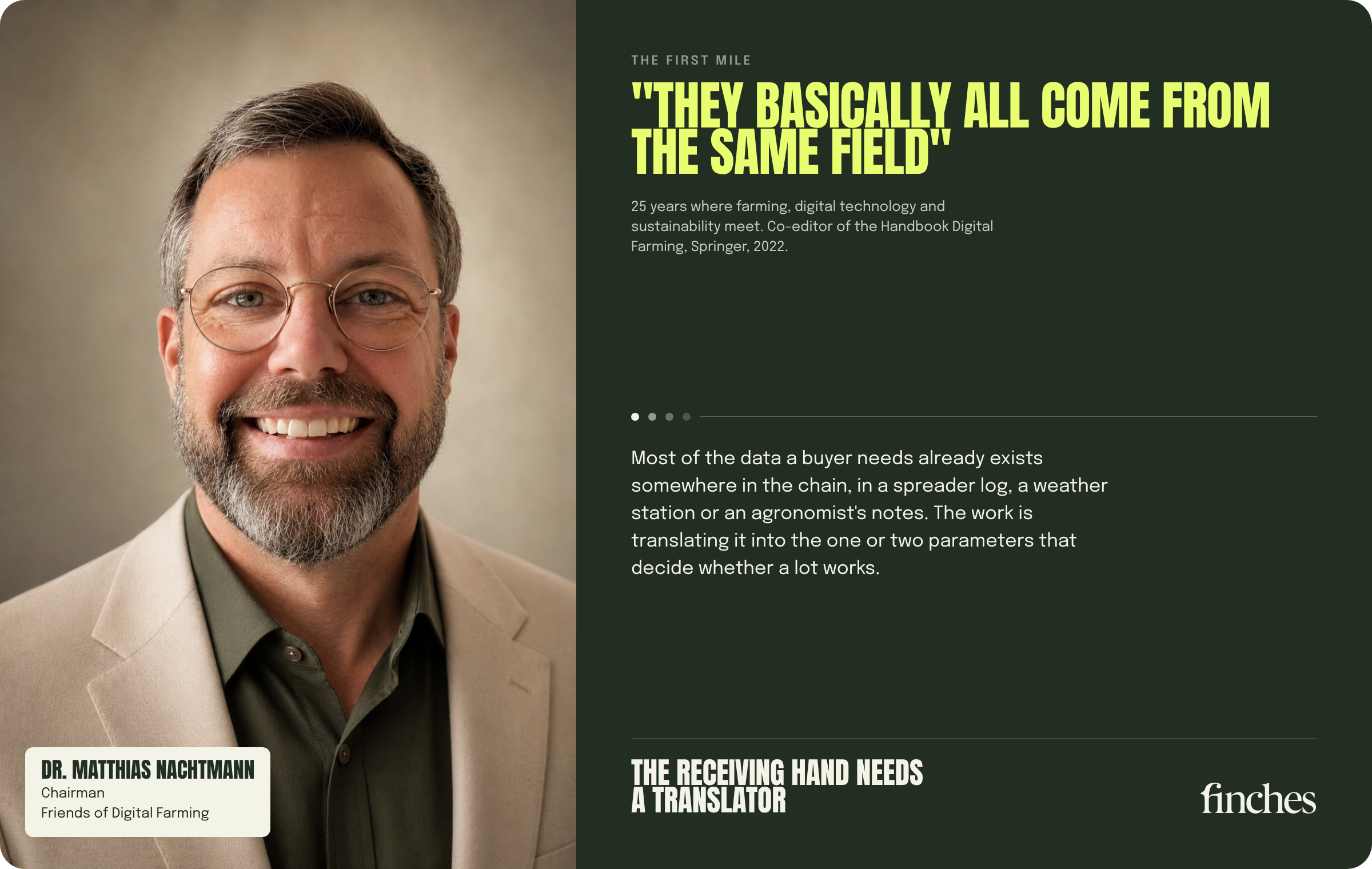
When Nachtmann wrote his diploma thesis in 1997, he copied figures from the city of Mainz's emissions register into an Excel file by hand, so that a farm could make its case for a new pig barn in an expert assessment. The metrics existed even then. Everything else was manual. Today machines log their own data as they work, and AI can read records that were never cleanly structured, even printouts, if someone is willing to spend the computing power. Fifteen or twenty years ago, he remembers, everyone complained about getting tractors and implements from different makers to talk to each other. The industry put enormous work into the ISOBUS standard, and machines now work together far better than they did. Data still doesn't flow freely between machines, farm management systems and the companies further down the chain, and the handover from the field to the receiving hand is where he sees the biggest problem.
Seventeen forms for one field
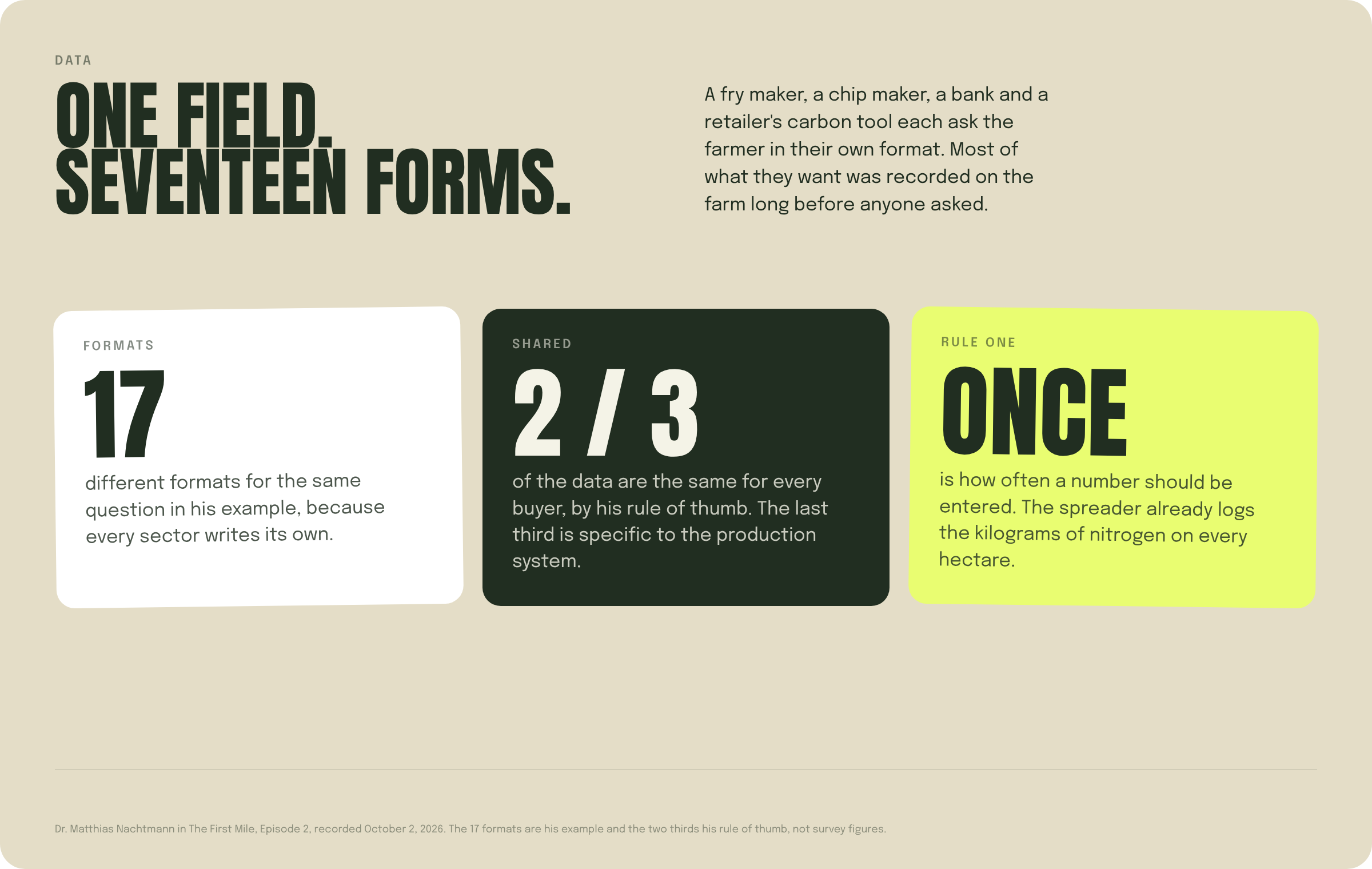
Nachtmann gives the industry credit for trying. The European grain trade has started agreeing on which sustainability data actually matter. In Germany, the dairy industry is harmonizing its requirements through its industry association, and arable farming has its own initiative. Each effort makes sense inside its own sector. On the farm they all add up, and he makes the point with a number picked for effect.
"What gets forgotten is that all these products sit side by side on the same stretch of shelf, and they basically all come from the same field. So when each segment comes up with its own scheme, the farmer is tearing his hair out, because he has seventeen different formats to fill in for the same thing."
What the chain lacks, in his words, is a set of rules of the road for exchanging data. Those rules would sit on top of the platforms and data spaces that already exist: common standards, clear permissions and services that work with one another, so that data a farm has recorded once can be reused across many value chains. They start with a plain question about each data point: what is it worth, and to whom does it have to travel for that value to be realized? The first rule he proposes is that a number gets entered once. A fertilizer spreader already records how many kilograms of nitrogen went onto each hectare and passes the figure to the farm management system.
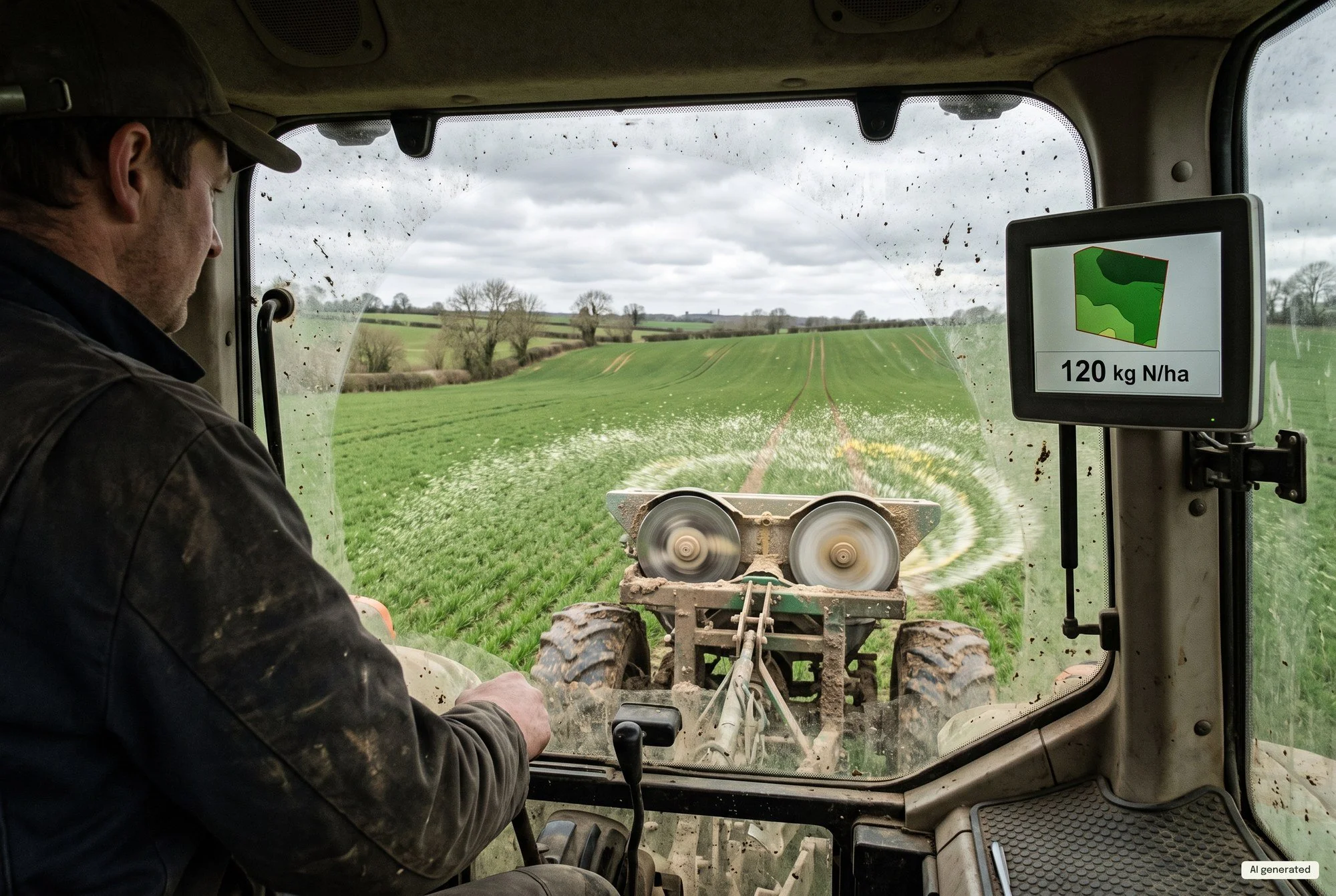
"Say a bank wants an efficiency figure to secure a loan. Don't invent your own metric. Take the number that's already there."
The same goes for a retailer that switches carbon accounting tools. Nachtmann's advice is to start from what the farmer has already recorded, not from what would be the most scientifically complete. Record once, reuse many times: that is one of a handful of principles, and on its own it would save hours at both ends of the chain.
Forty by sixty
To show how a single data point becomes valuable, Nachtmann sketched a french fry plant in a region with no other large potato processor. The plant needs tubers between 40 and 60 millimeters. Anything bigger or smaller has to be trucked somewhere else, so it shows up as waste and as cost.
In his example, two data points matter most to that plant: the potato variety, and the soil moisture at the moment the plants set their tubers. Soil moisture is one of several factors behind tuber size, and its effect is one agronomists have measured for decades. A plant short of water at tuber initiation sets fewer tubers, and more of them come out misshapen. That makes soil moisture an early read on how productive the whole processing chain will be, months before a single potato reaches the grading line.
The sensors, the models behind them and the irrigation that acts on them cost money, and in a drought year like this one the question of who pays for them stops being theoretical. The farmer, Nachtmann suggests, and at some point perhaps the processor too. Following the data point back also shows what the chain would need: documentation of how the crop was produced, and a clean handover, either from the trader who collects the potatoes or from the farm straight to the plant.
By his rule of thumb, most of the data is shared anyway. A french fry maker and a potato chip maker both care about the same nitrogen figure.
"I'd say two thirds of the data are always the same. Then a third is specific to the production system."
How far to look
Ask Nachtmann which early-warning signals a buyer should watch, and he first asks a question back: at what resolution, in space and in time?
His cousin trades grain. He watches the weather in Australia and across the big producing regions of the Southern Hemisphere and the United States, along with stock levels and the effect of El Niño on the season. His living depends on price differences, so he needs a global view built on a few coarse parameters. A mill, a maltster or a feed manufacturer needs something much closer to home.
"I spoke to one of our farmers last week. He normally gets nine to ten tons of corn or more, and some of his fields came in at three."
If that happens across a whole region, two thirds of the harvest is gone. This summer's drought hit hardest in a band running from the Palatinate through Rheinhessen to Lower Franconia. For a buyer with a plant to supply, Nachtmann's rule is local:
"If you've got a mill to fill, you should be monitoring how the crops are developing within 100 or 200 kilometers of your site, short term and long term."
Weather is the easy part. Agricultural forecasting and on-farm weather stations are far better than they were 25 years ago. In sugar beet, a buyer also has to track disease and insects, because new pests keep arriving, and the thresholds that trigger action shift from region to region. For the farmer it comes down to walking the field every week.
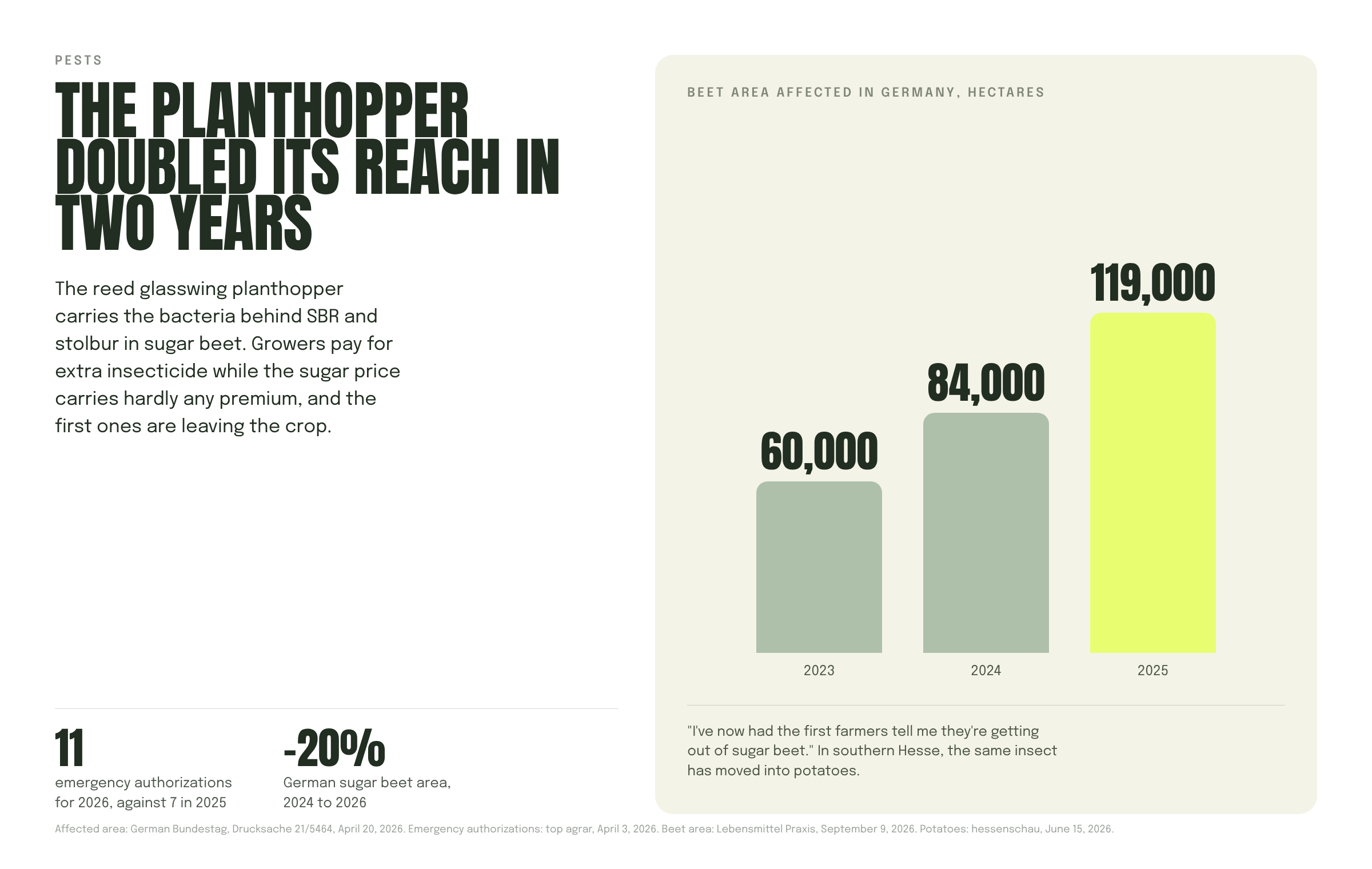
The reed glasswing planthopper shows what is at stake. The insect carries bacteria that make sugar beet sick with syndrome basses richesses (SBR) and stolbur, and the area affected in Germany roughly doubled between 2023 and 2025. This year federal regulators issued 11 emergency authorizations for products against it, up from seven the year before. In southern Hesse, the same insect has moved into potatoes, where it leaves the tubers rubbery.
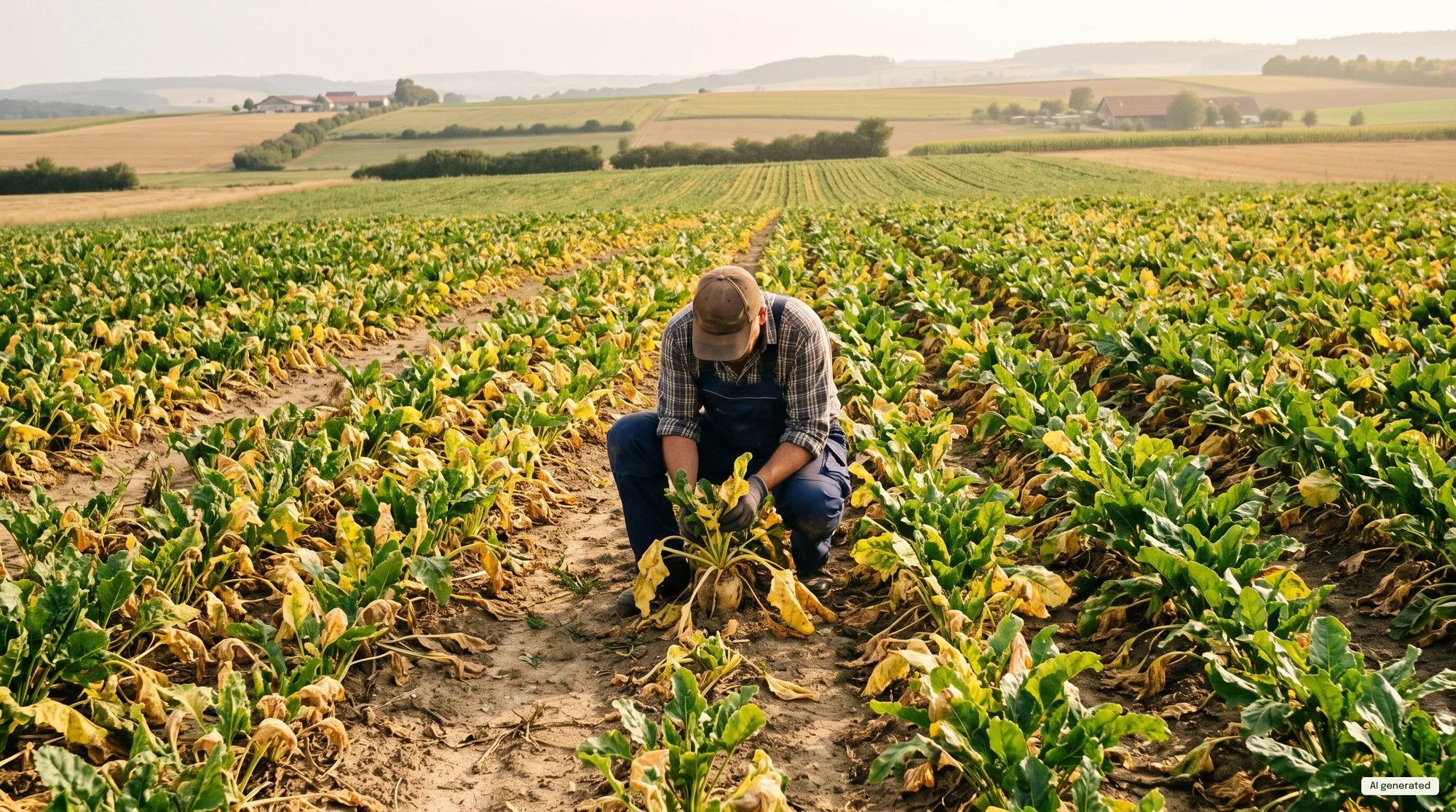
"I've now had the first farmers tell me they're getting out of sugar beet."
Their reasons stack up: the planthopper and the diseases it spreads, a sugar price so low that it carries hardly any premium, and rising costs for the extra insecticide. One grower in southern Hesse cut his beet area by about two thirds. Südzucker offered a bonus to growers who reduced their contracted area for 2026. Across Germany, the beet area has shrunk by about a fifth since 2024.
A year per lesson
Catharina's last question was the one every founder in this market asks: which problem is painful enough that someone will pay to have it solved?
Nachtmann sees few truly new business models. The one he admires is xarvio Healthy Fields, which BASF launched for winter wheat in Germany and France in 2020. The farmer pays a fixed price at the start of the season for a field that stays healthy, with compensation if leaf damage passes an agreed level, instead of paying for the crop protection products. What he likes about it is that it starts from a real problem, and that a field's disease risk and disease status can be captured well in digital form. As for scale, he has it secondhand: his former colleagues tell him the model seems to be scaling.
The skylark bread is the counterexample, and in his telling the reason is how lean food supply chains already are.
"Food is a commodity market. Whatever you do that's new can't add effort or cost you efficiency, because that usually eats the added value."
From the two cases he draws two conditions. The evidence a model depends on has to be captured digitally, reliably and at a reasonable cost, which is where the skylark bread fell short. And there has to be enough market coverage to build on: disease models, farm management systems, and connected machines that pass data between sprayer, tractor and farm software. In his view, his own community is so deep in the details that it misses how far this has already come. Connected digital tools are now in use on millions of hectares, even though getting systems to work together and reusing the data they collect remain the hard part.
He also has a warning for founders.
"Compared with other markets, our production cycles in farming are a year long. That makes your learning curve extremely slow."
What makes him think the moment has come anyway is the other side of the trade.
"I do think we're at a threshold right now, because the receiving hand is far more active than it was ten or twenty years ago."
Where Finches comes in. Matthias Nachtmann is not a Finches customer or advisor, and no commercial arrangement sits behind this episode. What follows is our own view, written as ours.
The translation chapter Nachtmann wants to add is the work a buyer has to do before any data can help. It starts with the raw material that decides the season and with the one or two parameters that decide whether a lot works: tuber size for a fry plant, with potatoes the crop that also ran through our first episode, how much corn a mill or feed plant can count on in a dry year, or a specification with almost no tolerance for baby food. Most of the data points behind those parameters already exist somewhere in the chain, in a spreader log, a weather station or an agronomist's notes. That translation is what we build at Finches, one raw material and one parameter at a time, so the signal reaches the sourcing team while there is still time to act on it.
The First Mile is a webcast by Finches on sourcing resilience, hosted by Finches Co-Founder & CEO Catharina van Delden (who also runs a pecan farm).
Notes on facts and sources
Everything Matthias Nachtmann says is quoted from the recorded conversation of October 2, 2026. The 4,500 euros spent on monitoring the skylark project is the figure he confirmed in writing after the recording, on October 15, 2026; we could not find a published source for it. The seventeen forms and the two thirds of shared data are his own example and his rule of thumb, not survey results.
Guest. Founder and Chairperson of Friends of Digital Farming e.V., formerly at BASF, now serving on boards and advising agtech firms, including Pessl Instruments: Anuga speaker profile. Friends of Digital Farming as a nonprofit bringing together practitioners, business and academia: Bayern Innovativ. Founding members including BASF and John Deere, and support for the digital farming professorship at TU Kaiserslautern: idw, November 25, 2019. His BASF role as Digital Farming and Sustainability Business Development Lead: Ruhr University Bochum, November 25, 2024.
The book. Handbook Digital Farming: Digital Transformation for Sustainable Agriculture, edited by Jörg Dörr and Matthias Nachtmann, Springer, May 2022: Springer. German edition Handbuch Digital Farming, 2024: Chair of Digital Farming, RPTU, March 28, 2024.
Skylark bread. Pilot coordinated by BASF in the southern Palatinate in 2020, two plots of about 20 square meters per hectare on fields over five hectares, about 10 cents extra per 750-gram loaf: top agrar, May 29, 2020. Partners Bäckerei Görtz and Walter Mühle in Böhl-Iggelheim: top agrar, August 30, 2020. Retail premium dropped as too much effort and too hard to explain, model moved to a farmer bonus: top agrar, September 11, 2022. Current German guidance of at least two skylark plots of at least 20 square meters per hectare: QS checklist, April 1, 2025.
ISOBUS. AEF founded in October 2008 by seven equipment manufacturers and two associations, with DLG previously the only ISOBUS test institute: AEF. AEF certification label and ISOBUS database introduced in September 2013: OEM Off-Highway.
Potatoes. The 40-by-60-millimeter band is Nachtmann's example. Water stress at tuber initiation reduces tuber set and increases misshapen tubers: University of Idaho Bulletin 789, 1997 and Spud Smart, April 25, 2022.
Corn and drought. German grain corn averaged 9.45 metric tons per hectare over ten years, 10.09 in 2025, with Rhineland-Palatinate at 9.67: Deutsches Maiskomitee citing Destatis, January 28, 2026. Soil drought in 2026 hardest from the Palatinate and Rheinhessen to Lower Franconia: daswetter.com, August 14, 2026. Corn development in Rhineland-Palatinate described as extremely uneven by region: top agrar, July 24, 2026.
Sugar beet and the planthopper. Pentastiridius leporinus and the pathogens behind SBR and stolbur: top agrar, April 20, 2025. Affected beet area of about 60,000 hectares in 2023, 84,000 in 2024 and 119,000 in 2025: German Bundestag, Drucksache 21/5464, April 20, 2026. Eleven emergency authorizations for 2026 against seven in 2025: top agrar, April 3, 2026. Grower in southern Hesse cutting beet area by about two thirds, and the insect in potatoes: hessenschau, June 15, 2026. Südzucker bonus of 10 euros per metric ton for growers cutting 2026 contracts by at least 15 percent, amid falling prices: top agrar, November 21, 2025. German beet area down about 20 percent from 2024 to 2026, to about 338,700 hectares: Lebensmittel Praxis, September 9, 2026.
Healthy Fields. Field-specific disease management with a health guarantee and compensation above an agreed level of leaf damage: BASF, February 19, 2020. Fixed price at season start, launched in Germany and France for winter wheat in 2020: BASF, November 6, 2020.
Connected farmland. For context on the scale of connected farmland: xarvio FIELD MANAGER covers more than 20 million hectares set up by more than 130,000 farmers and advisers: BASF, September 18, 2025. In a survey of 500 German farms, 46 percent used farm management software: Bitkom and DLG via top agrar, June 3, 2024.
