
Alexandra Vázquez Bea, Co-Founder, CFO and COO of Finches, spoke on the industry panel of the AgriFood Demo Day & Symposium in Munich on September 17, 2026. Her quotes come from her remarks for the panel and are lightly edited for length and clarity.
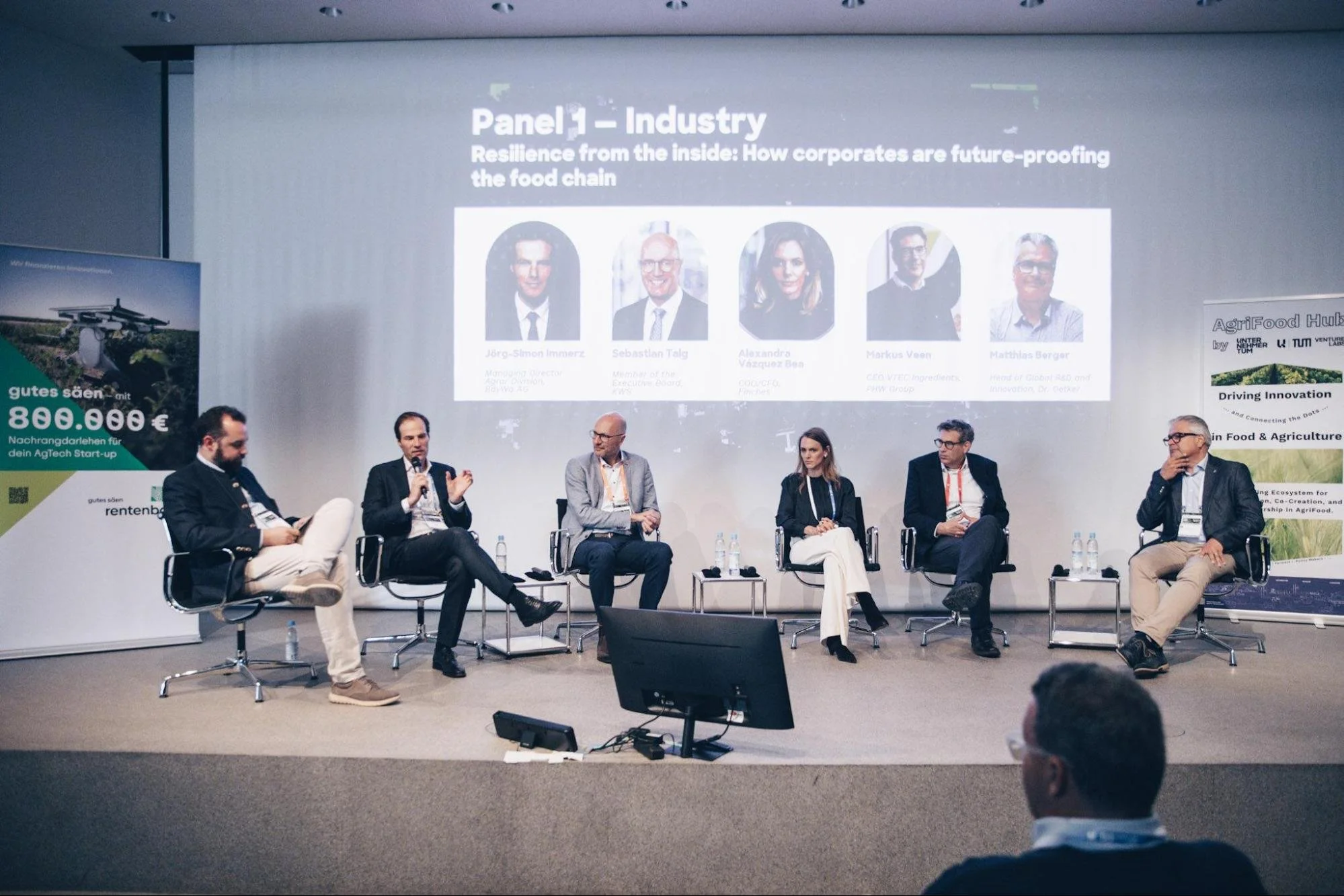
Panel 1 at the AgriFood Demo Day & Symposium, Pinakothek der Moderne, Munich, September 17, 2026.
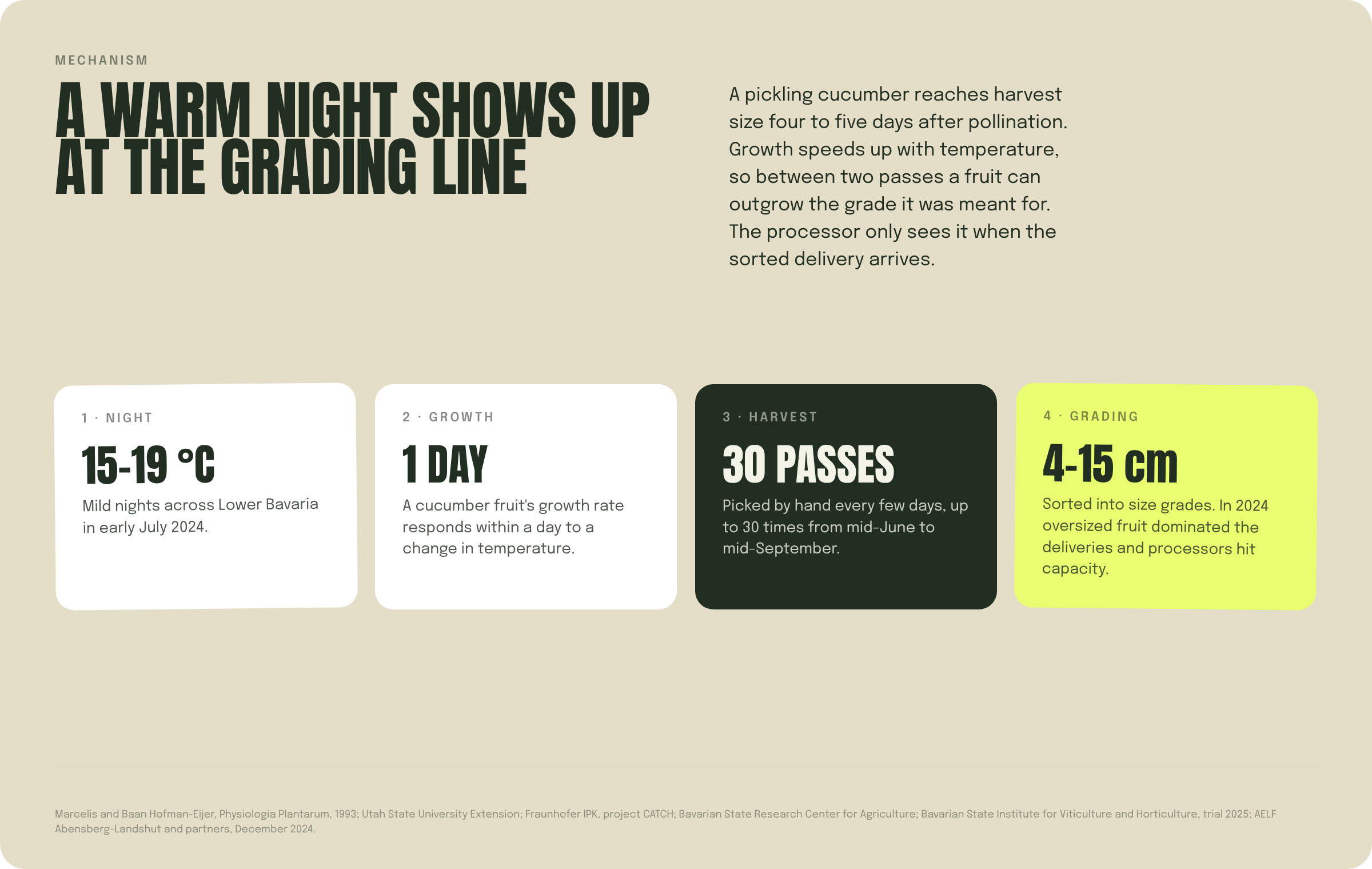
In the first days of July 2024, the nights in Lower Bavaria stayed warm. They held between 15 and 19 degrees Celsius, the region's annual vegetable review noted later, and the pickling cucumbers in the fields around Dingolfing answered the way cucumbers do. They grew faster than the pickers could keep up with.
That stretch of Bavaria holds Germany's largest contiguous area of pickling cucumbers, and the crop is still harvested by hand. Pickers lie face down on long rigs with wings, which growers call cucumber flyers, and pull the fruit off the plants as the rig moves down the rows. A picker manages up to 13 cucumbers a minute. That July it wasn't enough. Oversized fruit dominated the daily deliveries, processors were running at full capacity, and some farms gave up on parts of their fields, partly because of the workload and partly because the fruit could no longer be sold.
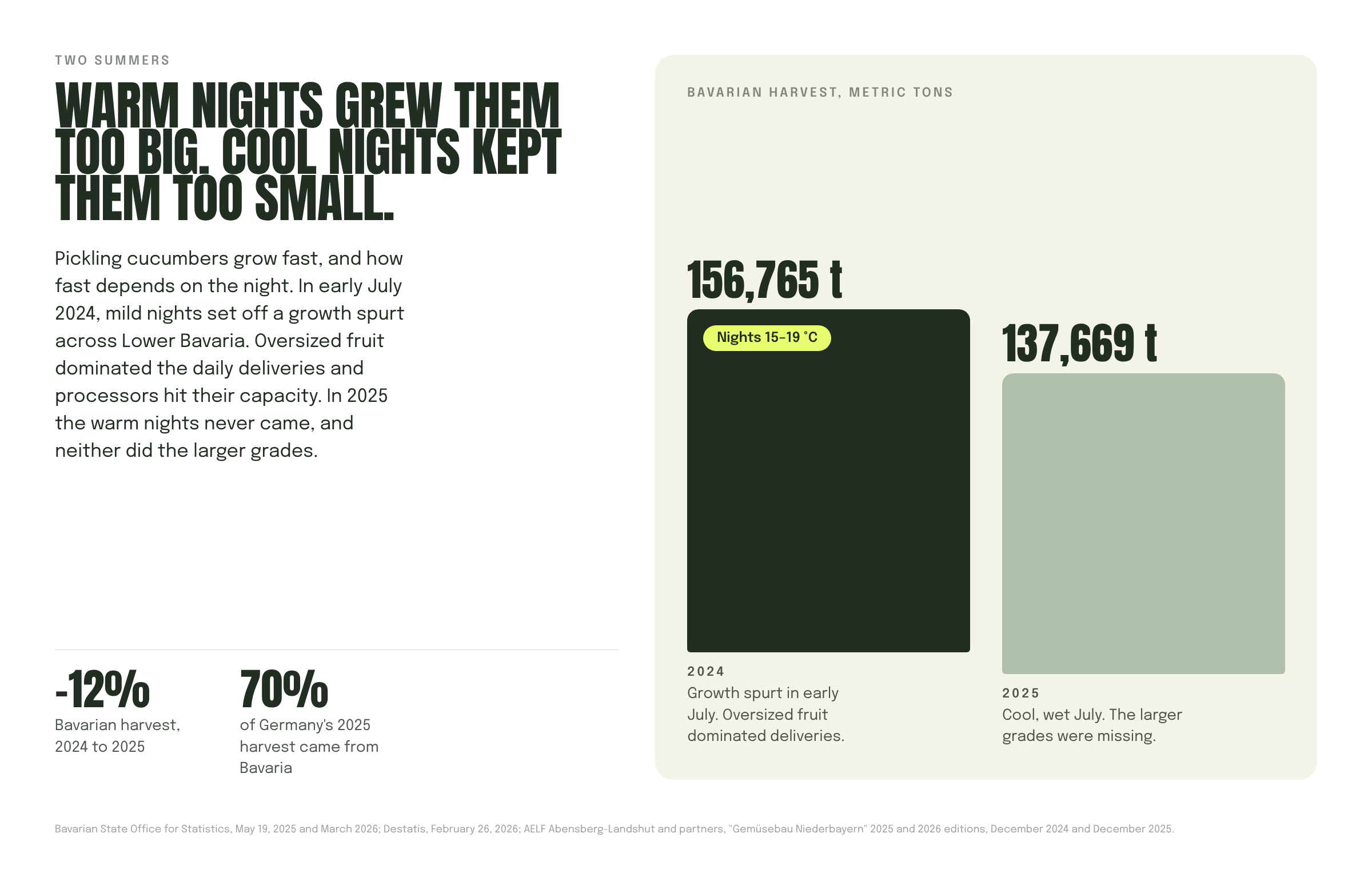
On paper, 2024 was a big year. Bavaria brought in 156,765 metric tons of pickling cucumbers, more than any other vegetable in the state.
The next summer ran the other way. July 2025 was cool and wet, the warm nights never came, and the fruit stayed small. Bavaria's harvest fell to 137,669 metric tons, about 12 percent less, and the same review a year later called the season slightly below average because the larger grades were missing. Germany as a whole harvested 197,600 metric tons, down 7.5 percent.
Five links in one chain
Cucumbers were Alex's example when she took the stage at the Pinakothek der Moderne for the fifth AgriFood Demo Day. The morning symposium ran under the title "Feeding Europe: Where Innovation Meets Food Resilience," and the first panel was the industry panel: "Resilience from the inside: How corporates are future-proofing the food chain."
The lineup, read along the row of chairs, was a stretch of the food chain itself. Sebastian Talg sits on the executive board of KWS, the seed breeder. Jörg-Simon Immerz came from the agricultural trader BayWa, Markus Veen from VTEC Ingredients, a PHW Group company that makes plant-based ingredients, and Matthias Berger from Dr. Oetker. Each company covers one link. Alex sat on the panel for the layer that runs across all of them.
She came to the panel from the finance side of the food industry. Before co-founding Finches, she was CFO and a member of the board at Veganz Group, which she took to its Frankfurt IPO in four and a half months, and COO/CFO of Oetker Digital, the digital unit of the Oetker Group. She opened with the assumption the industry was built on:
"For a long time the food system was built for a stable climate, predictable costs, predictable yields. That world is gone."
The science behind the second sentence is blunt. A 2017 study in PNAS that combined four independent methods estimated that every degree Celsius of global warming cuts average global yields of maize by 7.4 percent and wheat by 6 percent, before farmers adapt.
The Association for Supply Chain Management defines supply chain resilience as "the ability of a network to anticipate, adapt to and recover from disruptions." Alex's point was that the disruptions have become the baseline:
"So resilience can't mean predicting the next shock. It means being ready for constant volatility: spotting problems early, keeping your options open and moving fast."
A season of thirty passes
Her diagnosis started where the cucumber story does:
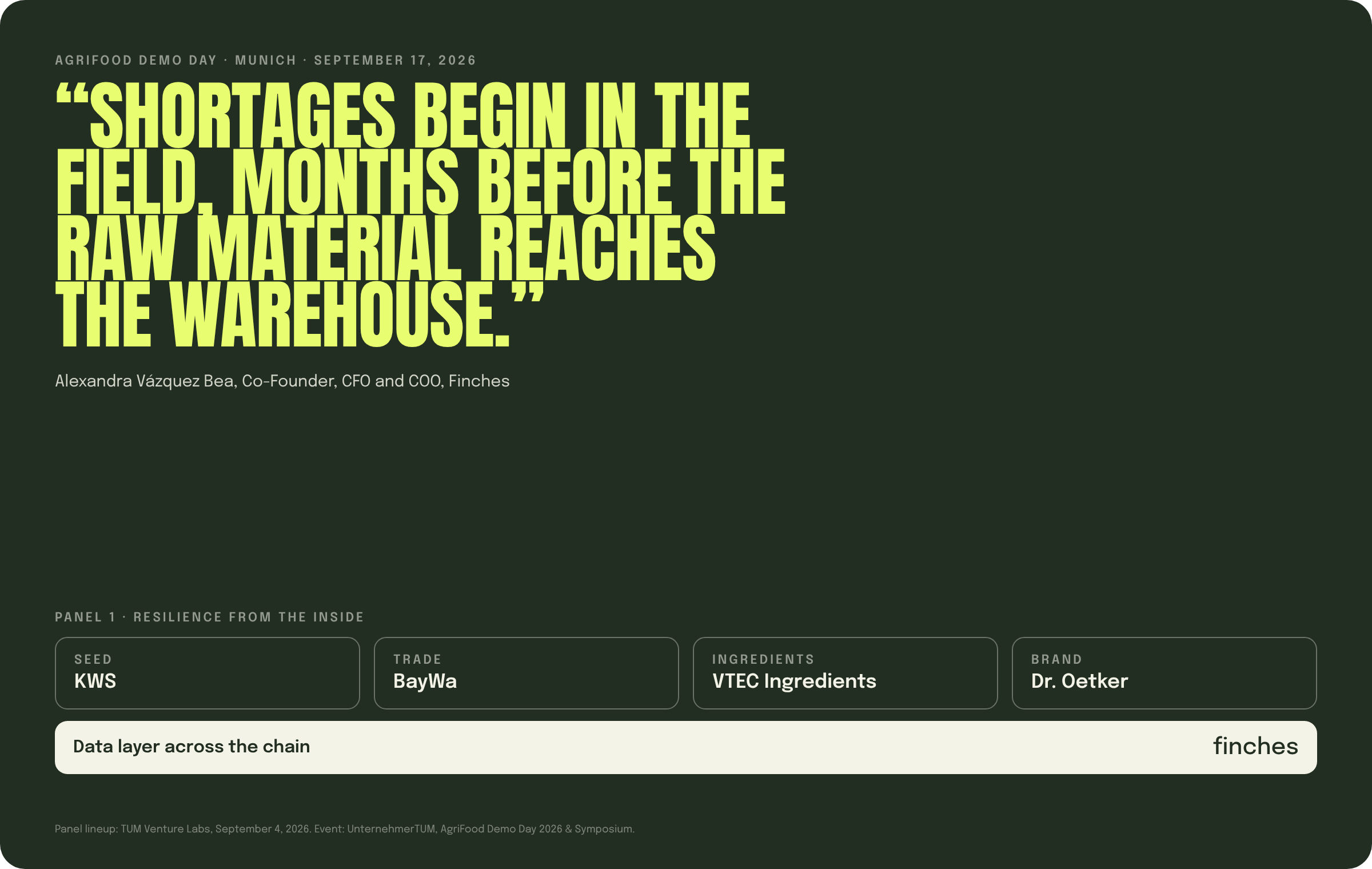
"Shortages begin in the field, months before the raw material reaches the warehouse."
For most crops the gap is months. A drought at flowering shows up at harvest and then again on the factory schedule. For cucumbers, the gap is days.
A pickling cucumber plant keeps flowering through the season. Under the right conditions a fruit reaches harvestable size four to five days after pollination, and how fast it gets there depends on temperature. In greenhouse experiments published in 1993, the growth rate of a cucumber fruit responded within a single day when the temperature changed, at every stage of its development.
That is why the fields get picked so often: up to 30 passes in a season that runs from mid-June to mid-September. A Bavarian variety trial in 2025 was harvested every fourth day. Each pass is sorted into size grades measured in centimeters, from 4 to 7 at the small end to 12 to 15 at the large one. In the United States, where processors pay growers by size, smaller cucumbers command higher prices.
A run of warm nights speeds up every fruit on every plant at once. Between one pass and the next, a cucumber can outgrow the grade it was meant for. Across a whole growing district, the processor receives a delivery it did not plan for: too many large fruit, too few small ones, and more volume than the lines can take on the days it arrives. Cool nights do the opposite and leave the factory waiting for tonnage that never comes.
"Cucumber yields and fruit sizes swing wildly with small changes in the weather, like a slight shift in overnight temperatures. If you don't know what's coming out of the field and through your factory gate, your plant ends up in constant firefighting mode: last-minute shift changes, packaging lines planned around the wrong volumes and a lot of wasted raw material."
Temperature is only one of the forces at work. In 2024 the first downy mildew infections in Lower Bavaria's cucumbers were recorded in the first week of June, early for the disease, which thrives on long hours of leaf wetness and cool temperatures. In 2025, Fusarium after the wet July was already costing growers yield in early August.
None of this is hidden. It sits in different hands, which was Alex's point:
"Each of my fellow panelists can see their own link in the chain, and they're sitting on a lot of data. But most of it is siloed. Having data isn't the same as having predictive insight you can act on."
Our view at Finches. Every signal in the cucumber story existed before the fruit reached a grading line. Night temperatures show up in weather forecasts days ahead. Disease pressure gets recorded by the advisors who walk the fields, and the growers watch the fruit on the plants. What none of those sources does on its own is connect the night temperature in one district to the delivery plan of one factory. That connection is the work we do. Finches Intelligence brings weather, satellite, pest and local news data together with a buyer's supplier regions and the field notes of its own agronomists, so a risk reaches the sourcing team as an alert while the plan can still change.
Anticipate, adapt, recover
In the two cucumber summers, ASCM's three verbs had concrete meanings. Anticipating meant knowing about the warm nights before the oversized fruit arrived at the gate. Adapting meant moving shifts and packaging lines while that could still be planned. When neither happened in time, all that was left was recovery, and in 2024 that began with growers giving up on parts of their own fields.
Alex argued that looking upstream, into the field, buys weeks to months of lead time. For a crop that changes grade between one pass and the next, even a few days of warning can decide whether a shift change gets planned or called in at the last minute.
Alexandra Vázquez Bea is Co-Founder, CFO and COO of Finches, which builds sourcing intelligence for agricultural raw materials.
Notes on facts and sources
Alexandra Vázquez Bea's quotes come from her prepared remarks for Panel 1 of the AgriFood Demo Day & Symposium, September 17, 2026. Her career details come from the speaker biography she submitted to the organizers in August 2026, including the four and a half months from start to listing at Veganz Group.
The event. Fifth AgriFood Demo Day, September 17, 2026, Pinakothek der Moderne, Munich, with the symposium "Feeding Europe: Where Innovation Meets Food Resilience" and Panel 1 "Resilience from the inside: How corporates are future-proofing the food chain," 09:45 to 10:25: UnternehmerTUM and UnternehmerTUM, English page. Panel lineup: TUM Venture Labs on LinkedIn, September 4, 2026. Sebastian Talg as member of the KWS Executive Board since September 2025: KWS. VTEC Ingredients as a PHW Group company for plant-based ingredients: Lebensmittel Praxis, June 1, 2023.
Supply chain resilience. "The ability of a network to anticipate, adapt to and recover from disruptions": ASCM Insights, "The ABCs of Supply Chain Resilience".
Yields and warming. Each degree Celsius of global warming reduces global yields of wheat by 6.0 percent, rice by 3.2 percent, maize by 7.4 percent and soybean by 3.1 percent, without CO2 fertilization, adaptation or genetic improvement: Zhao et al., PNAS, August 2017.
Cucumbers in Bavaria. Germany's largest contiguous pickling cucumber area around the district of Dingolfing-Landau: Bavarian Ministry of Agriculture, "Der Gartenbau in Bayern 2020," August 2021. Bavarian harvest of 156,765 metric tons in 2024, the largest of any vegetable in the state: Bavarian State Office for Statistics, May 19, 2025. Bavarian harvest of 137,669 metric tons on 1,149.8 hectares in 2025: Bavarian State Office for Statistics, March 2026. German harvest of 197,600 metric tons in 2025, down 7.5 percent: Destatis, February 26, 2026.
The 2024 and 2025 seasons. Night temperatures of 15 to 19 °C in early July 2024 and the growth spurt that followed, oversized fruit dominating daily deliveries, processors at capacity, parts of fields shut down, and the first downy mildew infections in early June 2024: AELF Abensberg-Landshut and partners, "Gemüsebau Niederbayern 2025," December 5, 2024, p. 3. Slightly below-average yield in 2025 because the larger grades were missing, and Fusarium losses in early August after a wet July: AELF Abensberg-Landshut and partners, "Gemüsebau Niederbayern 2026," December 5, 2025, p. 2. Smaller grades in 2025 attributed mainly to missing warm nights and cooler weather, harvest every fourth day, size grades of 4 to 7, 6 to 9, 9 to 12 and 12 to 15 cm: Bavarian State Institute for Viticulture and Horticulture, pickling cucumber trial 2025.
Harvest and growth. Hand harvest on rigs with wings, pickers lying face down, up to 13 cucumbers a minute: Fraunhofer via idw, February 1, 2018. Up to 30 harvest passes per season: Fraunhofer IPK, project CATCH. Season from about mid-June to mid-September: Bavarian State Research Center for Agriculture, leaflet "Die Gurke". Four to five days from pollination to harvestable size, depending on cultivar and temperature: Utah State University Extension, Utah Vegetable Production Guide. Fruit growth rate responding within one day to a change in temperature: Marcelis and Baan Hofman-Eijer, Physiologia Plantarum, 1993. Smaller cucumbers commanding a higher price from US processors: USDA Risk Management Agency, "An Economic Assessment of Cucumbers". Downy mildew favored by six to twelve hours of leaf moisture and cool temperatures: NC State Extension, "Cucurbit Downy Mildew," January 9, 2023.
