
Call us when you see smoke: the rule that keeps McDonald's Germany supplied
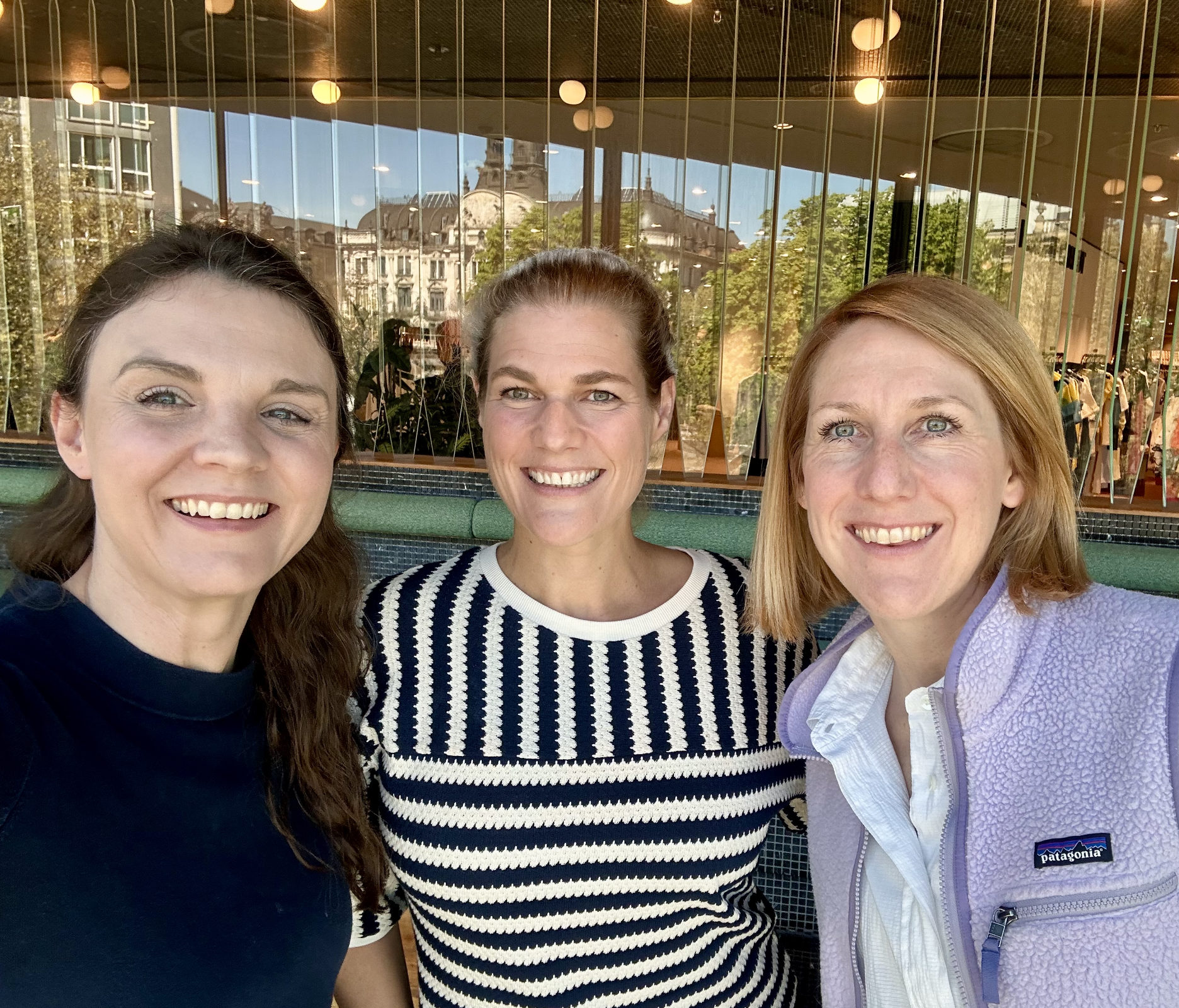
Finches Co-Founders Steffi and Catharina with Diana in Munich
Our webcast “The First Mile” by Finches, Episode 1: Diana Wicht, Supply Chain Lead at McDonald's Deutschland, on what actually breaks an agricultural supply chain. Recorded in German on 5 August 2026.
In the summer of 2025, German farmers brought in the best wheat harvest in years. 23.2 million tonnes, up a quarter on the year before. Anyone reading the tonnage would have concluded that the bread supply was safe.
Then the labs got to work. The test that decides whether wheat can become bread is refreshingly physical: grind the grain, stir it with water into a paste, heat it, and time how long a small plunger takes to sink through. Sound grain makes a thick paste and the plunger sinks slowly. Grain that got rained on late in the season has already woken up its own enzymes, those enzymes have started digesting the starch, the paste is thinner, and the plunger drops. Fewer seconds, in other words, means a worse loaf, and German mills stop buying for bread below 220 of them.
In 2025 the national average was 302 seconds, down 54 from the year before. That still sits comfortably above 220, which is exactly why the average is the wrong number to look at: nobody bakes with a national average. Wheat is bought lot by lot, from individual farms and silos, and when the mean slides the whole distribution slides with it. Roughly one sample in five came in under 220, and in Bavaria, Brandenburg and Schleswig-Holstein it was more than two in five. Flour from those lots bakes a loaf with a wet, sticky crumb. Push it through a slicing machine and the blades clog.
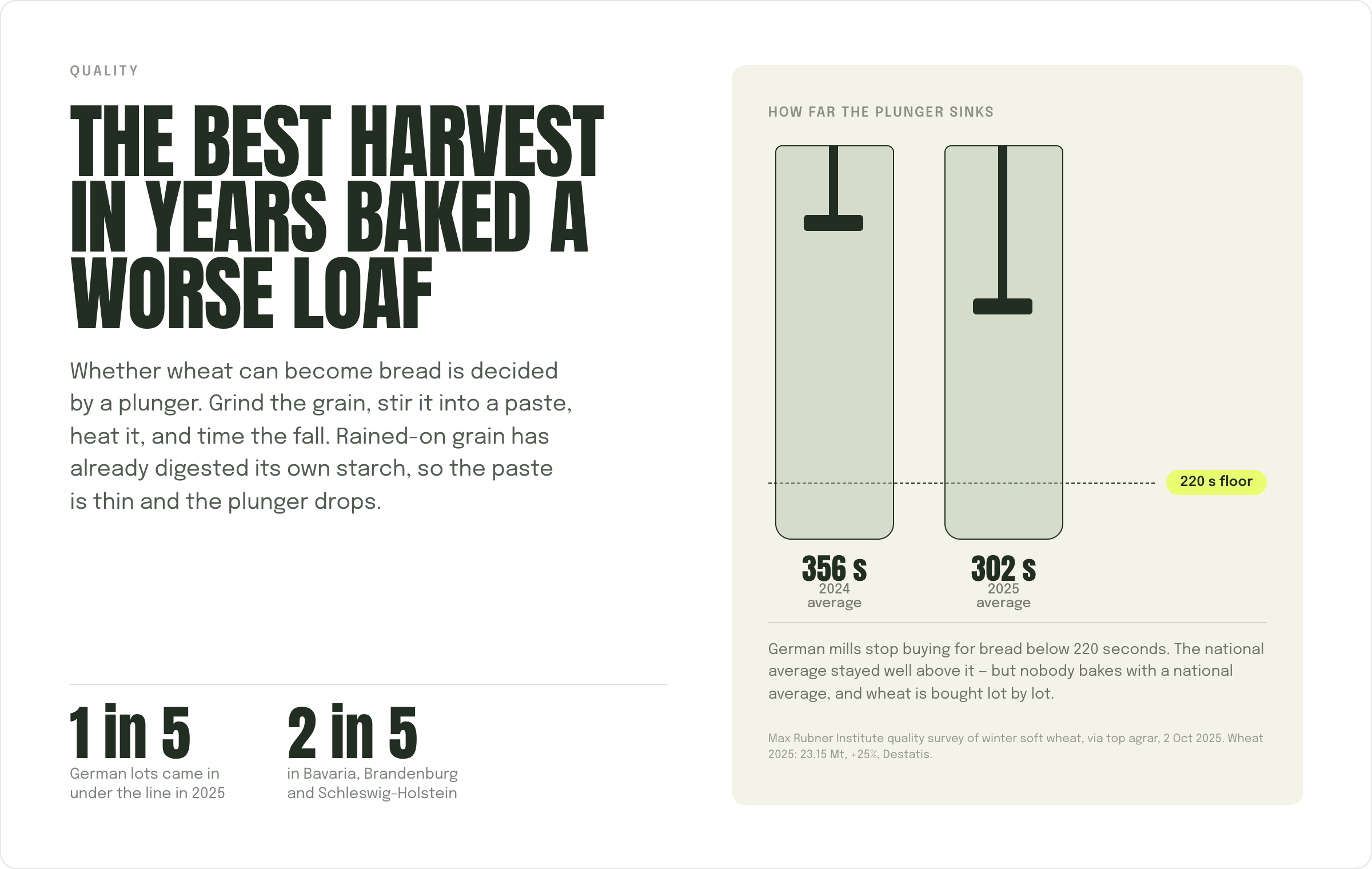
In Günzburg in Bavaria, a bakery run by one of McDonald's oldest suppliers produces around 1.2 million buns a day, and every one of them gets sliced. So the record harvest of 2025 was, for some buyers, the wrong harvest. This is the part of the food system that never makes the news: the tonnage was there, the quality was not, and by the time anyone could measure it, the crop was already in the barn.
Diana Wicht spends her working life in front of that kind of problem. She has been at McDonald's for 14 years, and she runs the supply chain for the German market, which in this company means strategic sourcing for every food product and every piece of packaging, the logistics and planning behind it, food safety, the quality standards each product has to hit, and sustainability, which McDonald's keeps inside the supply chain instead of in a department of its own. More than 1.5 million people eat at around 1,400 German restaurants every day. Five raw materials matter most to that business: beef, potatoes, wheat and chicken as the raw goods behind the burgers and the menu, and paper for the packaging that goes around them.
We invited her to open The First Mile, our new webcast on sourcing resilience, because her risk is the kind you cannot solve by ordering earlier.
The ten-year clock
Start with a single fry. The potatoes that go into it cannot be any potatoes; the specification is long, and it goes as far as deciding which varieties are permitted into the chain at all. Which means that when the climate shifts, or the rules governing how a crop may be grown change, somebody has to produce a new variety that still clears the spec.
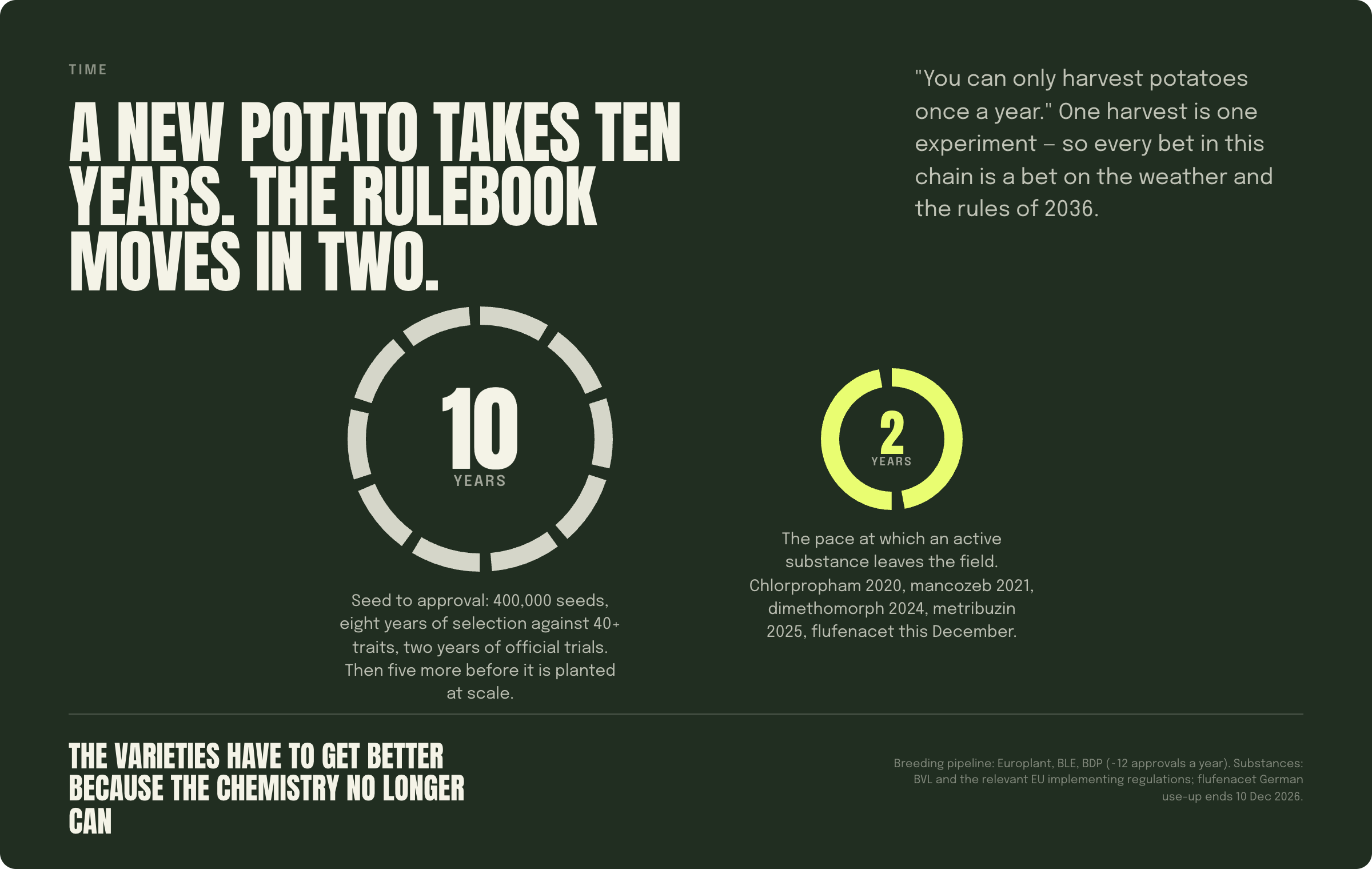
That job begins with roughly 400,000 seeds at a German breeding station. Eight years of selection follow, against more than 40 traits, and the handful of plants still standing at the end go to the federal variety office for two more years of official trials. Ten years, then, before a new name reaches a field, and breeders elsewhere in Europe say it takes another five before that name is planted at any scale. Around a dozen new potato varieties clear German approval in an average year.
None of that delay is bureaucratic. It is the plant.
"You can only harvest potatoes once a year. That is why the development cycle for new potato varieties is such a long-term process, because at the end of the day I only get one chance a year to see what a new variety actually produces and how I can develop it further."
One harvest a year is one experiment a year. Each round of selection costs an entire growing season, and because a potato plant yields fewer than fifteen tubers, the first years go into producing enough material to have something worth measuring. Everyone in this chain is placing bets now on what the weather and the rulebook will look like in 2036.
Three TOPICS, not one
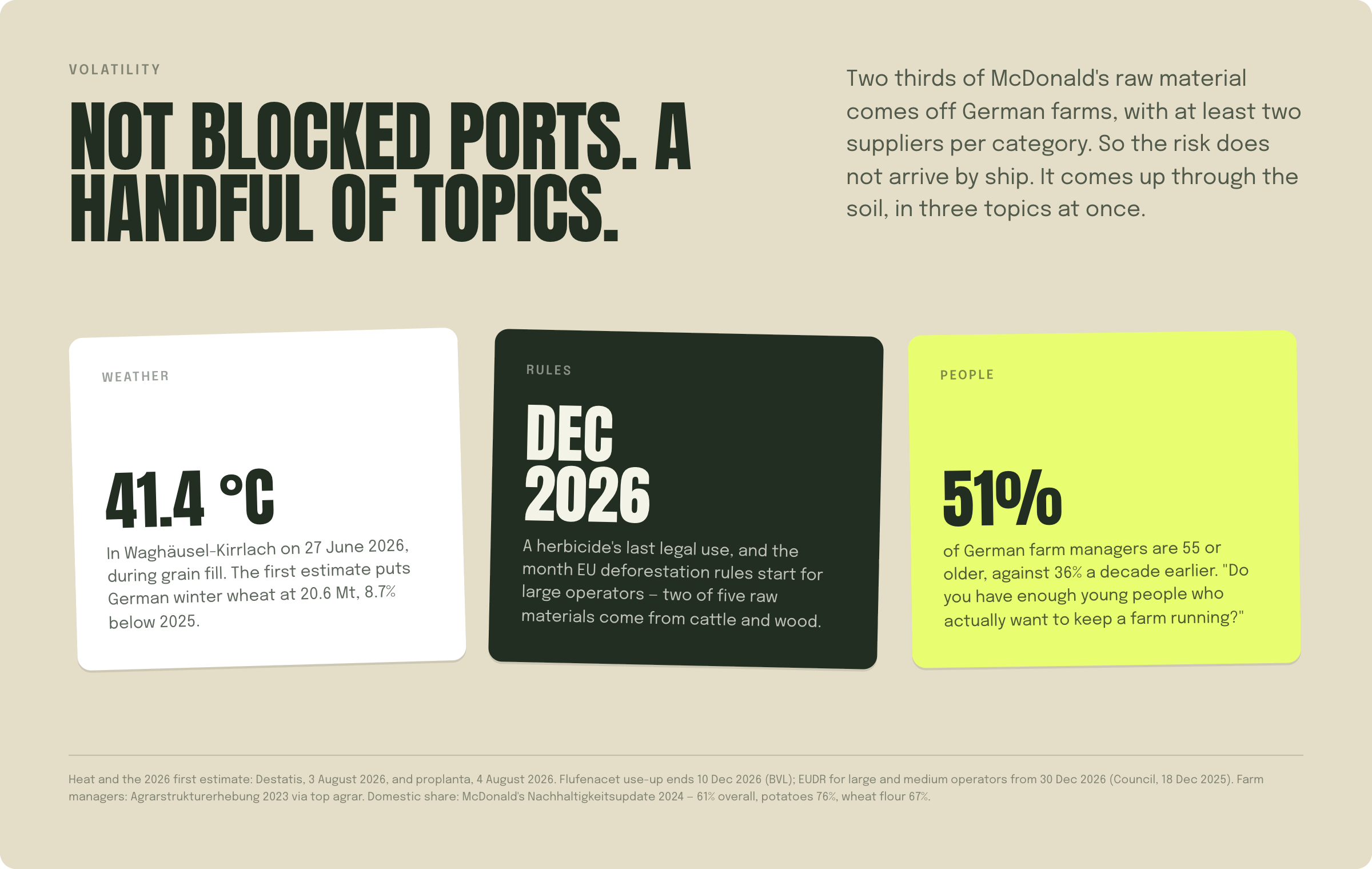
Diana buys nothing off the shelf, and she sources most of it close to home. Roughly two thirds of her raw material comes off German farms, and the beef is German in full, bought from farms across the country. Potatoes come from Lower Saxony and Saxony-Anhalt, gherkins from Bavaria. For potatoes the domestic share published for 2024 reaches 76 percent, for wheat flour 67 percent. She keeps at least two suppliers for every relevant category, so that no single harvest and no single factory can take an item off the menu.
"Food is best fresh and you shouldn't spend too long transporting it from A to B."
Freshness is the first reason she gives. The second, she says, was always resilience, and it was true at McDonald's long before the word became fashionable in procurement. It also means the crises that keep her awake are not the ones that made headlines for the last four years. Blocked ports and stranded containers belong to somebody else, and she offers Japan as the mirror image, a market with barely any agriculture of its own, watching European fields for news about its own supply. Her risks come up through the soil.
Ask where the biggest source of volatility sits and she corrects the grammar before answering.
"The biggest volatility coming in is not something you can talk about in the singular. You have to talk about it in the plural. It is a handful of topics."
Topic one is the weather, and the German potato record of the past eight years reads like a series of overcorrections. Drought in 2018 cut the harvest to 8.9 million tonnes, roughly 24 percent below the previous year and the smallest crop since reunification. By 2025 the pendulum had reached the far end: 13.87 million tonnes, the largest planted area since 2000, the biggest crop in a quarter of a century, and prices weak enough to punish the people who grew it. So growers cut the 2026 area by 7.1 percent, walking away from ground that only pays in a good year. Then July stopped raining across northwest Europe, and Dutch quotations for processing potatoes went from around 2 euros per 100 kilos to 15 in a single week. Same crop, same decade, seven-fold price move, and a menu price that is expected to hold through all of it.
Topic two is regulation.
"The EU Green Deal and everything under it obviously has a big influence and brings change into a supply chain like ours."
Diana describes what her supply chain has to adapt to, without political assessment. The regulation she has to plan around did not arrive in one piece of legislation. The famous law, the Sustainable Use of Pesticides Regulation with its 50 percent reduction target, was withdrawn by the Commission in February 2024 and never replaced. What arrived instead came one active substance at a time.
Chlorpropham kept harvested potatoes from sprouting in store until its last legal German application in October 2020. Losing it meant more than switching products: growers had to strip out their own buildings, ventilation ducts and fogging equipment included, because enough residue lingers in a shed to push a later crop over its legal limit. Mancozeb, a workhorse against late blight, was revoked in Germany in July 2021 with a use-up deadline the following January. Its manufacturers fought the EU decision underneath that revocation, lost at the General Court in October 2025, and appealed in December. Dimethomorph went in 2024, metribuzin in 2025, and flufenacet's German use-up period runs out this December. Advisers writing up the 2026 blight season describe a shorter list of usable substances and resistance building against what remains.
That is the potato problem seen from the field: as substances drop out of the toolbox, more of the job moves into the variety itself. Breeding one takes about ten years. Approvals and use-up periods move in one and two-year steps. Both clocks are real, and everyone in this chain has to plan across the two of them at once.
Her animal supply chains run on the same pattern of adjustment. Germany's husbandry labelling law still covers only fresh pork and has slipped twice, now to January 2027, while retailers set their own deadlines, with Aldi dropping the two lowest husbandry tiers across pork, poultry and beef by 2030 and Rewe doing the same for its own-label fresh meat. Two of her five raw materials, beef and paper, come from cattle and wood, both of which sit among the seven commodities under the EU Deforestation Regulation, whose obligations start for large and medium operators on 30 December 2026.
Topic three is the one that almost never appears on a risk register.
"Do you have enough young people who actually want to keep a farm running?"
The statistics are behind her. Germany counted about 255,000 farms in 2023, 15 percent fewer than in 2010, averaging 65 hectares. More than half of the people running them, 51 percent, were 55 or older, against 36 percent a decade earlier. When the succession question was last asked nationally, in 2020, more than two thirds of sole proprietorships led by someone over 55 had nobody lined up to take over. That survey has since been discontinued, so 2020 remains the newest national picture. New farming apprenticeship contracts came to 4,742 in the 2024/25 training year, down 4.5 percent, though the agricultural trades as a whole grew slightly and farming stayed above its long-run average.
Diana names the counterweight herself, that farms are getting larger and more professional and that technology is absorbing some of the work. Which leaves exactly the question she asked. Whether the business that comes out of all that consolidation is one somebody actually wants to inherit.
Smoke
Everything above is why McDonald's cannot behave like a normal buyer, and the company's own supplier list shows how far it goes in the other direction. Every relevant category runs on at least two suppliers, and the relationships behind them are long. The fries come from Agrarfrost in Wildeshausen, Lower Saxony, which has supplied McDonald's since 1985. The buns come from a bakery that has held the contract for more than 40 years. The patties come from a plant in Günzburg that has been in place since 1971. These are not vendors that get swapped after a bad quarter.
That kind of dependency only works in one direction if it works at all, which is why Diana describes these relationships as partnerships rather than purchasing arrangements. And it produces one operating rule, the sentence we kept thinking about after the recording stopped.
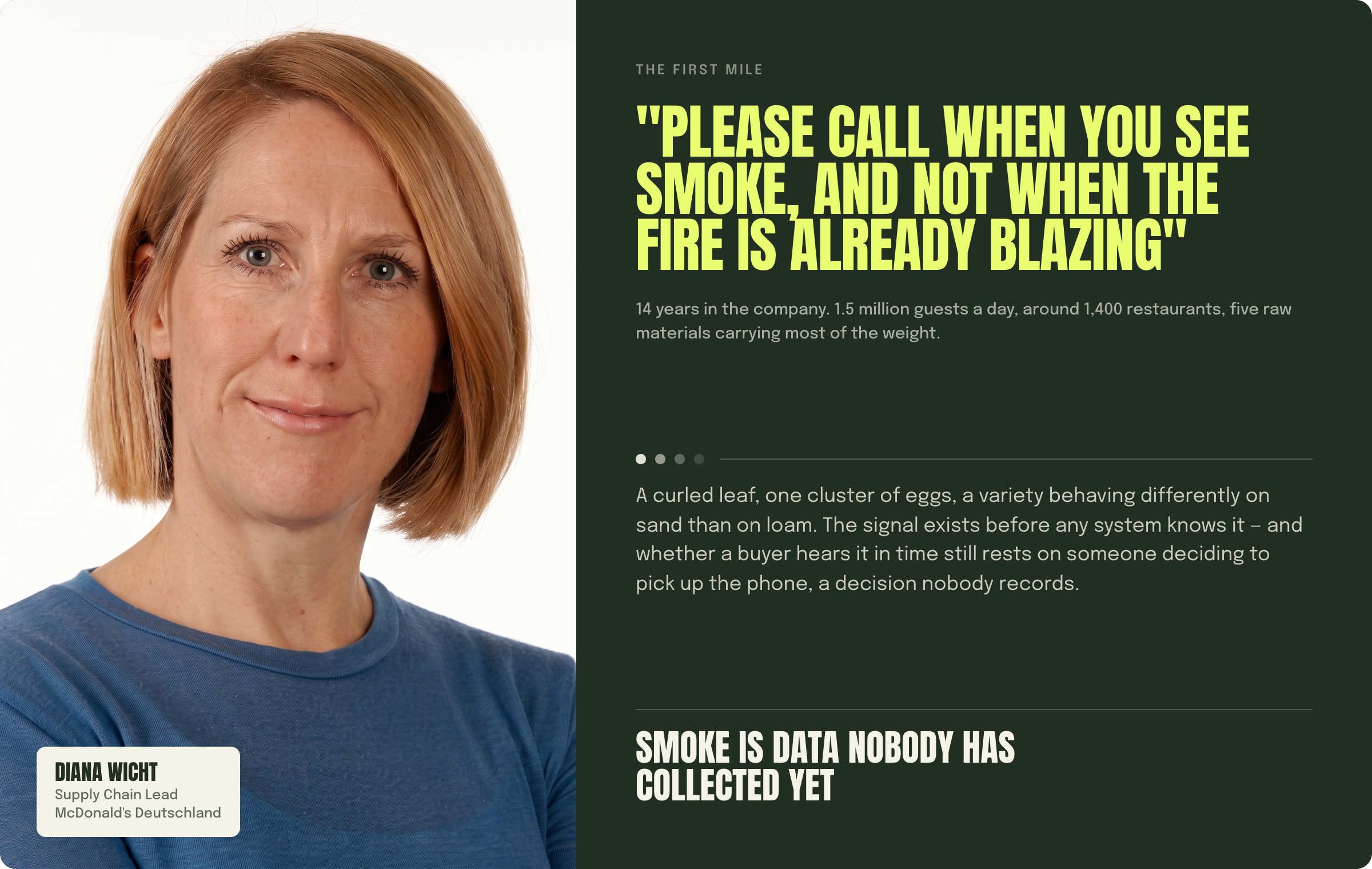
"Please call when you see smoke, and not when the fire is already blazing."
She wants the problem while it is still small enough to steer against, and she ties that directly to volume.
"To feed one and a half million guests every day in Germany alone with good, high-quality food, I need a strong network. And I cannot and do not want to allow myself any mistakes in that."
Now think about what she is actually asking her suppliers to do. Call me when you are not yet sure. Call me about the field that looks slightly off, the variety behaving strangely on one soil type, the lab result that is inside spec but drifting. Call me before you have a diagnosis, when the problem might still resolve itself and make you look like someone who panics.
Every incentive in a normal supplier relationship argues against that call. You look weaker than your competitor. You hand your customer a reason to hedge. If it turns out to be nothing, you have spent credibility for free. This is why the earliest and most valuable signal in a food supply chain is also the one that is systematically not reported, and why Diana talks about a basis of trust rather than a clause. What that trust buys, when it holds, is what she calls swarm intelligence: practice moving sideways between suppliers, and everyone covering for each other in the weeks when the roof is on fire somewhere.
"For a lot of this there is no blueprint. How do I build an agriculture fit for the future? A lot of it is trial and error, a lot of it is trust, and simply trying things out."
Her example is a project called Crop Rotation, piloted from 2020 and announced in January 2021 under a headline that says it all: “potato farmer makes burger buns”. The contract farmers growing potatoes for the fries supplier plant them on a given field only every few years. In the seasons between, they now grow wheat for the mill that supplies the flour for the buns. Rotation itself is as old as farming, and the field would have grown something in those years regardless. What is new is that both crops now belong to the same customer's supply chain, so one field carries the fries and the buns in turn, and it produces, in her words, a resilient rotation model at a larger scale. It came together, she says, because those suppliers already trusted each other enough to try. Further suppliers have joined since, the company says, bringing mustard and soy into the rotation, with lettuce a possibility next.
What the data is for
The last question, with her next meeting waiting: what do data and AI actually do in a chain like this? Her answer arrived in a strict order. First make the right data exist at all, which is where the investment is going now, jointly with suppliers. Then use it deliberately, and she was specific about what that does not mean.
"Which does not mean losing yourself in reporting or bureaucracy, but generating genuinely usable data, to the point, that helps all of us make better decisions, make decisions earlier, and so deploy resources more intelligently and strengthen resilience considerably."
Trust and experience are worth a great deal, she says, and European agriculture stays competitive only if it also collects the efficiency and the learning currently sitting unused in the data.
Put the two halves of her answer together and the shape of the problem appears. The partnership exists so that a signal from a field reaches a sourcing team while it is still smoke. The data question is what that signal travels on. Right now, in most agricultural supply chains including the good ones, it travels on somebody's willingness to make an awkward phone call.
Where Finches comes in. McDonald's Deutschland is not a Finches customer, and no commercial arrangement sits behind this episode. We do work with the Agrarfrost group, which has supplied McDonald's with fries since 1985. What follows is our own view of the problem, written as ours.
The signal almost always exists before any system knows it. Someone standing in a field has already seen the curl of a stressed leaf, the first cluster of eggs on the underside of one, a variety behaving differently on sand than on loam a kilometre away. Whether a buyer 600 kilometres away hears about it in time still depends on two human decisions: whether that person picks up the phone, and whether the person at the other end can tell an early warning from background noise. Neither decision is recorded anywhere, which is also why nobody can tell you how often the call does not happen.
Smoke is data nobody has collected yet. Collecting it is slow work, and it starts inside one supply chain at a time. With the Agrarfrost group we are working on exactly that. A lot of potatoes has to clear several parameters at once, and Alexandre Moulay, who runs the McDonald's business at Agrarfrost, puts the stakes in two sentences:
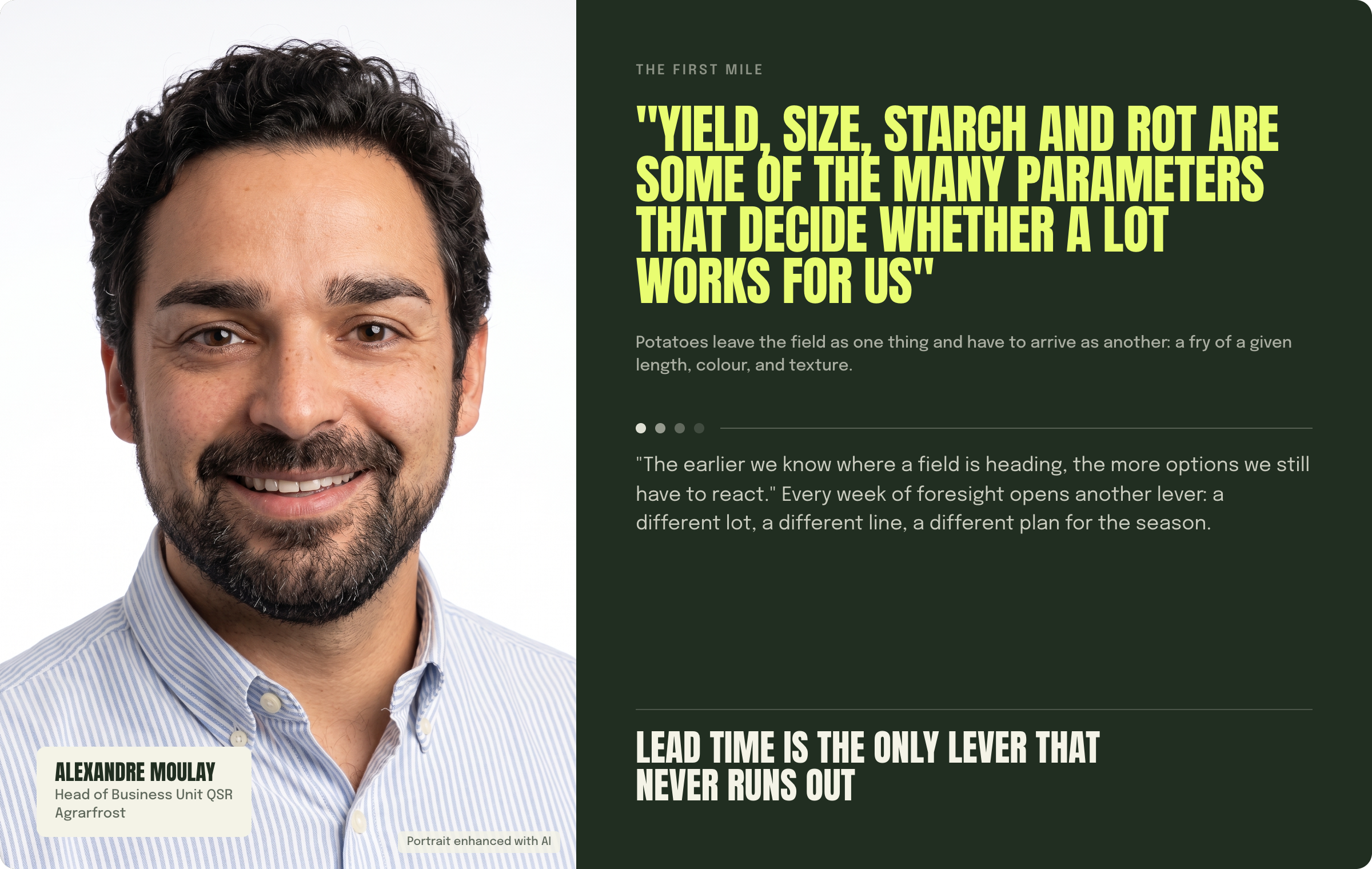
"Yield, size, starch and rot are some of the many parameters that decide whether a lot works for us. The earlier we know where a field is heading, the more options we still have to react."
Our first two models take on the last two of those four: predicting starch content and the probability of rot in a potato crop, reading the risk profile of one field against the next, and giving agronomists a way to record what they see in the morning without losing the evening to paperwork. Yield and tuber size are read off the same field records, which is where the work goes next.
Which is Diana's rule arriving from the other end of the chain. Someone standing in a field usually knows first. Everything after that is a question of whether the signal travels: whether it gets recorded at all, whether it reaches the person 600 kilometres away who can still do something with it, and whether it arrives while there are options left. That stretch is the first mile.
The First Mile is a webcast by Finches on sourcing resilience, hosted by Finches Co-Founder & CEO Catharina van Delden (who also runs a pecan farm).
Notes on facts and sources
Everything Diana says is quoted from the recorded conversation of 5 August 2026, including the scale figures used in the text: around 1,400 restaurants, more than 1.5 million guests a day, and around two thirds of raw material from German agriculture. For reference, the company's Nachhaltigkeitsupdate 2024, published September 2025, gives 1,365 restaurants, 1.85 million guests a day and 113 supply partners as of 31 December 2024, and 61 percent of raw material from Germany, with potatoes at 76 percent and wheat flour at 67 percent.
Suppliers and volumes. Diana named no suppliers in the interview. All supplier facts here come from McDonald's own public supplier directory: Agrarfrost in Wildeshausen, Lower Saxony, fries supplier since 1985; the bun bakery in Günzburg, supplier for more than 40 years, around 1.2 million buns a day, supplied by the Willa-Mühle in Johanniskirchen, Lower Bavaria, which is electronically linked to the bakery; OSI in Günzburg, patty supplier since 1971. Bun volume from the Nachhaltigkeitsupdate 2024.
Crop Rotation. Piloted from 2020: McDonald's project page and the launch release of 19 January 2021, headlined "Kartoffelbauer macht Burger-Brötchen". McDonald's has not published participant or hectare figures for the project.
Potato breeding. 400,000 seeds, eight years of selection against more than 40 traits, two years of official trials at the Bundessortenamt, about ten years to approval: Europlant. One generation per year and the low multiplication factor: BLE / oekolandbau.de and Seed World Europe, which also records breeders' own estimates of 10 to 15 years to market. About 12 new varieties approved per year: BDP.
Harvests and quality. Wheat 2025 at 23.15 million tonnes, up 25 percent on 2024: Destatis time series. Falling number 302 seconds against 356, with about 20 percent of 2025 samples below the 220-second bread-wheat threshold, and more than 40 percent of samples below it in Bavaria, Brandenburg and Schleswig-Holstein: Max Rubner Institute quality survey of winter soft wheat, via top agrar, 2 October 2025. The survey was reported at 79 percent of samples evaluated. 2018 potatoes 8.9 million tonnes, minus 24 percent, lowest since reunification: Destatis final result, via proplanta. 2025 potatoes 13.87 million tonnes on 301,800 hectares, the largest area since 2000: Destatis time series, status 21 January 2026. 2026 planted area minus 7.1 percent to 280,400 hectares: Destatis, 19 May 2026, preliminary; oversupply and weak contract prices as the driver, with marginal ground dropping out: top agrar, 13 March 2026. Dutch processing-potato quotations from 2 to 15 euros per 100 kilos in one week: top agrar, 21 July 2026. No official 2026 German potato estimate exists yet; the first is due at the end of September. For context on this year's cereals, the 2026 first estimate puts winter wheat at 20.6 million tonnes, 8.7 percent below 2025, after 41.4 °C at Waghäusel-Kirrlach on 27 June during grain fill: Destatis, 3 August 2026 and proplanta, 4 August 2026.
Regulation. SUR withdrawal announced 6 February 2024, formalised in the Official Journal on 6 May 2024, no successor proposal as of February 2026: European Parliament legislative train. Chlorpropham last German application 8 October 2020, and the store-cleaning consequence including technical corridors, fogging rooms and underground channels: top agrar, 21 September 2019 and Regulation (EU) 2019/989. Mancozeb revoked in Germany 4 July 2021, use-up to 4 January 2022: BVL; the underlying EU non-renewal, Implementing Regulation (EU) 2020/2087, was upheld by the EU General Court on 29 October 2025 in T-742/20 RENV, with an appeal lodged in December 2025. The court found the Commission had made a manifest error in relying on the reprotoxicity classification and upheld the non-renewal on the remaining grounds. Metribuzin use-up period ended 24 November 2025, flufenacet's ends 10 December 2026: Regulations (EU) 2024/2806 and 2025/910, and BVL. Shrinking list of blight substances and resistance pressure for the 2026 season: top agrar, 28 April 2026. German husbandry labelling law covers fresh pork only, mandatory from 1 January 2027 after two postponements: BLE. Retailer commitments to husbandry tiers 3 and 4 by 2030, which differ in scope by company, Aldi across pork, poultry and beef and Rewe for own-label fresh meat: AgrarDebatten. EUDR obligations for large and medium operators from 30 December 2026, micro and small from 30 June 2027, cattle and wood among the seven commodities, with packaging used only to carry another product outside scope: Council, 18 December 2025.
Farm structure. 255,000 farms in 2023, minus 15 percent since 2010, average 65 hectares: Destatis, 16 January 2024. 51 percent of farm managers aged 55 or over, against 36 percent in 2013: Agrarstrukturerhebung 2023, via top agrar, 6 January 2026. Succession unresolved on more than two thirds of sole proprietorships with a holder aged 55 or over, from the 2020 agricultural census, the last national data on the question: Destatis. 4,742 new Landwirt/in apprenticeship contracts in 2024/25, minus 4.5 percent, alongside 13,696 across all green professions, slightly up, and farming contracts still above the 2008 to 2022 average: Deutscher Bauernverband, 22 December 2025.
