
You can’t put flowers back on a tree
How Peru’s mango season was settled over the southern winter, months before anyone picks anything. Reporting on the 2026/27 campaign, 10 September 2026.
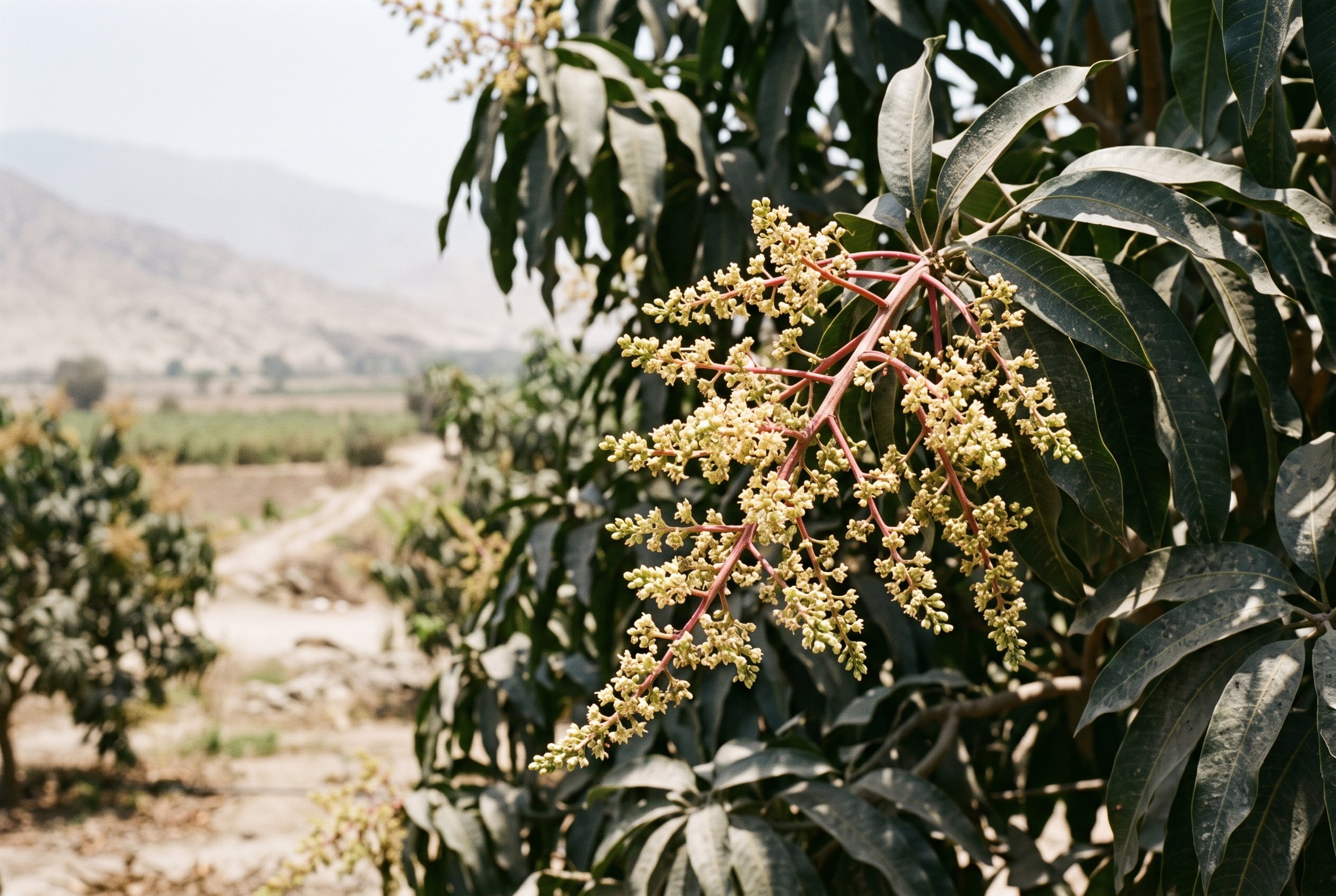
The trees are all still standing. Twenty-four thousand hectares of Kent mango in the San Lorenzo valley alone, irrigated, staked out, the same trees that shipped fruit last season and the season before. Anyone counting hectares in northern Peru this month would conclude that the harvest starting in three weeks is fine.
Then you walk the rows and count flowers.
What the nights did
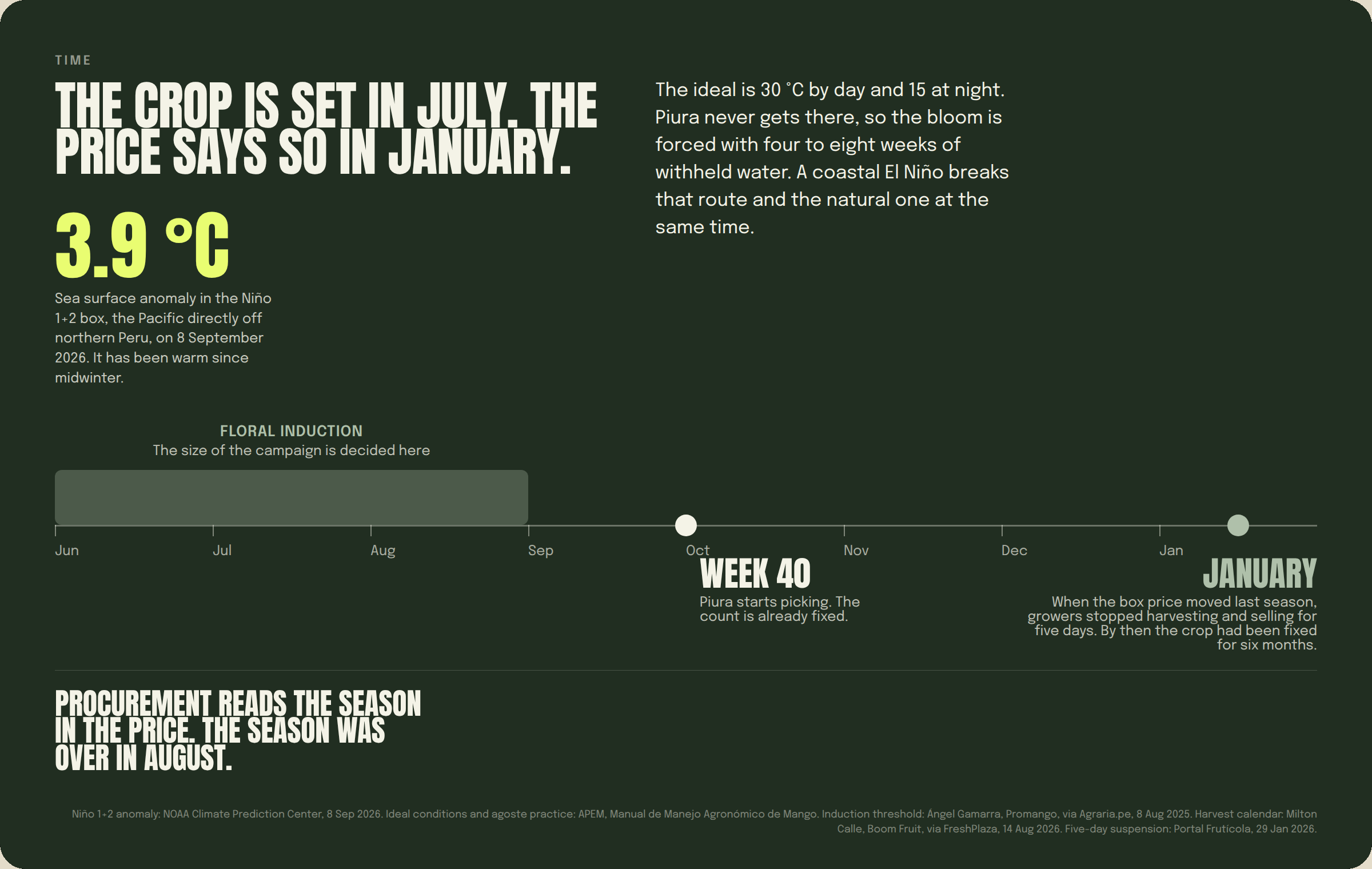
A mango tree carries next season’s crop on panicles that come out of buds on last year’s wood, and every one of those buds can go one of two ways. It can push a flower panicle, or it can push another flush of leaves. Temperature is one of the things that decides, and the window in which the bud decides is the southern winter, roughly June to August.
The trade’s own agronomy manual, published by the Peruvian mango exporters’ association, gives the ideal as 30 degrees by day and 15 at night. Piura does not get there. Its coldest month is August, and August nights average 17. Ángel Gamarra, who runs the growers’ association Promango, put it plainly in August 2025: for cold alone to induce flowering, temperatures in the valley would have to drop to around 13 degrees, and instead they sit at 16 or 17. That is not the description of a bad year. That is Piura in a normal one.
So nobody in Piura waits for the bloom. It is manufactured. Growers withhold water for four to eight weeks, a practice the manual calls agoste, until roughly 60 per cent of the buds have gone floral, then push them over with potassium, ammonium and calcium nitrate. Gamarra’s advice to his members this April was about dose, frequency and adjusting the water stress to soil type and plant age. Flood irrigation is a problem in his account, because the moisture cannot be controlled and the growth regulators are not taken up properly.
Now lay a coastal El Niño across that. On 12 July this year Piura recorded a night of 24 degrees against a seasonal norm of 17, and a daytime high of 34.2, which the national weather service called the hottest winter day there in more than fifty years and attributed directly to El Niño Costero. Warm nights push the bud toward leaves. Warm, humid air also makes the manufactured route harder, because a grower cannot impose a dry spell on a season that will not stay dry.
And a plantation has to be in good enough shape to work on in the first place. After a season in which the box price fell below the cost of production, many growers had no money for maintenance. That is why Gamarra put 40 to 50 per cent of the San Lorenzo area at risk of flowering failure back in August 2025, and why he said on 1 September this year that the fields are going into this campaign without adequate nutrition. One bad price year quietly sets up the next bad weather year. No climate model contains that mechanism.
The count
There is no instrument that reads a region’s flowering. There are people walking orchards, and they do not entirely agree.
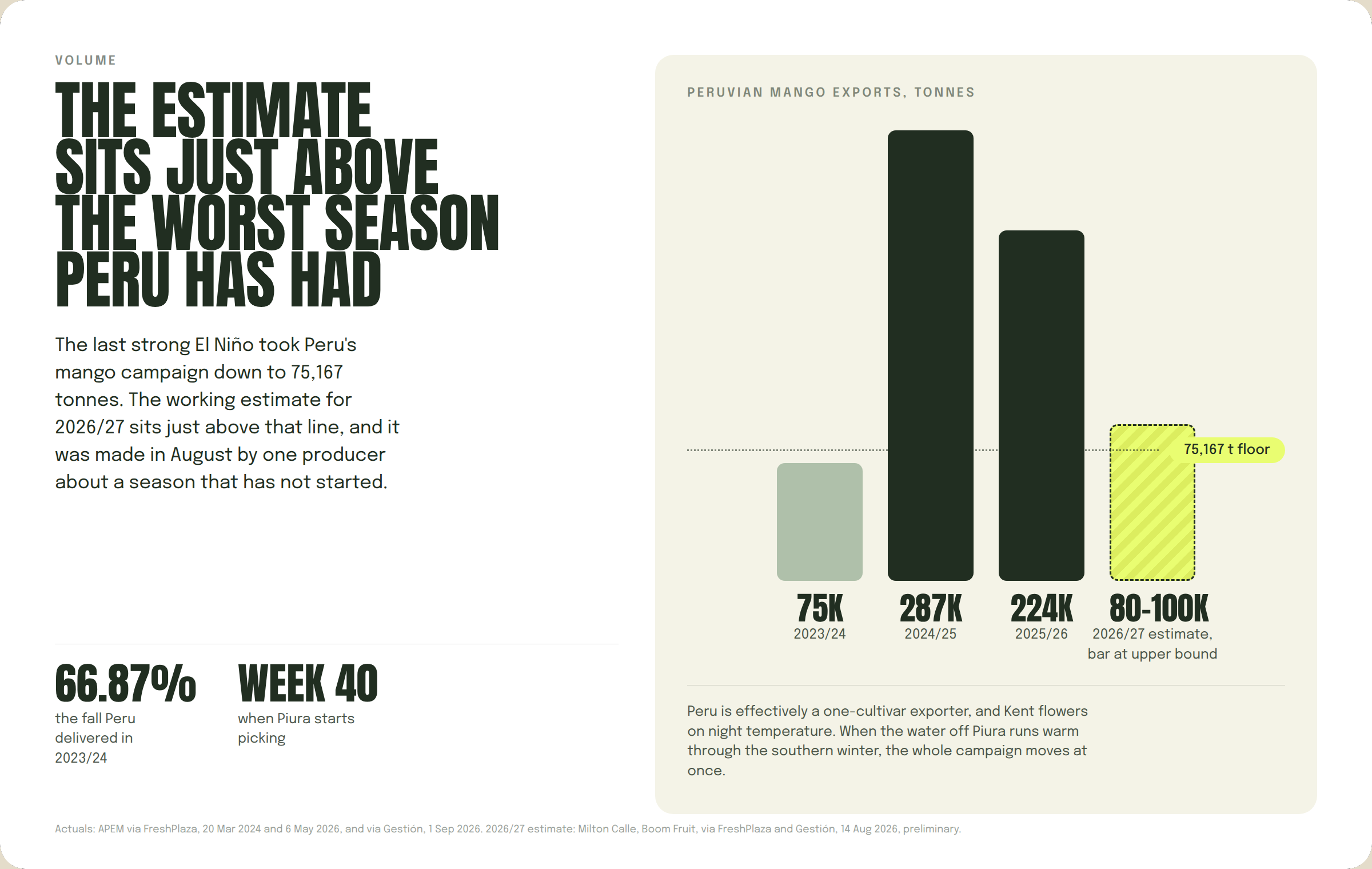
In mid-August, Milton Calle, who grows mangoes in Piura and Casma and owns the exporter Boom Fruit, put Piura at 10 to 15 per cent flowering. Piura is around 72 per cent of Peru’s mango volume, so that figure does most of the work in any national number. Calle projected production down about 60 per cent and an exportable season of 80,000 to 100,000 tonnes.
Two weeks later the picture had moved. On 1 September, Gamarra reported Piura at roughly 20 per cent open flowers with a further 10 per cent in early bloom, Lambayeque at 10 per cent, and Áncash reaching 45 per cent on an estimated 169,000 tonnes. He expects fruit set to be poor anyway.
Both men are describing the same orchards a fortnight apart, one of them counting his own blocks and one aggregating across a region, and neither is working to a shared definition of what counts as a flower. Calle also warned against the arithmetic everyone else was doing with his number: because flowering sits at 15 per cent, he said, it does not follow that exportable volume falls 85 per cent. He is right about the arithmetic, and the reason sits inside the flower structure. A panicle is not one flower but several hundred to well over a thousand of them, and in most cultivars the large majority are male and cannot set fruit at all. Of the rest, almost nothing survives: one published count, on a cultivar carrying about 550 flowers to the panicle, put final fruit retention at 0.22 per cent. A mango tree discards nearly everything it opens, in a good year as much as a bad one. That surplus is why a thinner bloom does not run straight through into a thinner harvest, and why a flowering percentage in August is a weak predictor of tonnage in January.
Which is worth holding onto, because the number now travelling fastest through the trade press is the 60 per cent decline, and it is a working estimate made by one producer in August about a season that has not started.
Which is worth holding onto, because the number now travelling fastest through the trade press is the 60 per cent decline, and it is a working estimate made by one producer in August about a season that has not started.
And what did flower now has to get through the weather that suppressed it. On 10 September the national weather service announced the start of rain on the north coast for the 15th to the 17th, 10 to 15 millimetres, its zonal chief for Piura and Tumbes pointing to a heavy concentration of moisture over those three days. Sea temperatures stood at 27.8 degrees off Talara and 25.3 off Paita, both above normal, with four Kelvin waves due to hold them there into November. The fungus behind mango blossom blight needs free water, or humidity above 95 per cent, to germinate, and it does its best work between 25 and 30 degrees. It kills the flowers it infects and cuts fruit set. So the small bloom Piura did manage goes into its most vulnerable stage in exactly the conditions the disease wants.
The last time
Peru has been here recently enough that the outcome is on record.
In 2023/24 the country exported 75,167 tonnes of mango against 226,907 the year before, a fall of 66.87 per cent, as reported by then APEM president Carlos Iván Vílchez Peralta in March 2024. The causes were Cyclone Yaku’s rainfall and, again, July and August temperatures above the 50-year average during induction. Kent is more than 90 per cent of what Peru exports, so a single cultivar’s physiology carried the entire loss.
Europe read that season as a line in a customs table. Total European mango imports fell 7 per cent in 2024 to 446,896 tonnes, and the CBI puts the drop down principally to Peru’s 44 per cent decline.
Then it went the other way. The 2025/26 campaign closed at 223,686 tonnes, down 22 per cent on the 287,424 of the year before, but it arrived compressed rather than merely smaller: week 3 alone carried 20,664 tonnes. The value of a 21-kilo box fell hard inside a single week, dropping a lot of growers below their cost of production, and at the end of January producers stopped harvesting and selling for five days to slow the slide. Sea freight fruit was moving at 50 to 60 US cents a kilo. Costs that normally run about one sol a kilo had doubled.
Three seasons, the same valleys, the same cultivar: a shortage, then a glut priced under cost, then a shortage forecast again. The middle one is part of the reason for the third.
One cultivar, one valley
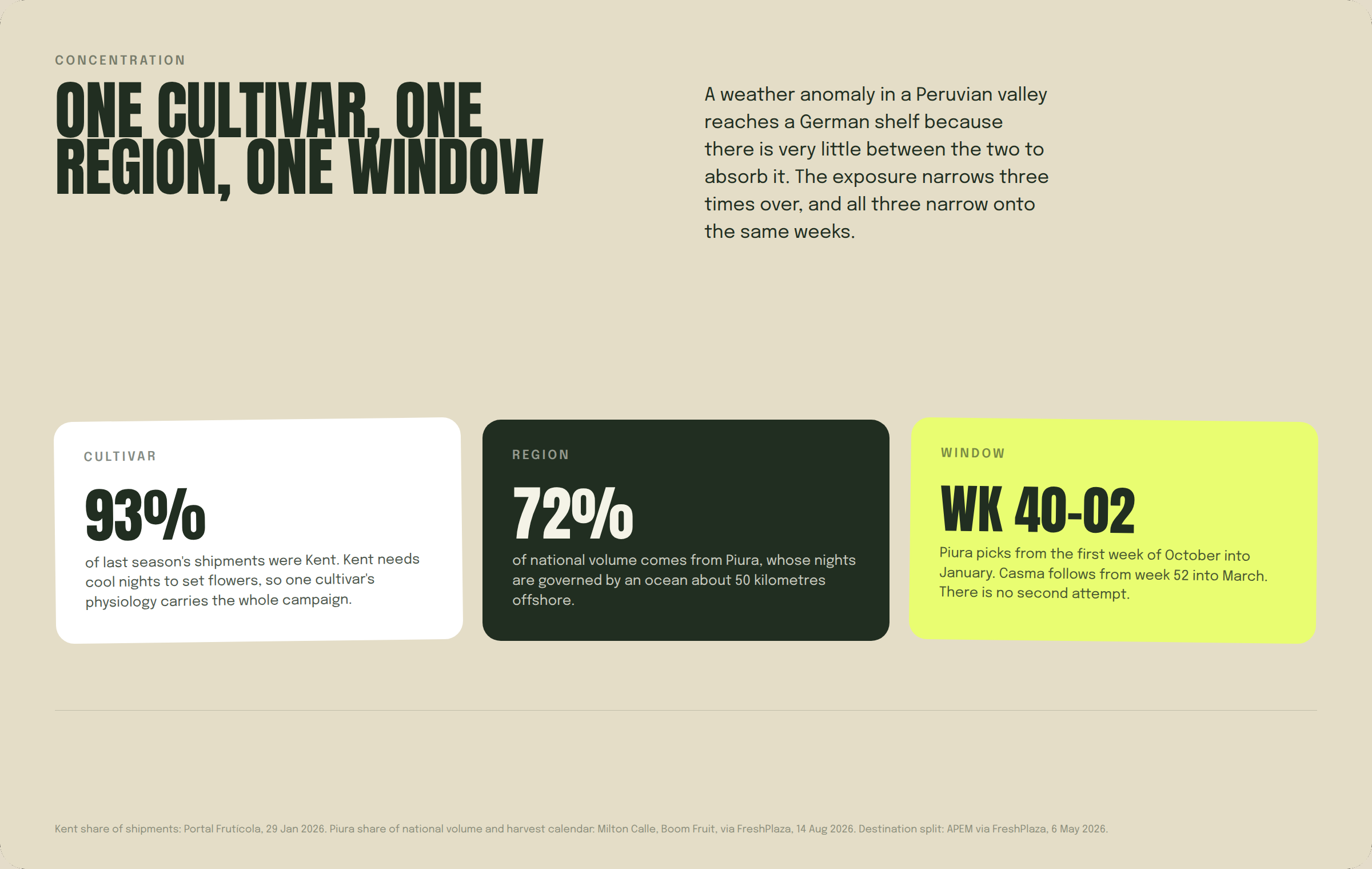
A weather anomaly in a Peruvian valley reaches a German buyer only because there is very little between the two to absorb it.
Kent was 93 per cent of last season’s shipments. Piura is roughly 72 per cent of national volume. The window is narrow: Piura runs from week 40 into week 2 of 2027, with Casma picking up around week 52 and stretching into March.
Downstream the exposure gets specific. Peru sent 112,696 tonnes to Europe in 2025/26 and 84,200 to the United States. The Netherlands took a third of Peru’s exports, and the Netherlands mostly ships it on again: it imported 181,000 tonnes of mango in 2024, over 40 per cent of the European total, and re-exported 156,000 of them, about a third of that onward to Germany. Peruvian Kent is roughly 11 per cent of what Germany imports.
So a buyer covering the November-to-February shelf is buying from a handful of valleys in one region of one country, inside a window a few weeks wide, in one cultivar whose flowering turns on how cold the nights were over a stretch of ocean six months earlier.
Every input in that chain was public long before it became a price. The sea surface anomaly off Piura is published weekly and costs nothing to read. The physiology has been understood since the eighties. The flowering counts ran in the Peruvian trade press in the second week of August. What does not exist anywhere is the line that joins them to one buyer’s actual position: this cultivar, this window, this contracted volume, this alternative origin, this cost of being wrong. At Finches we watch that line get drawn by hand, late, usually after somebody forwards an article to a colleague. Publishing the signal and connecting it to a contract are separate pieces of work, and the second one is where sourcing teams are still on their own.
What the price says in January
The forecast side of this is unusually clear.
NOAA’s Climate Prediction Center, in its update of 8 September, gives a greater than 90 per cent chance of a very strong El Niño running from September-November through November-January, with Niño 3.4 already 1.8 degrees above normal. For October to December it puts a 69 per cent chance on an event stronger than any recorded since 1950. ENFEN, the Peruvian committee that issues the country’s own coastal assessment, is holding a Coastal El Niño alert and expects extraordinary magnitude from September 2026 through January 2027, with at least a 62 per cent probability in the Niño 1+2 region. Its next statement is due on 14 September.
None of that arrives in a procurement system in that form. It turns up months later, converted into the only unit most sourcing organisations can act on, which is an offer sheet in November with fewer pallets on it at a price nobody budgeted for.
The trees settled this in August. Everything between now and January is the market finding out.
Notes on facts and sources
Flowering, production and volume forecast, 2026/27
Piura flowering 10 to 15 per cent; Piura 72 per cent of national volume; production decline of around 60 per cent; exportable volume 80,000 to 100,000 tonnes; Casma high zone 40 to 50 per cent and low zone under 10 per cent; harvest week 40 to week 2 of 2027, Casma from week 52 to weeks 9-10. Source: Milton Calle, producer and owner of Boom Fruit, in FreshPlaza, 14 August 2026, https://www.freshplaza.es/spain/article/9863313/el-nino-golpea-la-floracion-del-mango-en-peru-la-produccion-podria-caer-hasta-un-60/ and Gestión, 14 August 2026, https://gestion.pe/economia/empresas/el-nino-golpea-la-campana-de-mango-que-les-espera-a-piura-lambayeque-y-casma-hasta-2027-noticia/ and Infobae, 15 August 2026, https://www.infobae.com/peru/2026/08/15/mango-peruano-en-riesgo-el-nino-podria-reducir-hasta-60-la-produccion-exportable-en-la-campana-2026-2027/ Preliminary: a single producer’s estimate for a season in progress.
Calle’s caveat, original Spanish: “No significa que porque tengamos 15% de floración, el volumen exportable va a caer un 85%.” Same sources.
Piura around 20 per cent open flowers plus 10 per cent early bloom; Lambayeque 10 per cent; Áncash up to 45 per cent on an estimated 169,000 tonnes; poor fruit set expected; inadequate field nutrition; six Promango research lines; production cost normally 1 sol per kilo and doubled last season; field prices 2.50 to 3.00 US dollars per kilo for air freight early season and 0.50 to 0.60 for sea freight in late January. Source: Ángel Gamarra, president of Promango, in Gestión, 1 September 2026, https://gestion.pe/economia/empresas/piura-en-alerta-floracion-del-mango-se-desploma-y-crece-el-temor-por-un-super-el-nino-noticia/ Gamarra’s words on flowering: “La floración está en un porcentaje bajo y es probable que el cuajado de la fruta sea deficiente.” Preliminary.
San Lorenzo valley, 24,000 hectares of Kent mango; 40 to 50 per cent of that area at risk of flowering failure; plantations unmaintained for lack of financing after a poor price season. Source: Ángel Gamarra Condori, president of Promango, in Agraria.pe, 8 August 2025, https://agraria.pe/noticias/piura-12-mil-hectareas-de-mango-kent-en-el-valle-de-san-lore-40333 Note: this article concerns the 2025/26 campaign. It is used above for the valley’s size, the induction threshold, and the maintenance mechanism, not as a reading of the current season.
Climate
Niño 1+2 anomaly 3.9 degrees, Niño 3.4 anomaly 1.8 degrees; greater than 90 per cent chance of a very strong El Niño from September-November through November-January 2026-27; 69 per cent chance of a historic event exceeding all El Niño events since 1950 in October-December 2026. Source: NOAA Climate Prediction Center, ENSO: Recent Evolution, Current Status and Predictions, 8 September 2026, https://www.cpc.ncep.noaa.gov/products/analysis_monitoring/lanina/enso_evolution-status-fcsts-web.pdf The same greater-than-90-per-cent framing appears in the CPC ENSO Diagnostic Discussion of 13 August 2026, https://www.cpc.ncep.noaa.gov/products/analysis_monitoring/enso_advisory/ensodisc.shtml
Coastal El Niño alert; extraordinary magnitude expected September 2026 to January 2027; at least 62 per cent probability in the Niño 1+2 region; next communiqué 14 September 2026. Source: ENFEN, Comunicado Oficial N° 15-2026, 28 August 2026, https://enfen.imarpe.gob.pe/download/comunicado-oficial-enfen-n-15-2026
Physiology and induction practice
Ideal conditions for mango given as 30 °C by day and 15 °C at night; agoste (withheld irrigation) of four to eight weeks with the stated purpose of promoting flowering, carried until roughly 60 per cent floral bud development; chemical induction with potassium, ammonium and calcium nitrate. Source: Manual de Manejo Agronómico de Plantaciones del Mango Peruano, APEM, https://peruvianmango.org/wp-content/uploads/2021/05/MANUAL-DE-MANEJO-AGRONOMICO-DE-MANGO-2.pdf
Piura climatology, average daily minimum: June 19 °C, July 18 °C, August 17 °C, August the coldest month. Source: WeatherSpark, https://es.weatherspark.com/y/18257/Clima-promedio-en-Piura-Per%C3%BA-durante-todo-el-a%C3%B1o The page does not state its reference period, so the figures are used above as a climatological order of magnitude, not as a station normal.
Induction by cold alone would require the zone to fall to 13 °C, against 16 to 17 °C observed: “Otra manera de que se induzca la floración, dijo, es que la temperatura en la zona baje hasta los 13 °C”, “sin embargo esto no viene ocurriendo ya que la temperatura se mantiene en 16° y 17° C”. Source: Ángel Gamarra, president of Promango, in Agraria.pe, 8 August 2025 (as above).
Dose, frequency and water stress adjusted to soil type and plant age; nitrates in the final induction phase; flood irrigation impeding uptake of growth regulators: “Todo ha cambiado; es fundamental evaluar dosis, frecuencia y aplicar estrés hídrico según el tipo de suelo y la edad de la planta”. Source: Ángel Gamarra in Mundoagro, 28 April 2026, https://mundoagro.io/pe/piura-bajo-la-lupa-el-mango-y-su-carrera-contra-el-clima-en-la-campana-2026-27/
Piura night temperature of 24 °C against a seasonal norm of 17 °C, daytime maximum 34.2 °C, thermal anomaly up to 6.5 °C, described as the hottest winter day in more than 50 years and attributed to El Niño Costero by SENAMHI specialist Jorge Carranza. Reported 12 to 13 July 2026. Sources: Infobae, 13 July 2026, https://www.infobae.com/peru/2026/07/13/piura-rompe-record-historico-de-calor-en-mas-de-50-anos-con-342-c-en-pleno-invierno-senamhi-advierte-que-las-altas-temperaturas-continuarian/ and América TV, 13 July 2026, https://www.americatv.com.pe/noticias/actualidad/calor-historico-piura-invierno-nino-segun-senamhi-n520325
SENAMHI’s seasonal outlook of 26 May 2026 gave the northern coast a 62 per cent probability of above-normal minimum temperatures for June to August 2026: “las temperaturas mínimas presentarían valores superiores a lo normal (62 %, respectivamente)”. Source: SENAMHI, https://www.senamhi.gob.pe/load/file/02262SENA-72.pdf
Temperature and floral induction established in the literature from 1987. Source: Shu, Z. H. and Sheen, T. F., Floral induction in axillary buds of mango (Mangifera indica L.) as affected by temperature, Scientia Horticulturae 31(1), 1987, pp. 81-87, https://www.sciencedirect.com/science/article/abs/pii/0304423887901099 Water stress followed by rain as a flowering trigger in low-latitude tropics: Cavalcante, Í. H. L., Mango flowering: factors involved in the natural environment and associated, National Mango Board review, October 2022, https://www.mango.org/wp-content/uploads/2022/12/Mango-Flowering-Review_Italo-Cavalcante-atual.pdf
Rain announced for the northern coast for 15 to 17 September 2026, medium intensity, accumulations of 10 to 15 mm; sea temperatures of 27.8 °C at Talara and 25.3 °C at Paita, both above historical norms; four Kelvin waves expected to sustain them into November: “Para los días 15, 16 y 17 hay una gran concentración de humedad”. Source: Jorge Carranza, zonal chief of SENAMHI for Piura and Tumbes, in La República, 10 September 2026, https://larepublica.pe/sociedad/2026/09/10/fenomeno-el-nino-senamhi-anuncia-el-inicio-de-lluvias-intensas-en-la-costa-y-sierra-de-piura-y-en-tumbes-675790
Colletotrichum gloeosporioides requires free water or relative humidity above 95 per cent for conidial germination, optimal between 25 and 30 °C; blossom blight kills affected flowers and “infection reduces fruit set and production considerably”. Source: Akem, C. N., Mango Anthracnose Disease: Present Status and Future Research Priorities, Plant Pathology Journal 5(3), 2006, pp. 266-273, https://scialert.net/fulltext/?doi=ppj.2006.266.273
Flowers per panicle and sex ratio: ‘Mallika’ 838.00 staminate and 283.45 hermaphrodite flowers per panicle, ‘Alphonso’ 827.08 staminate and 98.88 hermaphrodite (Kumar et al., 2015); fruit retention of 0.22 per cent on a cultivar carrying about 550 flowers per panicle (Ibrahim et al., 2007). Both cited in Cavalcante, Í. H. L., National Mango Board review, October 2022 (as above). Note: these counts are for cultivars other than Kent. They are used above for the order of magnitude and the surplus mechanism, not as Kent figures.
Historical campaigns
2023/24: 75,167 tonnes against 226,907 tonnes, down 66.87 per cent; Cyclone Yaku and July-August temperatures above the 50-year average; Kent over 90 per cent of exports. Source: Carlos Iván Vílchez Peralta, president of APEM, in FreshPlaza, 20 March 2024, https://www.freshplaza.com/latin-america/article/9610430/peruvian-mango-exports-plummeted-in-the-2023-2024-campaign/
2025/26: 223,686 tonnes, down 22 per cent from 287,424 tonnes in 2024/25; week 3 volume 20,664 tonnes; elevated night temperatures cited as a cause of reduced floral induction. Sources: Gestión, 1 September 2026 (as above), and Keyner Gamarra Azabache, president of APEM, in FreshPlaza, 6 May 2026, https://www.freshplaza.es/spain/article/9835511/peru-cierra-una-campana-de-mango-con-fuerte-caida-productiva-y-marcada-concentracion-de-volumenes/
Kent 93 per cent of shipments; five-day suspension of harvesting and sales in late January 2026; the value of a 21-kilo box falling sharply in a single week; season running 2 October to 7 April. Source: Portal Frutícola, 29 January 2026, https://www.portalfruticola.com/noticias/2026/01/29/mango-peru-piura/
European market
European mango imports 446,896 tonnes in 2024, down 7 per cent, attributed principally to Peru’s 44 per cent export decline; Netherlands imported 181,000 tonnes, over 40 per cent of the European total, and re-exported about 156,000 tonnes, 34 per cent of that to Germany; Peru around 11 per cent of German mango imports. Source: CBI, The European market potential for mangoes, last updated 31 December 2025, https://www.cbi.eu/market-information/fresh-fruit-vegetables/mangoes/market-potential
Peru’s 2025/26 destinations: Europe 112,696 tonnes, United States 84,200 tonnes (38 per cent), Netherlands 33 per cent of exports, United Kingdom 6 per cent, Spain 5 per cent. Source: FreshPlaza, 6 May 2026 (as above).
Figure not used
The widely circulated comparison of 80,000 to 100,000 tonnes “against 240,000 tonnes last season” does not match the official close. APEM reports 223,686 tonnes for 2025/26. The 240,000 figure corresponds to the season’s initial projection (243,000 tonnes), not the delivered volume, and has been replaced above with the actual.
