
Water always moves from wet to dry: crunchy snacks and nut sourcing
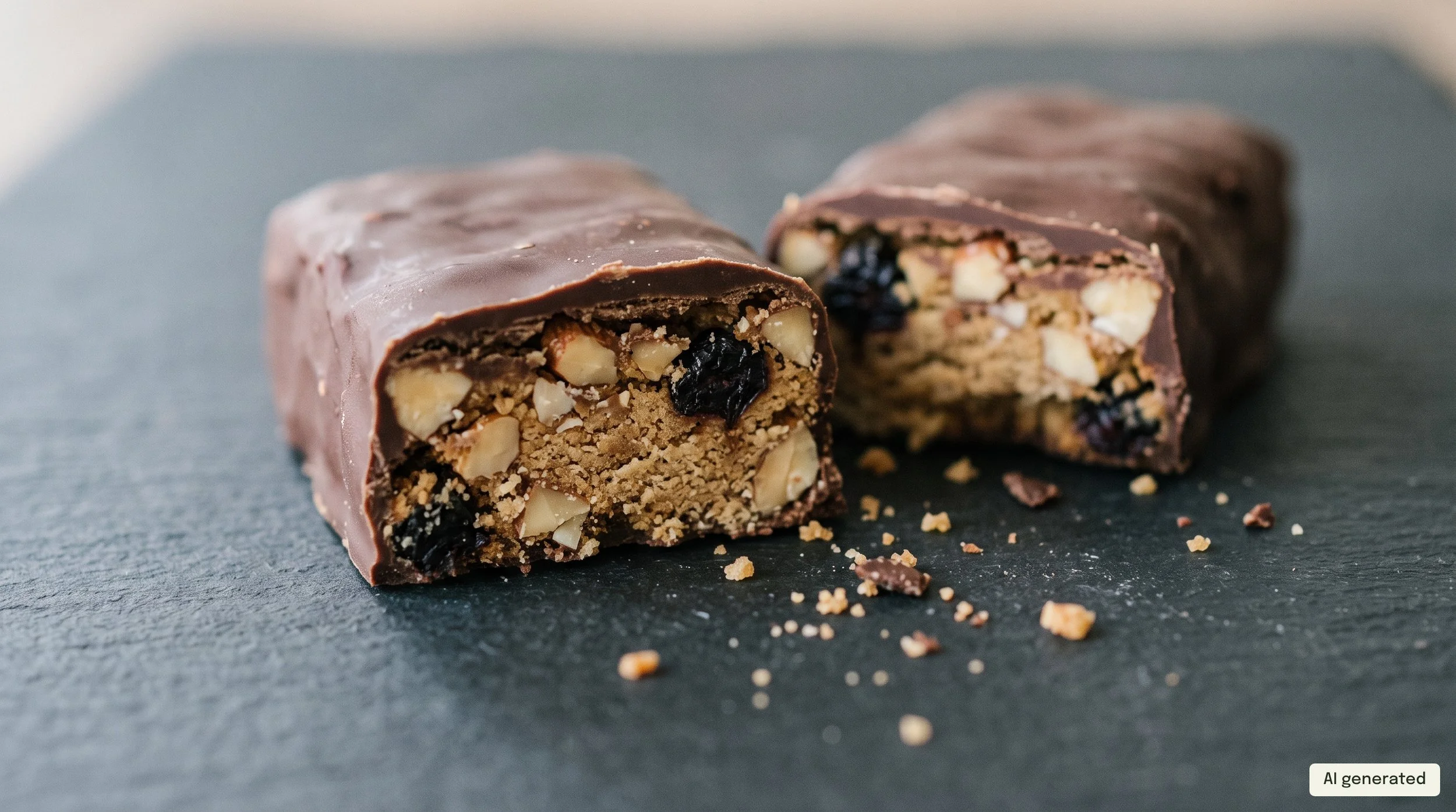
When Mondelez set out to put Lotus Biscoff biscuits inside a bar of Cadbury Dairy Milk, the recipe was the quick part. The team at Bournville went from a kickoff meeting to a trial run on the production line in under three weeks. Keeping the biscuit crunchy took longer.
Chocolate and biscuit taste good together on the first day. Over months in a sealed wrapper, a biscuit draws water from anything moister around it and goes soft. So the bar was engineered around the water: a shell of milk chocolate to keep moisture out, and a layer of fat-based Biscoff spread laid beside the biscuit crumb to protect its crunch. Then it went through lengthy testing to make sure the texture held for the whole of its shelf life. Norberto Chaclin, who heads research and development at Mondelez, told The Economist that mixing crunchy and soft ingredients is tricky. The magazine put the physics in one line: water migrates from moist to dry, and crisp things turn soggy.
That problem keeps getting bigger, because texture has become what snack makers sell. The Economist's story in its October 10 issue runs through the launches: a Dairy Milk bar stuffed with Biscoff, Skittles Gummy Crystals that add tiny crackly pieces to chewy sweets, an "Extra Crunchy" Cheez-It. Mintel, the research firm, puts the share of snacks making a claim about texture at 41 percent last year, up from 31 percent in 2023. It estimates that US demand for "texture-indulgent" snacks grew 28 percent in the two years to April, while the sales volume of textured snacks grew 8 percent. Posts tagged "crunchtok" racked up more than 1.5 billion views last year, and McDonald's changed the recipe of its McCrispy strips this year after customers said they weren't crispy enough.
Every one of those products depends on water staying where the recipe put it. A recipe can control where the water goes inside a bar. It has no say over the water an almond took on before it got there.
Wet to dry
The rule Mondelez engineered around has a precise form. Water moves from the part of a food with the higher water activity to the part with the lower one. Water activity describes how tightly a food holds on to its water, and it is a different number from moisture content. In a webinar on moisture problems in snack foods, Mary Galloway of AQUALAB explained that the difference comes down to physics and energy levels.
Her example is a mix of blueberries and almonds. The blueberries sit at a water activity of 0.66, the almonds at 0.43, so water leaves the berries and moves into the nuts. The almond softens and the berry dries out.
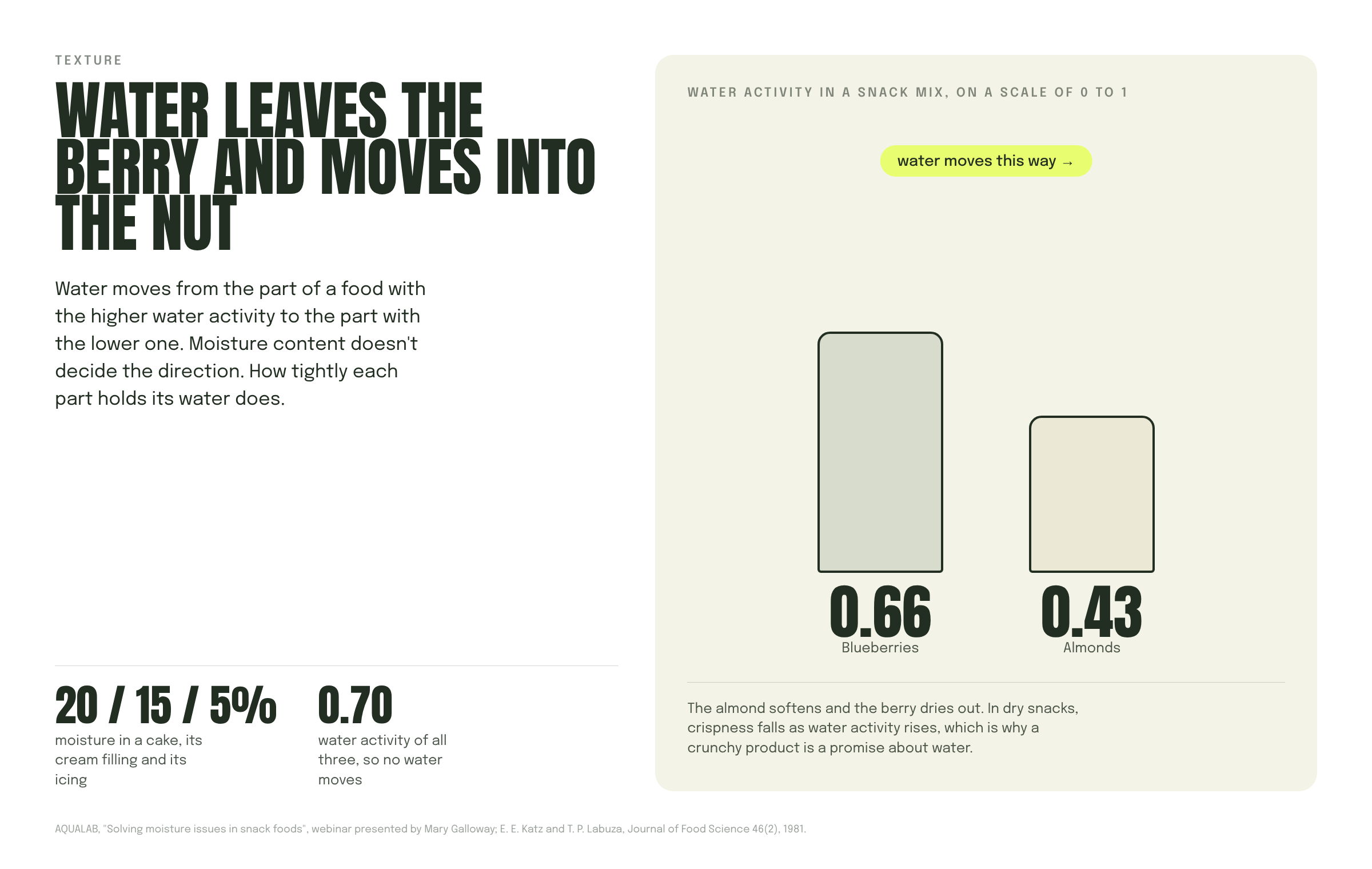
Moisture content alone can mislead. In another of Galloway's examples, a cake, its cream filling and its icing hold 20, 15 and 5 percent moisture. All three sit at the same water activity, 0.7, so no water moves between them at all.
For anything sold as crunchy, this is the whole game. Food scientists have known since a 1981 study by Katz and Labuza in the Journal of Food Science that the crispness of dry snacks is a function of water activity. As it rises, crackers, potato chips, puffed corn curls and popcorn lose their crunch.
The industry has a handful of ways to manage it. Set every component to the same water activity so nothing moves. Slow the movement down so it can't finish within the shelf life. Pack the parts separately. Or put a barrier in between, like the chocolate lining inside an ice cream cone. Mondelez built barriers into the Dairy Milk Biscoff.
Every one of those fixes starts from the same assumption: that each ingredient arrives as specified, and that the specification captures what matters about it.
The orchard floor
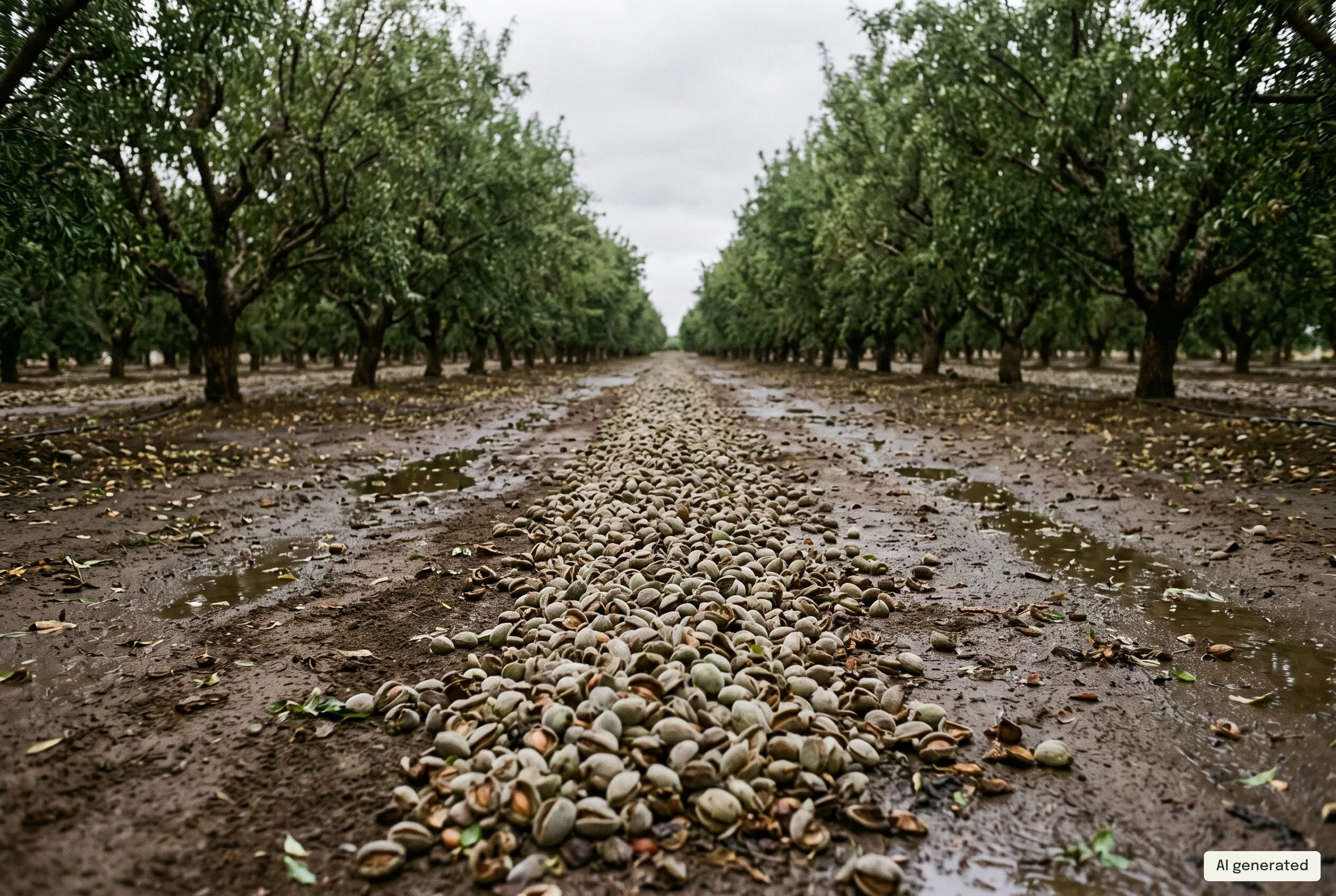
In California, almonds are shaken from the trees and left on the orchard floor to dry, then swept into rows called windrows and picked up. The growers' own rulebook is written around water. The Almond Board of California tells them not to shake when rain is forecast, because nuts dry faster on the tree than on the ground. Once the nuts are down, the wettest ones lie on the north side of the canopy near the trunk, where moisture can run about two percentage points higher, and in the bottom layer of the windrows.
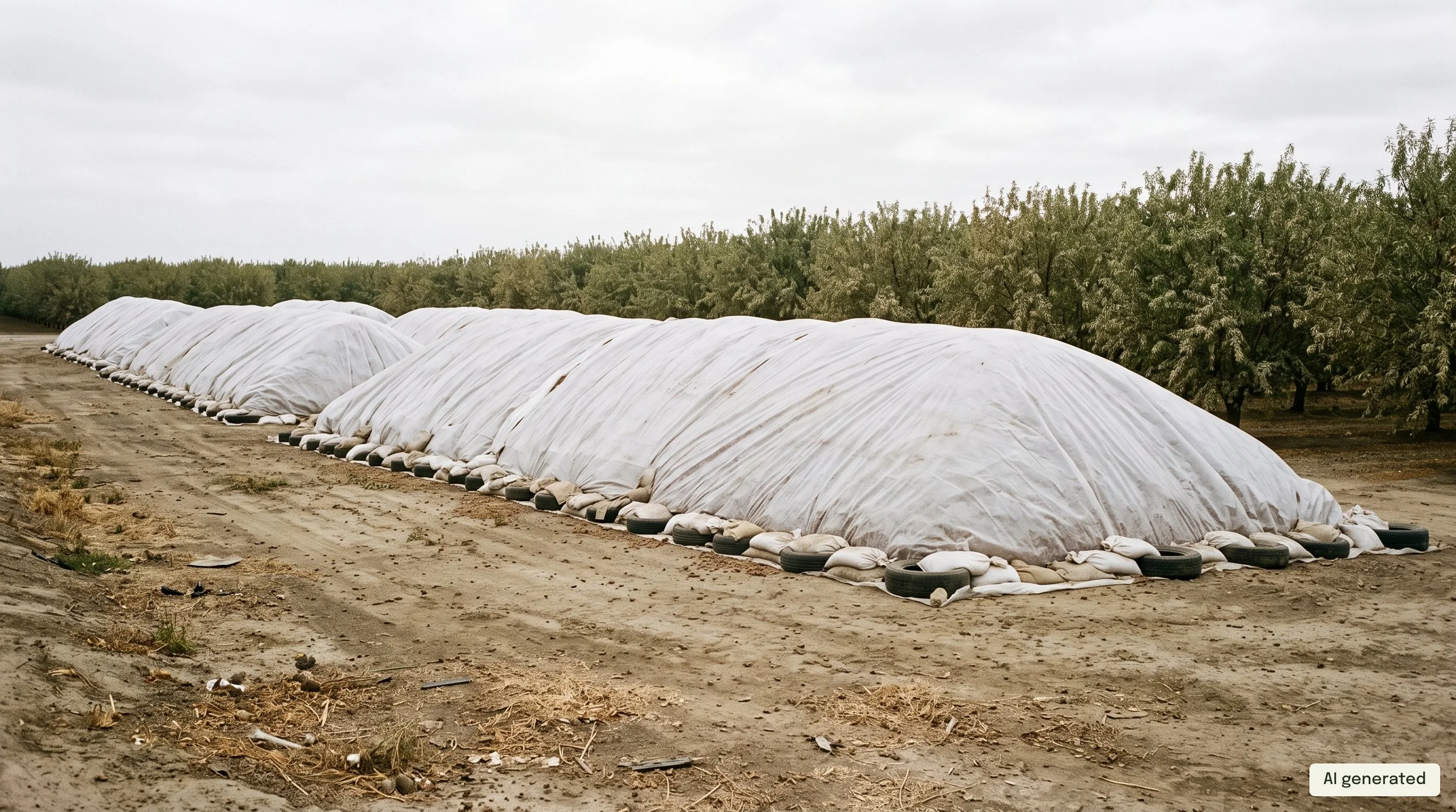
Before the crop goes into stockpiles, the board wants the kernels below 6 percent moisture, the hulls below 12 percent and the whole in-hull almond below 9 percent. The air inside a stockpile should stay under 65 percent relative humidity. Above those lines, the board names the consequences: mold, aflatoxin, and something called concealed damage.
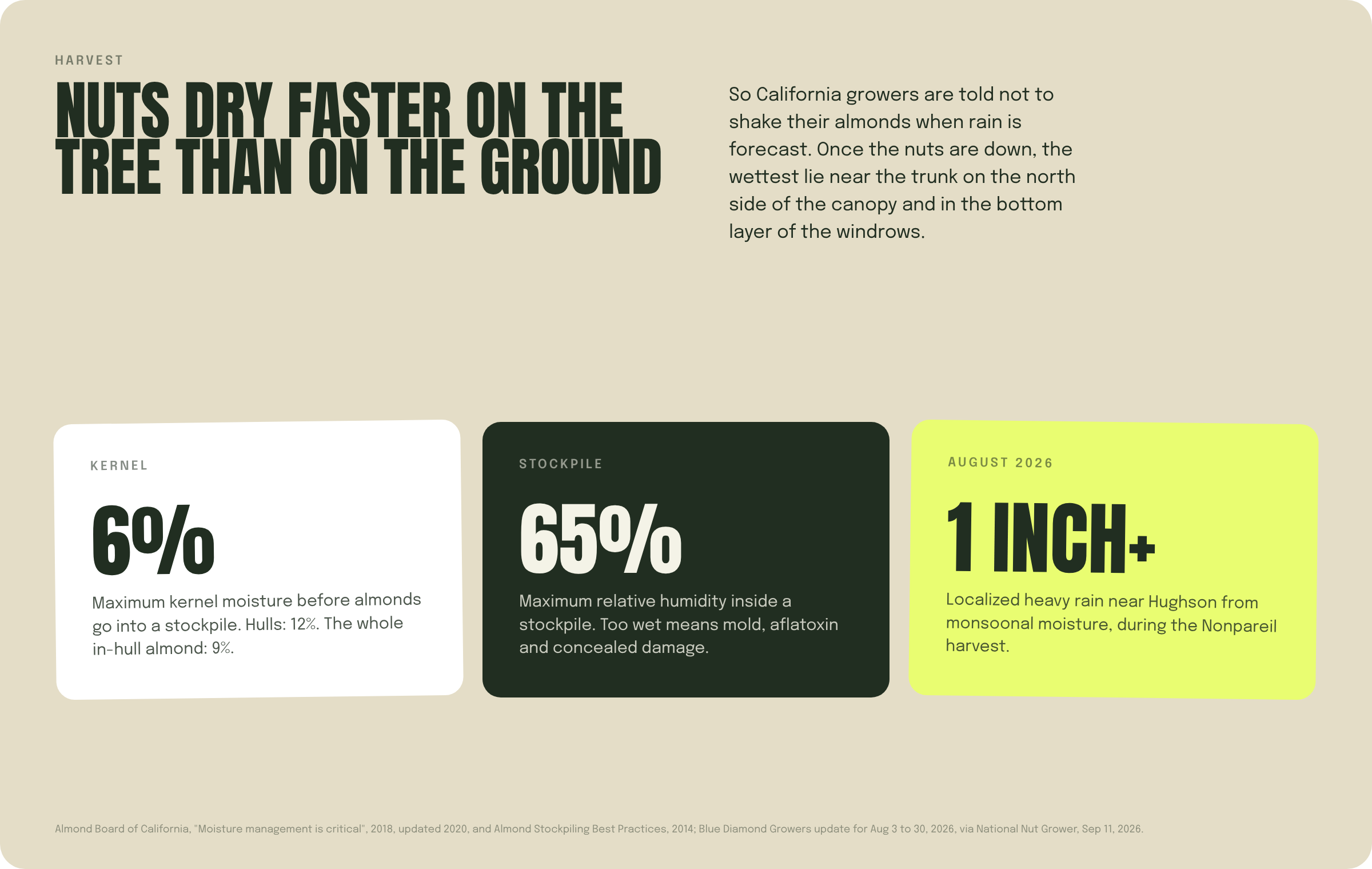
This August, rain arrived in the middle of the harvest. Monsoonal moisture brought localized heavy rain, more than an inch near the town of Hughson, according to Blue Diamond Growers' industry update covering August 3 to 30. In the same weeks, daytime highs in the northern San Joaquin and Sacramento valleys ran from the low 80s to just above 100°F (27 to 38°C), and the southern San Joaquin Valley reached 108°F (42°C). By the end of the month, the Nonpareil harvest was largely done. September then turned warm and dry, and the rest of the harvest moved fast.
After the roast
Concealed damage is how rain at harvest travels downstream, and it travels unseen. According to the Almond Board, it becomes apparent only after roasting, when the inside of the kernel turns darker than in sound nuts, and it can taste bitter. The board links it to nuts whose moisture is too high, especially in years with late harvests or early rains, and to stockpiles that sat with excess moisture for an extended time.
Researchers at UC Davis wanted to know what happens to an almond that gets wet and is then dried back to spec. In a study published in 2020, Luo and colleagues took Nonpareil almonds at 4 percent moisture, brought one batch up to 8 percent in hot, humid air, and then dried it back down to 4 percent. Both batches were roasted, light and dark, and stored for up to a year under accelerated conditions.
On paper the two batches were identical: 4 percent moisture going into the roaster. They didn't age the same way. The dark-roasted almonds that had been wet showed significant fat oxidation, the chemistry behind rancidity, by five months of storage. After twelve months their peroxide value, a standard measure of that oxidation, stood at 44.5 milliequivalents per kilogram, against 24.5 for almonds that had never been wet. In the light roast, a trained tasting panel picked up oxidized, cardboard and paint-like notes in the almonds with a wet history at seven months. Untrained consumers showed no clear preference either way.
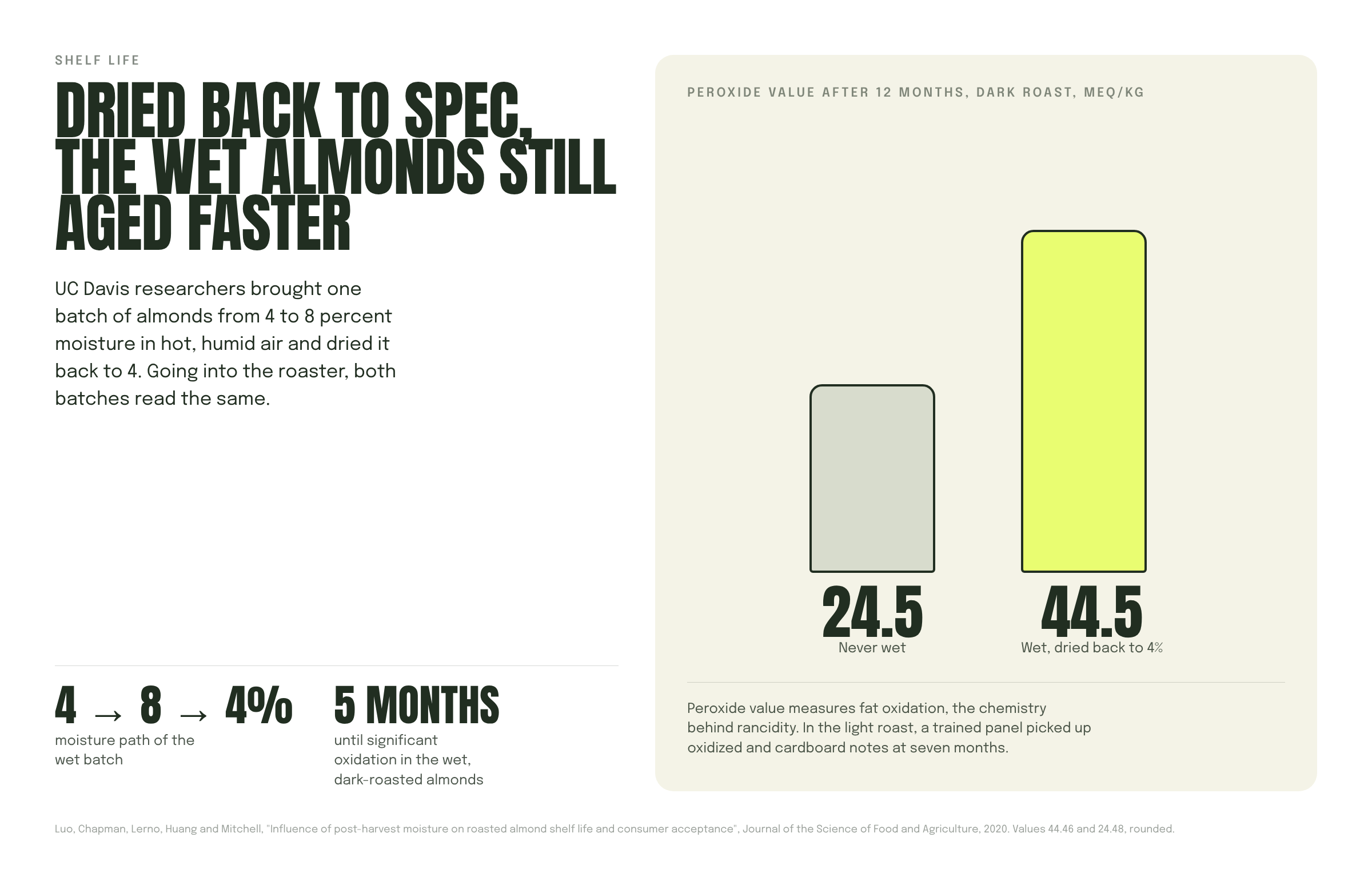
The authors conclude that moisture exposure after harvest, followed by mechanical drying, has a significant effect on how roasted almonds keep. And shelf life is what Mondelez tested the Dairy Milk Biscoff against.
The certificate says four percent
What we see at Finches is that a moisture reading tells a buyer how much water is in a nut on the day it is tested, and nothing about where that water has been. Two lots can both certify at 4 percent, and one of them may have lain in a wet windrow in August.
That history isn't secret. It sits in the source region as dated, local signals: the weeks the shakers ran, the day the monsoon rain came through, how long the nuts lay on the ground before pickup. None of it travels with the delivery, and a localized storm rarely moves a crop estimate. So a sourcing team usually meets it for the first time as a dark kernel coming out of the roaster, or as a shelf-life test that fails months later.
That gap is where we work. Finches watches the regions, farms and crops a buyer sources from, across weather, news, field reports and lab data, and flags the ones that need a decision while there are still options: which lots to sample first, which to roast lighter, which to use early. The lab still decides whether a lot is released. What changes is when the question gets asked: while the almonds are still in the warehouse, months before the bar is on the shelf.
It is the same rule Mondelez designs against, one step further up the chain. Inside a bar, engineers can plan for where the water will go. In an almond, the water moved in August, and the certificate shows only where it ended up.
Catharina van Delden is co-founder and CEO of Finches, the intelligence layer for agricultural sourcing, and also runs a pecan farm in Uruguay.
Notes on facts and sources
Texture trend and the Dairy Milk Biscoff. Chaclin's remark, the engineering of the bar (milk chocolate shell, fat-based Biscoff layer beside the crumb, lengthy shelf-life testing), the product examples, the Mintel estimates (texture claims on 31 percent of snacks in 2023 and 41 percent last year; US demand for texture-indulgent snacks up 28 percent and sales volume of textured snacks up 8 percent in the two years to April) and the 1.5 billion "crunchtok" views: The Economist, "Mouthfeel movement: why your snacks are chunkier and chewier than before", Business section, published online October 8, 2026, print edition of October 10, 2026, p. 56, https://www.economist.com/business/2026/10/08/why-your-snacks-are-chunkier-and-chewier-than-before. Mintel's underlying report was not available to us; the figures are Mintel's as reported by The Economist. For comparison, Mintel's own summary of its snacking research (July 2026) states that 59 percent of products launched in 2026 made no texture claims, and the Associated Press (September 14, 2026) reports the same share for packaged foods introduced in the US this year: https://www.mintel.com/insights/food-and-drink/snacking-texture-wars/ and https://www.wcax.com/2026/09/14/customers-crave-texture-challenging-companies-make-crispier-gooier-chewier-foods/. From kickoff meeting to line trial in under three weeks at Bournville: Mondelez International, "Bringing the Cadbury Dairy Milk Biscoff bar to life", May 21, 2025, https://www.mondelezinternational.com/news/careers-bringing-the-cadbury-dairy-milk-biscoff-bar-to-life/. McCrispy recipe change in 2026: Associated Press, September 14, 2026 (link above).
Water activity. Direction of moisture migration, the blueberry (0.66) and almond (0.43) example, the cake example (20, 15 and 5 percent moisture at a common water activity of 0.7) and the management options including the chocolate-lined ice cream cone: AQUALAB, "Solving moisture issues in snack foods", webinar presented by Mary Galloway, https://aqualab.com/learn/solving-moisture-issues-snack-foods. Crispness as a function of water activity: E. E. Katz and T. P. Labuza, "Effect of water activity on the sensory crispness and mechanical deformation of snack food products", Journal of Food Science 46(2), 1981, pp. 403 to 409, as summarized by AQUALAB, https://aqualab.com/learn/use-water-activity-get-and-maintain-right-texture.
Almond harvest and moisture rules. Do not shake before rain because nuts dry faster on the tree than on the orchard floor; wettest nuts on the north side of the canopy near the trunk, about 2 percentage points higher; bottom layers of windrows; stockpiling thresholds of 6 percent kernel, 12 percent hull and 9 percent in-hull moisture; maximum 65 percent relative humidity inside a stockpile; mold, aflatoxin and concealed damage as consequences: Almond Board of California, "From shaking to stockpiles to hulling and shelling: moisture management is critical", July 31, 2018, updated June 1, 2020, https://www.almonds.org/almond-industry/industry-news/shaking-stockpiles-hulling-and-shelling-moisture-management-critical, and Almond Board of California, Almond Stockpiling Best Practices, 2014, https://www.almonds.org/sites/default/files/content/attachments/alm-0601_stockpilingguide_grower_c6.pdf. Concealed damage apparent only after roasting, darker kernel interiors and bitter flavor: Almond Stockpiling Best Practices (above). Link to high moisture, late harvests and early rains: Almond Board of California, "High moisture content delivers lower returns, greater damage", June 3, 2021, https://www.almonds.org/almond-industry/industry-news/high-moisture-content-delivers-lower-returns-greater-damage.
2026 harvest. Localized heavy rain from monsoonal moisture, more than 1 inch near Hughson; temperatures from the lower 80s to just above 100°F in the northern San Joaquin and Sacramento valleys and 108°F in the southern San Joaquin Valley; Nonpareil and Independence harvest largely complete by the end of the period: Blue Diamond Growers, Almond Industry News Update for August 3 to 30, 2026, as reported by National Nut Grower, September 11, 2026, https://nationalnutgrower.com/news/california-almond-harvest-august-2026/. Warm, dry September and rapid harvest progress: Blue Diamond Growers crop progress report of September 28, 2026, as reported by National Nut Grower, October 1, 2026, https://nationalnutgrower.com/news/california-almond-harvest-september-2026/. Celsius values are our conversions.
Moisture exposure and roasted almond shelf life. K. K. Luo, D. M. Chapman, L. A. Lerno, G. Huang and A. E. Mitchell, "Influence of post-harvest moisture on roasted almond shelf life and consumer acceptance", Journal of the Science of Food and Agriculture, 2020, DOI 10.1002/jsfa.10624, https://mitchell.ucdavis.edu/sites/g/files/dgvnsk916/files/2020-09/jsfa.10624_1.pdf. Nonpareil almonds from the 2015 harvest; moisture-exposed batch raised from 4 to 8 percent (38°C, 90 percent relative humidity, 36 hours) and dried back to 4 percent; light and dark roasts stored at 39°C for up to 12 months; significant lipid oxidation in the moisture-exposed dark roast by 5 months; peroxide values of 44.46 versus 24.48 mEq/kg for dark roast at 12 months, rounded in the text; in the light roast, a trained panel rated the moisture-exposed almonds higher in oxidized, cardboard and painty/solvent flavors at 7 months, while untrained consumers showed no significant preference.
