
You can't tell a customer to come back next year: the sour cherry gap
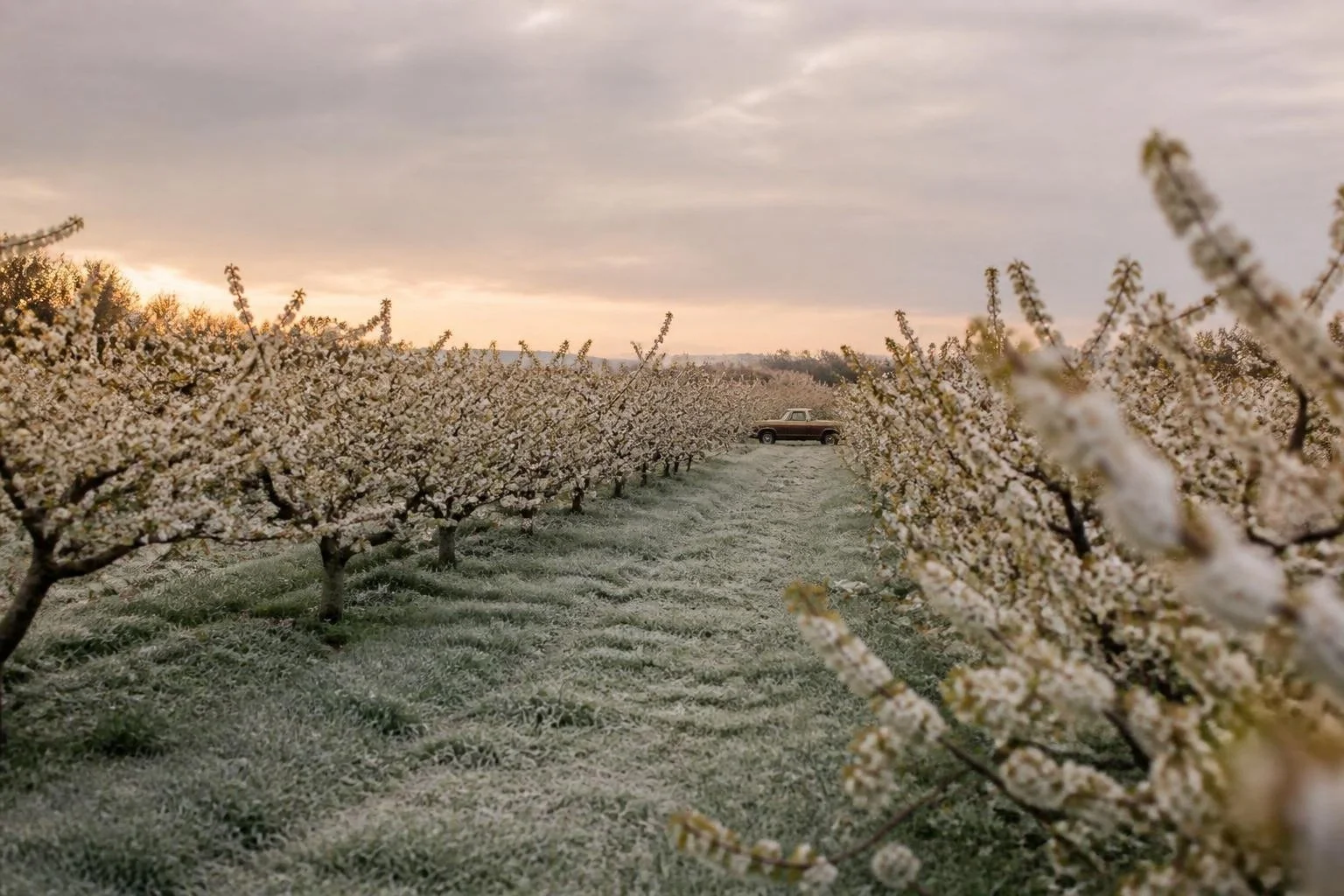
One night in April, the thermometer at Stony Point, an orchard site south of Suttons Bay on Michigan's Leelanau Peninsula, fell to -7 degrees Celsius. Michigan grows about 70 percent of America's tart cherries, most of them in this corner of the state. In July, Nikki Rothwell, who runs Michigan State University's horticultural research station in Leelanau County, put the northwest's harvest at around 40 million pounds, from orchards she reckons can carry about 180.
The same summer, the world grew more fresh cherries than in any year on record. The USDA's Foreign Agricultural Service puts global output for 2026/27 at 5.4 million tonnes, up 17 percent, with Turkey back to about a million tonnes after the frosts that wrecked its 2025 crop. German orchards picked 38,900 tonnes of sweet cherries, 16 percent above the ten-year average, and sweet cherries in German wholesale markets sold below last year's prices for most of the season.
Both are true because the cherry trade is really two trades that barely touch. The sweet cherry is eaten from a bowl. The sour cherry, the Montmorency in Michigan, the Lutówka in Poland, the Érdi bőtermő in Hungary, rarely reaches a fruit counter at all. Across Europe it goes almost entirely to processors, who pit and freeze it, press it into juice and concentrate, or pack it in jars. The sour cherry trade came up short on both sides of the Atlantic, and in America it went into the season with its freezers close to empty.
EIGHTEEN DEGREES
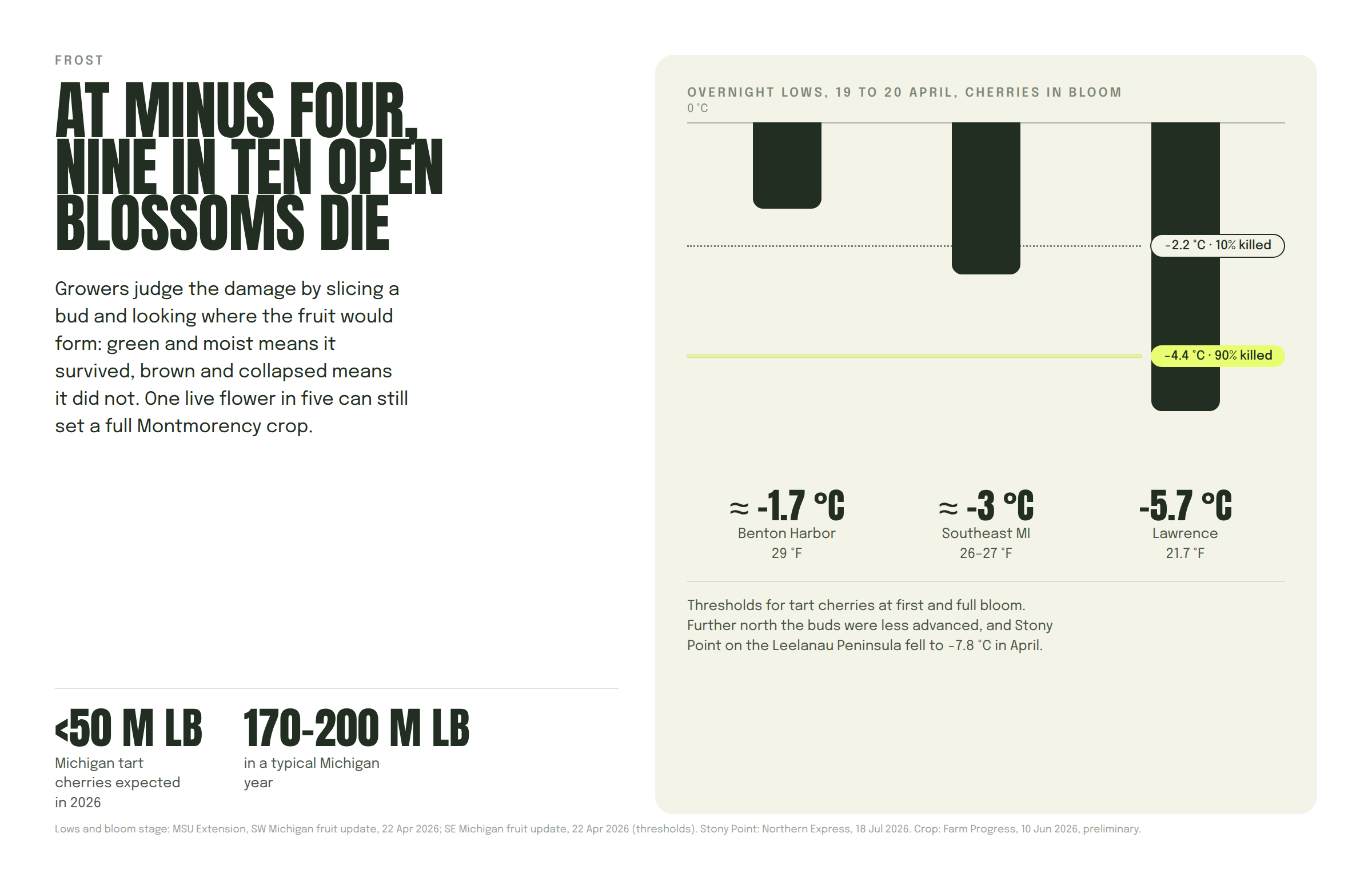
A cherry flower is at its most exposed in the few days it stands open. Michigan State's extension team publishes the thresholds in its spring bulletins: at first and full bloom, a tart cherry loses 10 percent of its flowers at −2.2 °C (28 °F)and 90 percent at −4.4 °C (24 °F). On the night of 19 to 20 April, tart and sweet cherries were in bloom across Berrien and Van Buren counties in the southwest, and the lows there ranged from -5.7 °C at Lawrence to about -1.7 °C at the Benton Harbor research centre. In the north the trees were further behind. How much a block lost, Rothwell said later, came down to the stage its buds had reached when the cold arrived.
None of it shows on the outside of the tree. The test is to slice through a bud and look at the tissue where the fruit would form. Living tissue is green to pale yellow and moist. Dead tissue has turned brown or black and looks soaked and collapsed. Then growers count, because a cherry tree carries far more flowers than it needs, and an old rule in Montmorency orchards holds that one live flower in five can still set a full crop. On 5 May the northwest team reported that the trees looked worse than just after the freeze. But they were still finding live flowers in most blocks, so they stuck with the old rule.

The count kept falling. By June, Michigan was expected to harvest less than 50 million pounds of tart cherries, roughly 23,000 tonnes, against a typical 170 to 200 million. Utah, the second-largest producer, was put at essentially zero. New York expected less than half a normal crop and Wisconsin a loss of 40 to 50 percent. Dorance Amos, who farms 200 acres of tart cherries in northwest Michigan's Elk Township, expected about 50,000 pounds from blocks that usually give him a million. "All regions are smoked from frost," he told reporters.
RAIN ON A RIPE CHERRY
Not every loss gives that much warning. California's sweet cherries were lost the other way round: the fruit set, grew, and was ruined in the last weeks. Three rain events in May split fruit on the tree, and the state finished at around 5.5 million 18-pound boxes against a pre-season estimate of 8 to 8.5 million, with grower losses put at $250 to $300 million. In San Joaquin County the agricultural commissioner reported 63 percent of the crop affected and 174 million dollars lost.
The damage starts long before the rain. A cherry stops laying down its waxy cuticle early in its growth, and the same film is then stretched across a fruit that keeps swelling, until it is covered in cracks too small to see. Rain that sits on a ripe cherry gets in through those cracks. The flesh cells directly underneath take up water and burst, and as they burst they release malic acid, which weakens the walls of the cells beside them. Each failure loads the next, so the split runs across the fruit the way a zipper opens. Researchers have watched this happen in fruit left to soak in water, with the cracking concentrated around the scar at the tip of the cherry. A split cherry cannot be packed, and one California shipper put the cost of a rejected truckload at $100,000 to $150,000.
THE FREEZER WAS ALREADY EMPTY
A sour cherry crop is picked over a few weeks in summer, and the processors who buy it supply food makers all year from cold storage, carrying stock from one season into the next. The American system writes this into federal rules. In heavy years the industry board can set part of the crop aside in an inventory reserve, frozen, canned, dried or as concentrate, and release it when a short crop plus the stock carried in cannot meet demand.
The reserve exists for years like 2026, and the freezers had almost nothing in them. At the end of April, tart cherries in storage were within 4 million pounds of the all-time low, set in 1977, according to Tim Brian of Smeltzer Orchards. Tom Facer, a New York agent who has handled tart cherries since 1983, called the year worse than the disaster of 2012, because the stock carried in was lower than it was then.
Prices followed. Growers expected about a dollar a pound, against 25 to 50 cents in recent years, and dried cherries could pass $8 a pound wholesale and $10 at retail, against $4.50 two years earlier. Brian pointed out that a restaurant putting dried cherries in a salad can buy cranberries for perhaps a quarter of the cost.
"Our processors are scared we're going to lose this market next year because we cannot begin to fill all of the orders," Amos said. Facer's warning was that a manufacturer who goes short of cherries in a year of unusually high prices will ask whether cherries belong in the product line at all, and that once the answer is no, the recipe stays changed. The customer has to be won back, and the harvest does not do that on its own. Growers who have long opposed imports now back them: both Brian and Facer said they would support imported fruit this season to keep cherry products on the shelf. Imported frozen tart cherries were projected to cost more than 2 dollars a pound delivered.
TWO THIRDS OF THE JAR
Europe's sour cherry trade is larger, and it divides by what the fruit becomes. Turkey, Poland and Serbia together produce and process 400,000 to 500,000 tonnes in an average year, split roughly evenly between frozen fruit and concentrate. Sour cherries preserved in jars are a different market. Hungary fills 30 to 60 million jars a year, 60 to 70 percent of European production, and Germany is second with 15 to 20 million. Three quarters of Hungary's jars go to Germany, where they cover about two thirds of what the country uses, and German canners also buy 5,000 to 7,000 tonnes of Hungarian fruit to fill jars of their own. Almost no other sour cherries are considered suitable for preserving, apart from part of Germany's own crop, so the Hungarian growers and the Hungarian and German canneries depend on each other almost entirely. The trade journal Cherry Times calls it a bilateral monopoly.
That market was already stretched. In 2025, European stocks of jarred and frozen sour cherries were used up at the start of the season, frost cut the crop almost everywhere, and prices reached three to four times the average of the previous three years. In June 2026, Hungary's forecast was around 30,000 tonnes, another 20 to 30 percent lower. The frost hit hardest in the northeast, where 55 percent of Hungary's sour cherry orchards stand and where most of the canning capacity sits, and a spring drought followed. Only about a third of the orchards are irrigated.
Germany grows some of its own, on a shrinking area. The final Destatis estimate for 2026 put the German sour cherry harvest at 9,600 tonnes, 16.8 percent below the ten-year average. Yield per hectare was almost normal. The shortfall is land: sour cherry orchards have shrunk from 2,000 to 1,500 hectares in a decade.
On the frozen side, the Hamburg ingredients supplier Bösch Boden Spies reported in late July that the Polish crop could come in 20 to 50 percent below its long-term average after spring frosts, with the worst damage in the southeast and parts of Mazovia. In Serbia, its team found trees heavy with fruit, but the cherries were small, so less of the crop could go through the pitting lines and processors were offering only limited volumes.
THE ESTIMATE MOVED FIRST
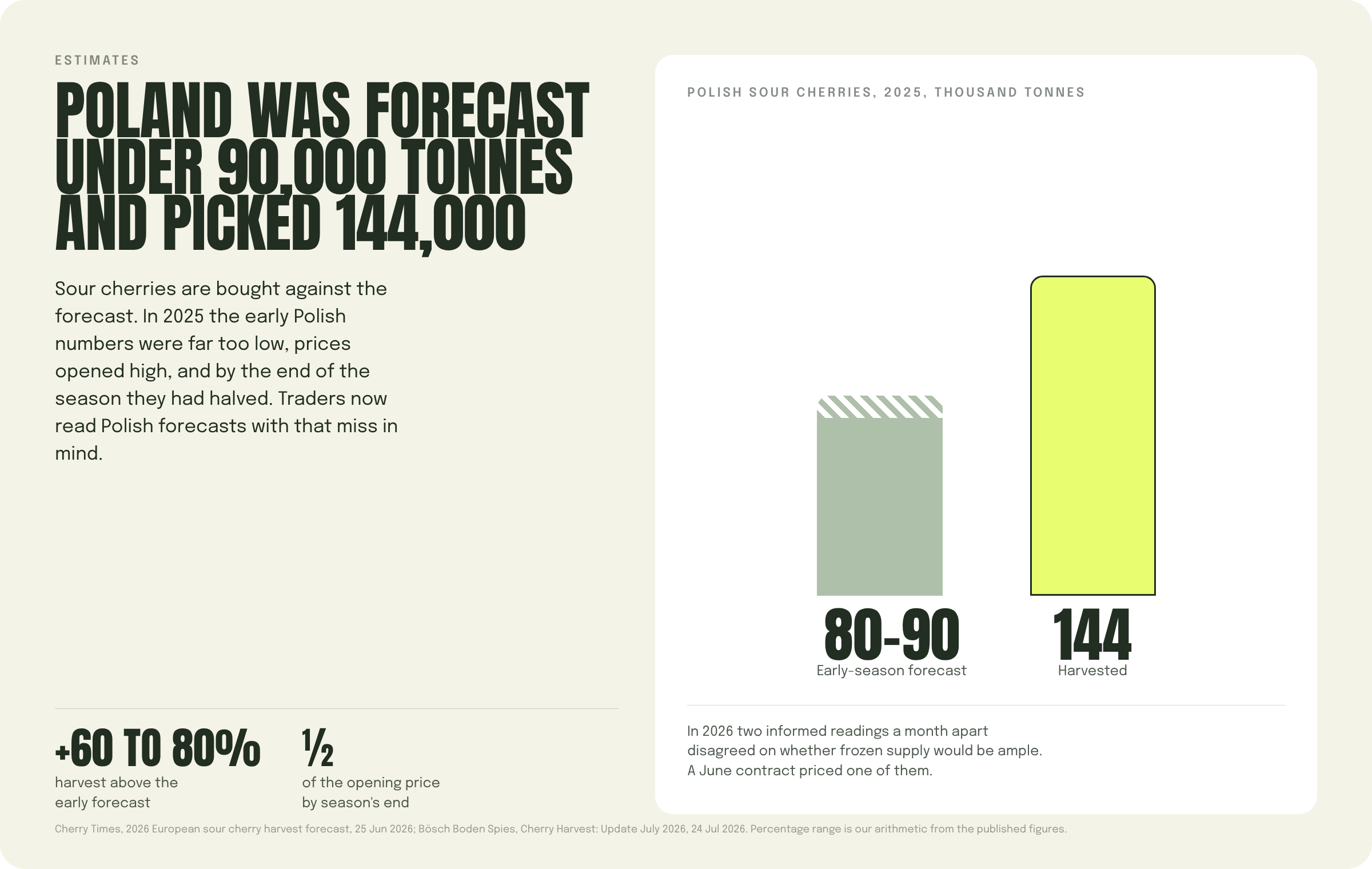
Sour cherries are bought against a forecast, and the forecasts have a poor recent record. In 2025, Polish estimates early in the season pointed to 80,000 to 90,000 tonnes. Poland harvested 144,000. Prices opened high and had halved by the end of the season, and Cherry Times reports that traders in Hungary and across Europe now take that miss into account when they read Polish forecasts.
In 2026, two informed sources a month apart read the same season differently. In late June, the Hungarian analysis in Cherry Times expected good harvests in Turkey, Serbia and Poland to keep frozen fruit and concentrate in ample supply. A month later, Bösch Boden Spies described Poland as badly frosted and Serbian pitting yields as down, and told customers to secure their volumes early. Both were informed readings of the same orchards. A buyer who signed for frozen pitted sour cherries in June was pricing one of those two readings.
What we see at Finches, across commodities, is that the harvest estimate is the first thing a buyer trades on, and that the signals behind it exist weeks before any estimate is published. A blade through a bud in April says how many flowers survived. The size of fruit hanging in a Serbian orchard at the end of June says what the pitting yield will be. Those readings sit in extension bulletins and supplier visit notes, in several languages, and they rarely reach the person signing the contract while the contract can still change.
The growers who came through 2026 best were the ones whose trees didn't all flower at once. Doug DeBadts, who grows tart cherries in Wayne County, New York, has one orchard within three miles of Lake Ontario that blooms about a week and a half later than his inland blocks, and he believes that helped. Turkish exporters make the same argument at national scale: the country's cherry regions are spread widely enough to ripen one after another across an eight to ten week season. The jar has no such spread: two thirds of the sour cherries in Germany's jars come from Hungary, and much of that from its frost-hit northeast.
Finches builds the intelligence layer for agricultural sourcing.
Notes on facts and sources
All figures below were checked against the named source on 30 September 2026. Figures marked preliminary were estimates at the time of publication by the source and may since have been revised.
Stony Point at 18 °F; northwest Michigan harvest about 40 million lb against a carrying capacity of about 180 million lb (Nikki Rothwell). Art Bukowski, "The 2026 Cherry Crop Report", Northern Express, 18 July 2026. https://www.northernexpress.com/news/feature/the-2026-cherry-crop-report/ Preliminary.
Michigan about 70% of US tart cherry production; Michigan under 50 million lb against a typical 170 to 200 million; Utah essentially zero; New York under half; Wisconsin 40 to 50% loss; Amos 50,000 lb from a usual million on 200 acres in Elk Township; storage within 4 million lb of the 1977 low (Tim Brian); worse than 2012 (Tom Facer); grower price about $1/lb against 25 to 50 cents; dried cherries above $8/lb wholesale and $10/lb retail against $4.50 two years earlier; cranberries at about 25% of the cost; Facer on product-line decisions; Brian and Facer supporting imports; imported frozen tart cherries above $2/lb delivered; DeBadts orchard near Lake Ontario blooming about 1.5 weeks later. Jennifer Kiel, "Frost devastates U.S. tart cherry crop, industry at risk", Farm Progress (Michigan Farmer), 10 June 2026. https://www.farmprogress.com/fruit/frost-devastates-u-s-tart-cherry-crop-industry-at-risk Crop figures preliminary.
Michigan Cherry Committee regional estimates; Amos processor quote comes from Farm Progress, 10 June 2026: "All regions are smoked from frost". Agronews, 13 June 2026. https://agronews.com/us/en/news/analytics/2026-06-13/95780
Lows of 21.7 °F at Lawrence to about 29 °F at Benton Harbor, 19 to 20 April; tart and sweet cherries in bloom in Berrien and Van Buren counties; bud tissue appearance, live against dead. MSU Extension, "Southwest Michigan fruit update", 22 April 2026. https://www.canr.msu.edu/news/southwest-michigan-fruit-update-april-22-2026
Critical temperatures at first and full bloom: tart cherry 28 °F for 10% kill, 24 °F for 90% kill. MSU Extension, "Southeast Michigan fruit update", 22 April 2026. https://www.canr.msu.edu/news/southeast-michigan-fruit-update-april-22-2026 (Celsius conversions ours.)
Tart cherries looking worse on 5 May; the 20% viable flower rule for Montmorency. MSU Extension, "Northwest Michigan fruit update", 5 May 2026. https://www.canr.msu.edu/news/northwest-michigan-fruit-update-may-5-2026
Damage depending on the stage of development (Rothwell). Farm Progress, 10 June 2026, as above.
Global fresh cherry output 5.4 million tonnes in 2026/27, up 17%, a record; Turkey about 1.0 million tonnes; USDA Foreign Agricultural Service, Fresh Peaches and Cherries: World Markets and Trade, as reported by FreshPlaza, 25 September 2026. https://www.freshplaza.com/north-america/article/9876841/global-cherry-crop-forecast-to-rise-17-in-2026-27/ Forecast. USDA counts sweet and sour cherries together in this series. The primary PDF at apps.fas.usda.gov returned the September 2025 edition when checked; figures confirmed through FreshPlaza only.
Turkey's 2025 frost; cherry crop down almost 60% to 400,000 tonnes. USDA FAS, Fresh Peaches and Cherries: World Markets and Trade, September 2025. https://apps.fas.usda.gov/psdonline/circulars/stonefruit.pdf
German sweet cherries 38,900 tonnes, 16.2% above the ten-year average (IndexBox summary of Destatis); German sour cherries 9,600 tonnes, 16.8% below the ten-year average; yield per hectare 1.1% below average; area down from 2,000 to 1,500 hectares. Destatis, press release no. 334, 21 September 2026. https://www.destatis.de/DE/Presse/Pressemitteilungen/2026/09/PD26_334_412.html and IndexBox, September 2026. https://www.indexbox.io/blog/german-fruit-growers-report-strong-2026-cherry-harvest/
German sweet cherry prices generally below last year's levels; Italian wholesale prices lower than last season in week 26. FreshPlaza, "Global market overview cherries", July 2026. https://www.freshplaza.com/north-america/article/9853127/global-market-overview-cherries/
California crop about 5.5 million 18-lb boxes against a pre-season estimate of 8 to 8.5 million; losses of $250 to $300 million; three May rain events. UC Davis CalAg, "June 2026 California Cherry Market Report", 12 June 2026, citing FreshFruitPortal (4 June 2026) and AgNet West (15 April 2026). https://calag.ucdavis.edu/reports/2026-06-12-cherry-market-report.html Preliminary.
San Joaquin County 63% of the crop and $174 million, per the 11 May letter of Agricultural Commissioner Kamaljit Bagri. California Farm Bureau, Ag Alert, 20 May 2026. https://www.agalert.com/california-ag-news/archives/may-20-2026/california-cherry-crops-decimated-by-spring-storms/
Rejected loads at $100,000 to $150,000 (Michael Jameson, Morada Produce). AgNet West, June 2026. https://agnetwest.com/california-cherry-growers-rain-losses-2026/
Rain cracking mechanism: cuticle deposition stops early and the film is stretched, microcracks, localised water uptake, cells bursting, crack running like a zipper. "Crack initiation and propagation in sweet cherry skin: a simple chain reaction causes the crack to 'run'", PLOS ONE, 2019. https://journals.plos.org/plosone/article?id=10.1371%2Fjournal.pone.0219794 ; "The zipper model: cherry rain-cracking scientifically explained", Journal of Biological Education, 2025. https://www.tandfonline.com/doi/pdf/10.1080/00219266.2025.2475011 ; localised uptake concentrated at the stylar scar: Horticulture Research (Nature), 2019. https://www.nature.com/articles/s41438-019-0161-3
Malic acid released by burst cells weakening neighbouring cells. "Sweet cherry fruit cracking mechanisms and prevention strategies: a review", Scientia Horticulturae (ScienceDirect), 2018. https://www.sciencedirect.com/science/article/abs/pii/S0304423818304345
Inventory reserve provisions of the US tart cherry marketing order. 7 CFR Part 930, eCFR. https://www.ecfr.gov/current/title-7/subtitle-B/chapter-IX/part-930
European sour cherries mainly processed; Turkey, Poland and Serbia at 400,000 to 500,000 tonnes in an average year; Hungarian jars 30 to 60 million, 60 to 70% share; Germany 15 to 20 million jars and 5,000 to 7,000 tonnes of Hungarian fruit; three quarters of Hungarian jars to Germany covering about two thirds of German requirement; "bilateral monopoly"; 2025 prices three to four times the previous three-year average; Hungary 2026 about 30,000 tonnes, 20 to 30% below 2025; 55% of orchards in the northeast; one third irrigated; Poland 2025 forecasts of 80,000 to 90,000 tonnes against a 144,000-tonne harvest; prices halving over the 2025 season; expected ample frozen and concentrate supply in 2026. Cherry Times, "2026 European sour cherry harvest forecast", 25 June 2026. https://cherrytimes.it/en/news/hungary-sour-cherries-2026-crop-european-market-production-prices Hungarian 2026 figure preliminary.
Poland 20 to 50% below the long-term average; worst damage in the southeast and Mazovia; Serbian fruit small, lower pitting yields, limited volumes. Bösch Boden Spies, "Cherry Harvest: Update July 2026", 24 July 2026. https://www.boeschbodenspies.com/en/news/cherry-harvest-update-july-2026/ Preliminary.
Turkish cherry regions across an eight to ten week supply period. Smartcherry, "Turkish cherry volumes set to recover", June 2026. https://smartcherry.world/countries/turkish-cherry-volumes-set-to-recover/
Pound-to-tonne conversions are ours (1 lb = 0.4536 kg).
