
Warm water helps shrimp grow until the rain comes: El Niño and Ecuador
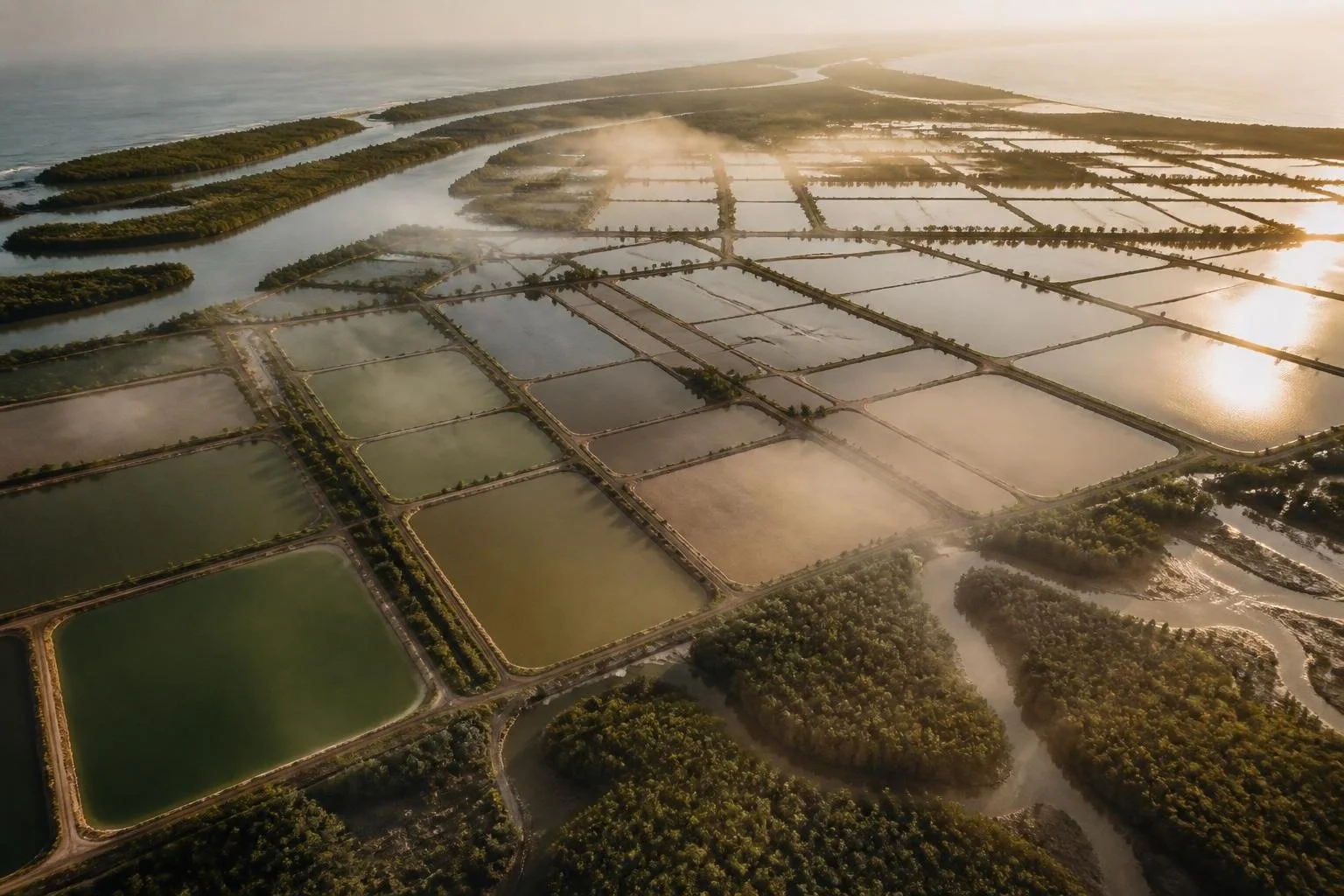
AI generated
In 1998, Ecuador exported 114,754 metric tons of shrimp, 5.4 percent more than the year before and the most it had ever shipped in a year. Reuters credited the warm water of that year's El Niño. Revenue still slipped, from $886 million to $875 million, because the world price was falling.
The next year a virus that apparently came from Asia reached the farms, and the industry did not know how. By November 1999 the head of Ecuador's national shrimp chamber was telling Reuters, "White spot virus has thrown us into chaos." The sector had employed about 250,000 people. It had since cut 15 to 20 percent of them. In 2000, Ecuador exported 37,700 metric tons.
This September, NOAA's Climate Prediction Center put the odds of a very strong El Niño this winter above 90 percent. In August the Niño 1+2 region, the patch of ocean off the coasts of Ecuador and northern Peru, ran 3.4 degrees Celsius above normal.
Ecuador exported 1.39 million metric tons of shrimp in 2025, about 37 times its volume in 2000. The farms behind that number were rebuilt after the virus.
Ponds left open
The rebuilding started with the animals that lived. Breeders took shrimp that had survived white spot, bred from them and repeated the cycle until the industry had stock that tolerated the disease. "Pretty much what Ecuador did is solving biology, with biology," said José Antonio Camposano, president of the National Chamber of Aquaculture, at the Global Shrimp Forum in Utrecht last month.
It was a different bet from the one much of the shrimp world made. Farms elsewhere intensified and bred pathogen-free lines. Ecuador kept its ponds open and thinly stocked, and relied on animals that coped with what was in the water, as Yahira Piedrahita, the chamber's executive director, described it in 2018. Gabriel Luna of the Global Shrimp Council puts the stocking at 8 to 20 shrimp per square meter. More than 230,000 hectares of ponds give the industry that room.
What the microphone hears
A shrimp pond is hard to read. It can hold several million animals across as much as 20 hectares, and the water is turbid, so counting what is in it is very difficult.
So Ecuador's farms listen. A shrimp that eats makes a sound: its jaws click on the pellet. An underwater microphone, a hydrophone, picks the click up, and software strips out the other noise in the pond and keeps the feeding sounds. The controller reads the amount of clicking as appetite and adjusts the next ration. The system's developers checked the link between sound and intake against feed trays, acoustic cameras and underwater cameras, and one hydrophone can steer several automatic feeders. These systems run on Ecuadorian farms: a study of 639 commercial ponds in Guayas province, from 2018 to 2020, compared them with timer and hand feeding.
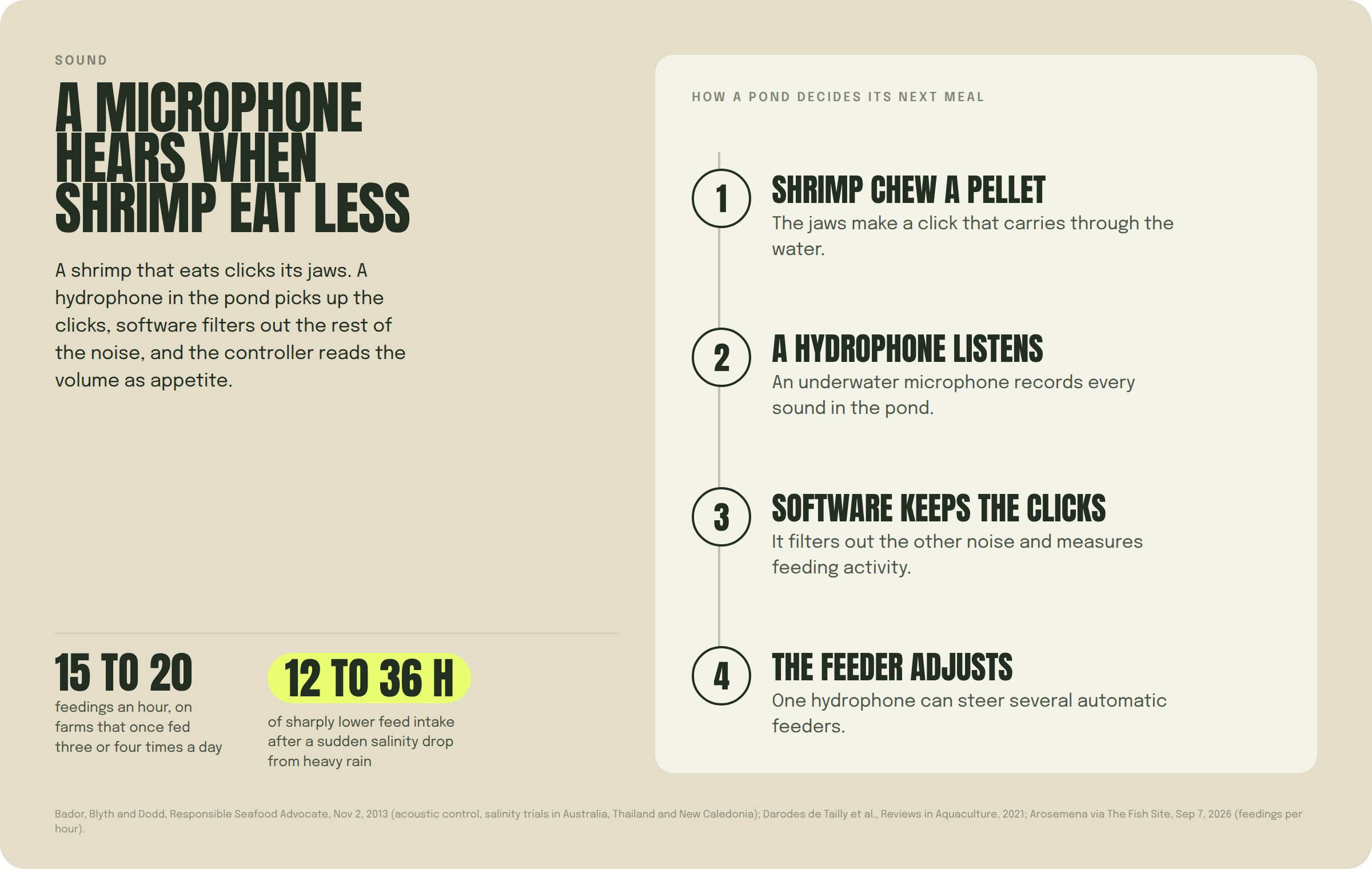
Automatic feeders have changed the tempo. Farms that once fed three or four times a day now feed 15 to 20 times an hour, according to Eduardo Arosemena, chief executive of Thai Union Feedmill Ecuador.
The microphone also hears the weather. In trials on farms in Australia, Thailand and New Caledonia, a sudden drop in salinity after heavy rain was followed by a strong fall in feed intake in the following 12 to 36 hours. To a hydrophone, that sounds like a pond going quiet.
Plant by plant
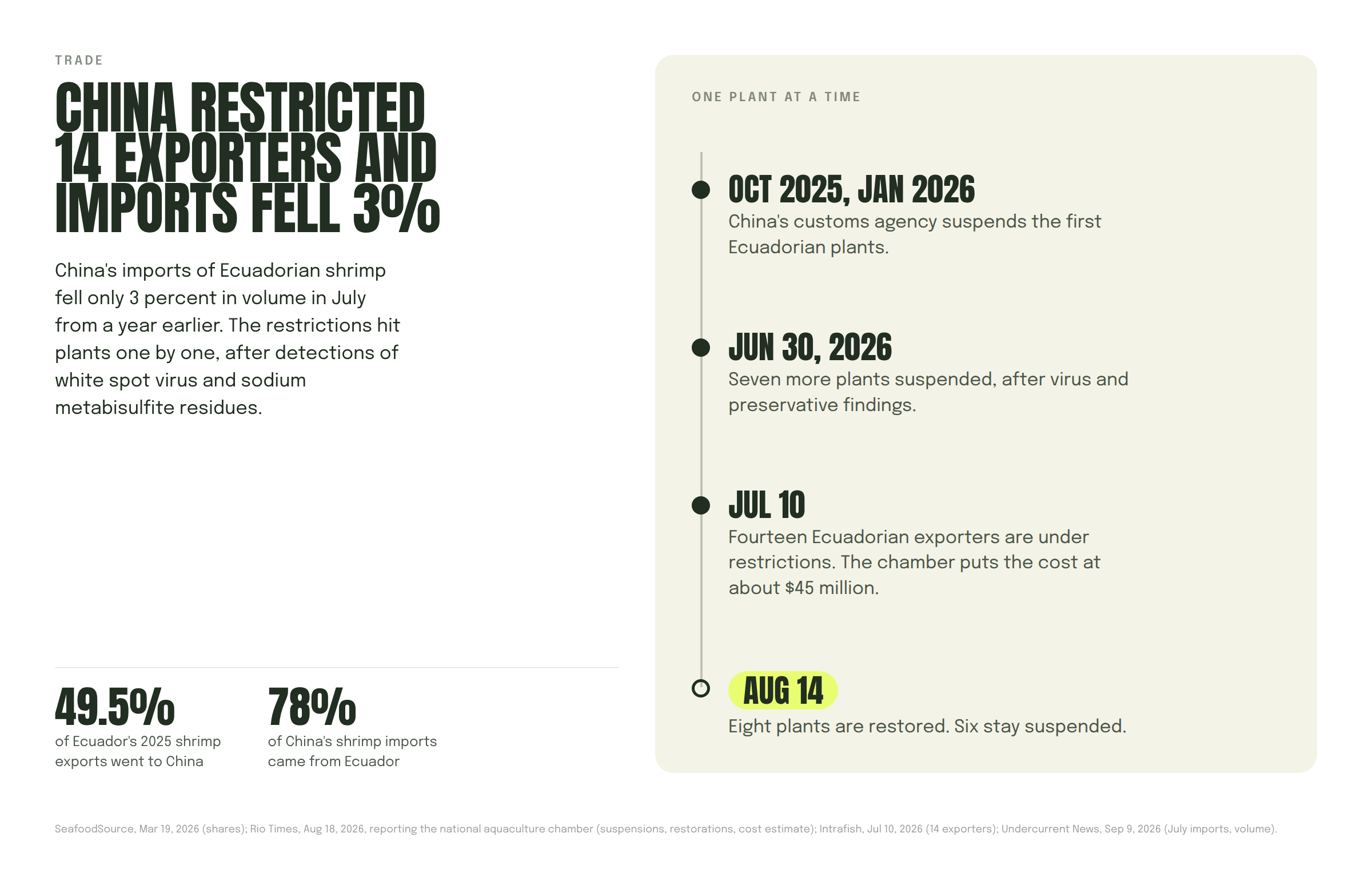
China bought 49.5 percent of Ecuador's shrimp exports in 2025, and Ecuador supplied 78 percent of China's shrimp imports, according to the Ecuadorian chamber. China restricts that trade one plant at a time.
China's customs agency suspended some Ecuadorian plants from October 2025 and others from January 2026. On June 30 the agency suspended seven more, after detections of white spot virus and residues of sodium metabisulfite, a preservative, in frozen shrimp. Exporters and Ecuador's authorities say the findings rose after China changed how it tests shrimp. By July 10, fourteen Ecuadorian exporters were under restrictions, and the chamber put the cost at about $45 million for the year to July 13. The chamber insisted that "This does not constitute a closure of the Chinese market," and the volumes agreed: China's imports from Ecuador fell only 3 percent in July from a year earlier. On August 14, customs restored eight plants. Six stayed suspended.
The risk in the American market is political. In late 2025, with a 50 percent tariff on Indian shrimp against 15 percent on Ecuadorian, Ecuador briefly overtook India as the largest shrimp supplier to the US, according to USDA data cited by S&P Global. The Supreme Court struck down those tariffs, imposed under emergency powers, on February 20, and a flat surcharge with no country-specific rates replaced them. Ecuador kept growing there anyway. Through July it supplied 40 percent of US frozen warmwater shrimp imports by volume, the largest share of any country, according to the office of Senator Cindy Hyde-Smith. The same office announced S. 5613, a bill that would raise US tariffs on Ecuadorian shrimp in steps to 40 percent in 2029. It has been introduced and has not become law.
Three months to a glut
A salmon needs more than two years to reach market size. A shrimp needs three to four months. Novel Sharma, a seafood analyst at Rabobank, used that gap at the forum to explain why the two industries behave differently: a salmon farmer cannot answer a price signal for years, and an Ecuadorian farmer can answer one within a single crop.
Ecuador shipped 1.39 million metric tons in 2025, 15 percent more than the year before, according to Rabobank's Gorjan Nikolik. Sharma put Norway's salmon exports at about the same volume. Shrimp has passed oil as Ecuador's largest export.
Prices have softened in 2026. In mid-August, large Ecuadorian shrimp for cooking and distribution in Europe fell to a two-year low, according to Undercurrent News. Henrik Aarestrup of the feed maker BioMar pointed to oversupply when asked what worries him, because a country this good at adding capacity can flood its own market. He named a second danger as well: a producer who raises densities to defend margin when prices fall, in a country where the water systems are connected. Allan Cooper of the feed maker Vitapro estimates that output could grow 7 to 10 percent a year for the next five years, adding several hundred thousand metric tons. The industry has not settled whether buyers will take it.
Warm water, then rain
The 1998 record came with warm water, and the warm water is back. What it does to a pond depends on how fast conditions change. Warm water holds less dissolved oxygen, while shrimp need more of it as the temperature rises. Heavy rain can cut a pond's salinity quickly, or flood the pond. Reinout van den Born, a meteorologist who briefed the forum on El Niño, said a warmer ocean can help shrimp growth early on, and that parts of coastal Ecuador can also get very heavy rain in a strong El Niño. Stability matters most, since shrimp, he said, "have much more difficulty when those conditions change quickly." A pond that takes a sudden salinity drop from that rain is the kind whose microphone records a quieter day or two.
NOAA's September 10 discussion gave a 75 percent chance that October to December would exceed every El Niño since 1950, measured as a three-month index of +2.5 degrees or more. NOAA also noted that impacts become more likely with an event of this size, though they are not guaranteed. Its next update is due on October 8.
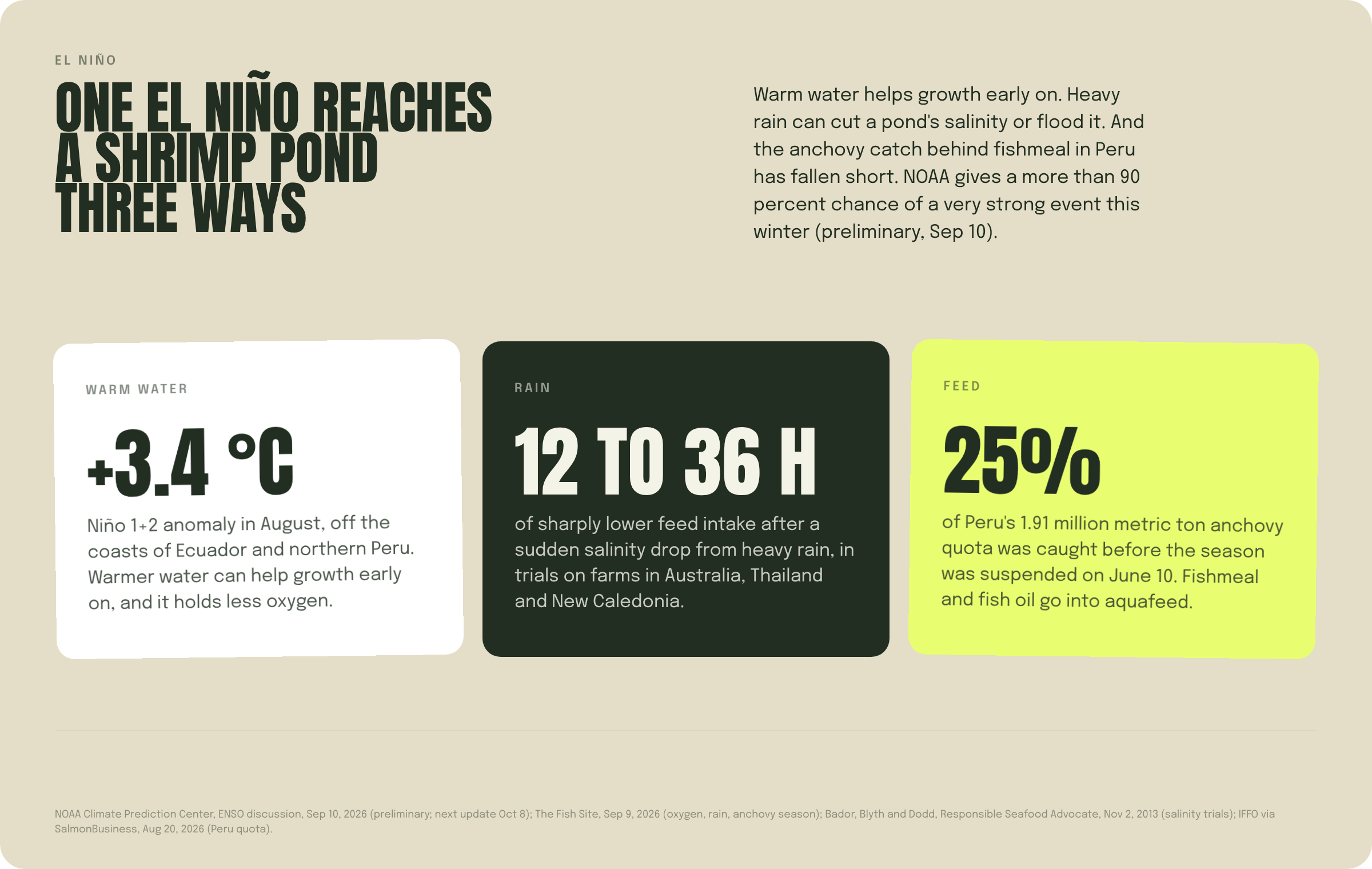
The warming reaches the feed as well. Peru normally produces about a fifth of the world's fishmeal. Its first anchovy season this year, with a quota of 1.91 million metric tons, was suspended on June 10 with about a quarter of the quota caught, according to the industry body IFFO. Fishmeal and fish oil go into aquafeed.
Shrimp farmers elsewhere face different problems from the same ocean. A strong El Niño raises the risk of a weaker or more irregular monsoon in India, which means less water for ponds, van den Born said. In Vietnam, a dry spell can let seawater move further up the Mekong, raising salt levels in the delta while temperatures climb. A buyer with suppliers in Ecuador, India and Vietnam reads one NOAA bulletin and gets three different answers.
The signals in this story sit in five places that publish them: a Chinese customs notice about plants, a bill in the US Senate, a trade-press price report, a NOAA bulletin and a Peruvian fishing quota. Each updates on its own calendar, and none of them mentions a buyer. Whether a sourcing team hears them together depends on someone remembering to check all five, and nobody records whether that happened. At Finches we put public signals like these next to what a company actually buys, so a buyer can see which of them reach its own suppliers.
Finches builds the intelligence layer for agricultural sourcing.
Notes on facts and sources
Every number in the post traces to a source below. Where sources disagree, the difference is stated. Figures that depend on a forecast are labeled preliminary.
1998 and the virus. Exports rose 5.4 percent to 114,754 tons in 1998, credited to El Niño warm water; revenue fell 1.2 percent to $875 million from $886 million on falling world prices; the quote from the head of the national shrimp chamber; about 250,000 people employed and employment cut by 15 to 20 percent; the virus apparently came from Asia and the industry did not know how it arrived: Reuters via MarineLink, November 5, 1999. Reuters gives "tons"; the Responsible Seafood Advocate gives nearly 115,000 metric tons for 1998, which matches. Exports of 37,700 metric tons in 2000: Yahira Piedrahita, National Chamber of Aquaculture, Responsible Seafood Advocate, June 25, 2018.
Ecuador in 2025. 1,394,411 metric tons, up 15 percent: Shrimp Insights, citing national export data and Undercurrent News, February 5, 2026, quoting Rabobank's Gorjan Nikolik. "About 37 times" is 1,394,411 divided by 37,700; both are export volumes. Shrimp overtook oil as the top export: Reuters, February 16, 2026. The post uses volume only, because the 2025 value differs by source: $8.4 billion in Reuters, quoting the head of the aquaculture association, and $7.47 billion for farmed shrimp in SeafoodSource, March 19, 2026.
Global Shrimp Forum. Camposano's quote, Luna's stocking range of 8 to 20 shrimp per square meter, the 230,000 hectares, Arosemena's 15 to 20 feedings an hour, Sharma's comparison of salmon (more than two years) and shrimp (three to four months) and the volume of about 1.3 million metric tons each in 2025, Aarestrup on oversupply and densities, and Cooper's 7 to 10 percent: The Fish Site, September 7, 2026. Van den Born on oxygen, salinity, the quote, India and Vietnam, and Peru's anchovy season: The Fish Site, September 9, 2026.
Open, thinly stocked ponds. Open, low-density systems and disease-resistant animals instead of intensive systems and pathogen-free lines; breeding from survivors: Piedrahita, Responsible Seafood Advocate, June 25, 2018.
Acoustic feeding. Turbid water, ponds of up to 20 hectares and several million animals, the hydrophone and filtering software, the check against feed trays, acoustic cameras and underwater cameras, one hydrophone for several feeders, and the 12 to 36 hour fall in feed intake after a sudden salinity drop in trials in Australia (from 2010), Thailand (2011) and New Caledonia (2012): Bador, Blyth and Dodd, Responsible Seafood Advocate, November 2, 2013. Two of the three authors work for companies in the field, and Dodd runs AQ1 Systems, which sells acoustic feeding systems. The controller adjusting the ration and acoustic feeders in operation in Ecuador and Southeast Asia: Darodes de Tailly et al., Reviews in Aquaculture, 2021. Sound from the shrimp's jaws, and the study of 639 commercial ponds in Guayas province from 2018 to 2020: Molina Poveda and Espinoza Ortega of Skretting Ecuador, Responsible Seafood Advocate, May 24, 2021.
Prices. Large Ecuadorian vannamei for cooking and distribution in Europe at a two-year low in week 33: Undercurrent News, August 14, 2026. The headline says "historical lows"; the body text says a two-year low, which is what the post uses.
China. Share of exports (49.5 percent) and of China's imports (78 percent): SeafoodSource, March 19, 2026. Suspensions from October 2025 and January 2026, seven plants from June 30, the detections, the testing change, eight plants restored on August 14, six still suspended, and the $45 million estimate as of July 13: Rio Times, August 18, 2026, reporting the chamber's statements. That outlet's articles are produced by an automated newsroom system. Fourteen exporters under restrictions by July 10: Intrafish, July 10, 2026. The chamber's quote from its July 9 statement: SeafoodNews, July 17, 2026. China's imports from Ecuador down 3 percent in volume in July: Undercurrent News, September 9, 2026. Outlets count exporters, companies and plants differently, so the post uses each outlet's own unit. We did not find the Chinese customs notice itself.
United States. Ecuador briefly passing India in late 2025, the 15 and 50 percent tariffs, citing USDA: S&P Global Commodity Insights, February 11, 2026. The Supreme Court ruling of February 20, 2026 and the flat surcharge without country-specific rates: Global Trade Alert, February 2026. The 40 percent import share through July 2026 and S. 5613, as announced by Senator Hyde-Smith's office: Aqua Culture Asia Pacific, October 5, 2026. The 40 percent share is the senator's office's figure, which it describes as Ecuador overtaking India for the first time over the first seven months.
El Niño (preliminary). More than 90 percent chance of a very strong event in fall and winter 2026-27, Niño 1+2 at +3.4 degrees Celsius in August, a 75 percent chance that October to December exceeds all events since 1950 (+2.5 degrees or more, three-month index), the caution that impacts are likely but not guaranteed, and the next discussion on October 8, 2026: NOAA Climate Prediction Center, September 10, 2026. The Niño 1+2 region covers 0 to 10 degrees south and 90 to 80 degrees west: NOAA Climate Diagnostics Bulletin. The figures must be refreshed after the October 8 update.
Peru. Quota of 1,914,049 metric tons, suspended on June 10 with about 25 percent caught, and Peru's roughly 20 percent share of global fishmeal: IFFO via SalmonBusiness, August 20, 2026 and Fish Farming Expert. Quota set by the Peruvian Production Ministry, resolution 000085-2026-PRODUCE: Infobae, April 1, 2026.
