
The wells under the concrete: what Huelva's strawberry water actually depends on
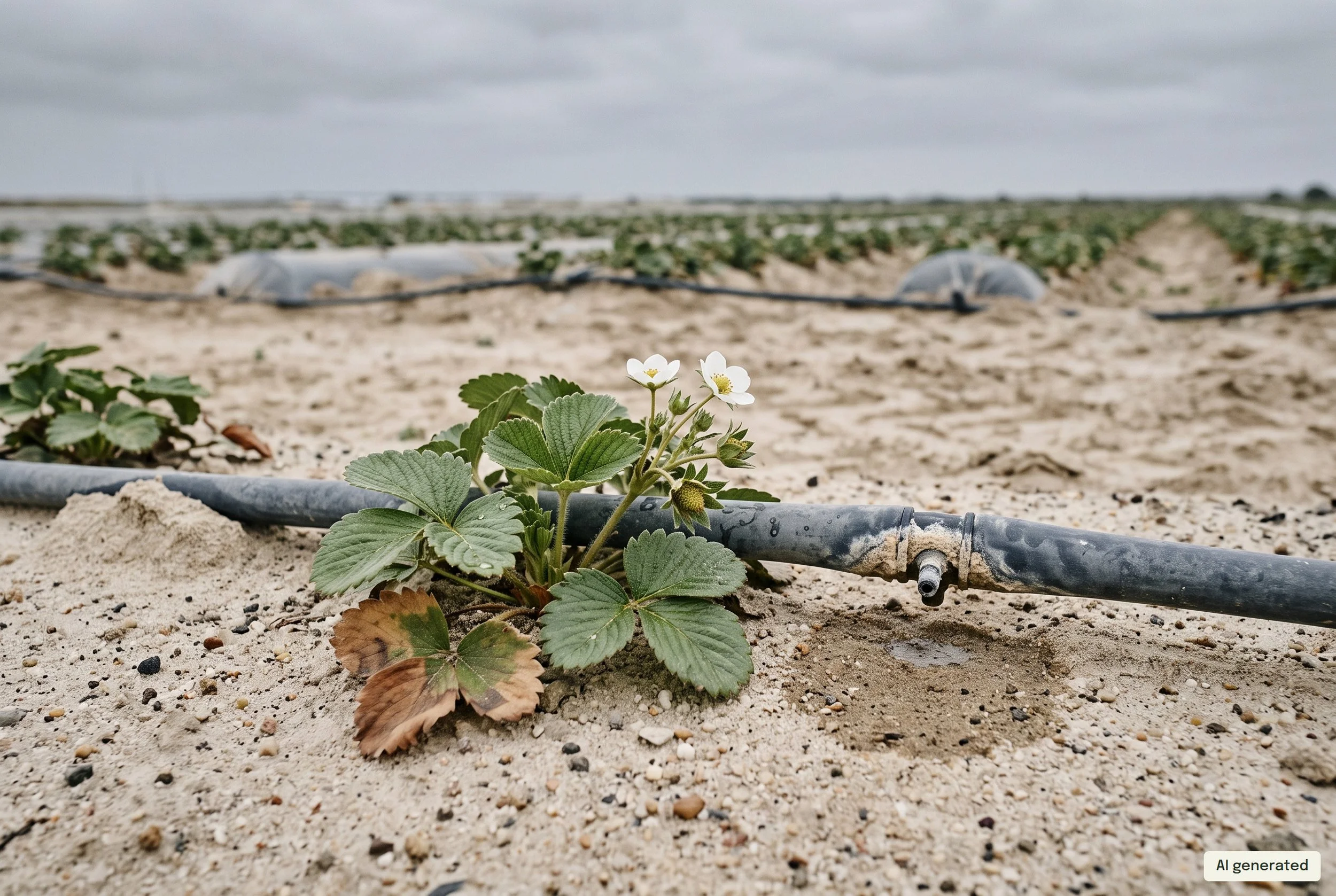
On a plot called El Pantanar, in Rociana del Condado, someone had poured a concrete slab over three wells. Underneath it, pumps were lifting groundwater into 7.25 hectares of berries growing outside any authorised irrigation zone. The basin authority had sanctioned the operator once already, in 2020, and been ignored. In May 2026 its inspectors broke the slab and sealed the wells.
That scene is the version of Huelva most people carry: Europe's winter strawberry basket quietly draining a wetland. It is accurate. It is also, as of this year, the wrong place to be looking.
Five weeks after the concrete came up, on 10 June 2026, the same authority told the irrigators who draw on La Rocina, the groundwater body that supports almost every berry farm in the province, that they could pump through the 2026/27 campaign with no reduction at all. The season before had run under a 15 per cent cut. Non-regularised irrigated area was reported at a historic low of around 300 hectares. Two consecutive hydrological years of above-average recharge had lifted the water table across the whole body.
Read those two events as a story about enforcement working and you would conclude that the Doñana water problem is closing. Read the engineering behind them and you get a different answer.
TWO KINDS OF WATER
Huelva grows the fruit that fills European shelves between December and early June, when nothing ripens further north. Andalusia accounts for more than 96 per cent of Spanish strawberry production, and almost all of it sits in this one province, in the sand north and west of the Doñana marshes. The province produces 98 per cent of Spain's berries and close to 30 per cent of the European Union's.
There are two entirely separate water systems under that sentence, and they are easy to confuse because both are reported as "water in Huelva".
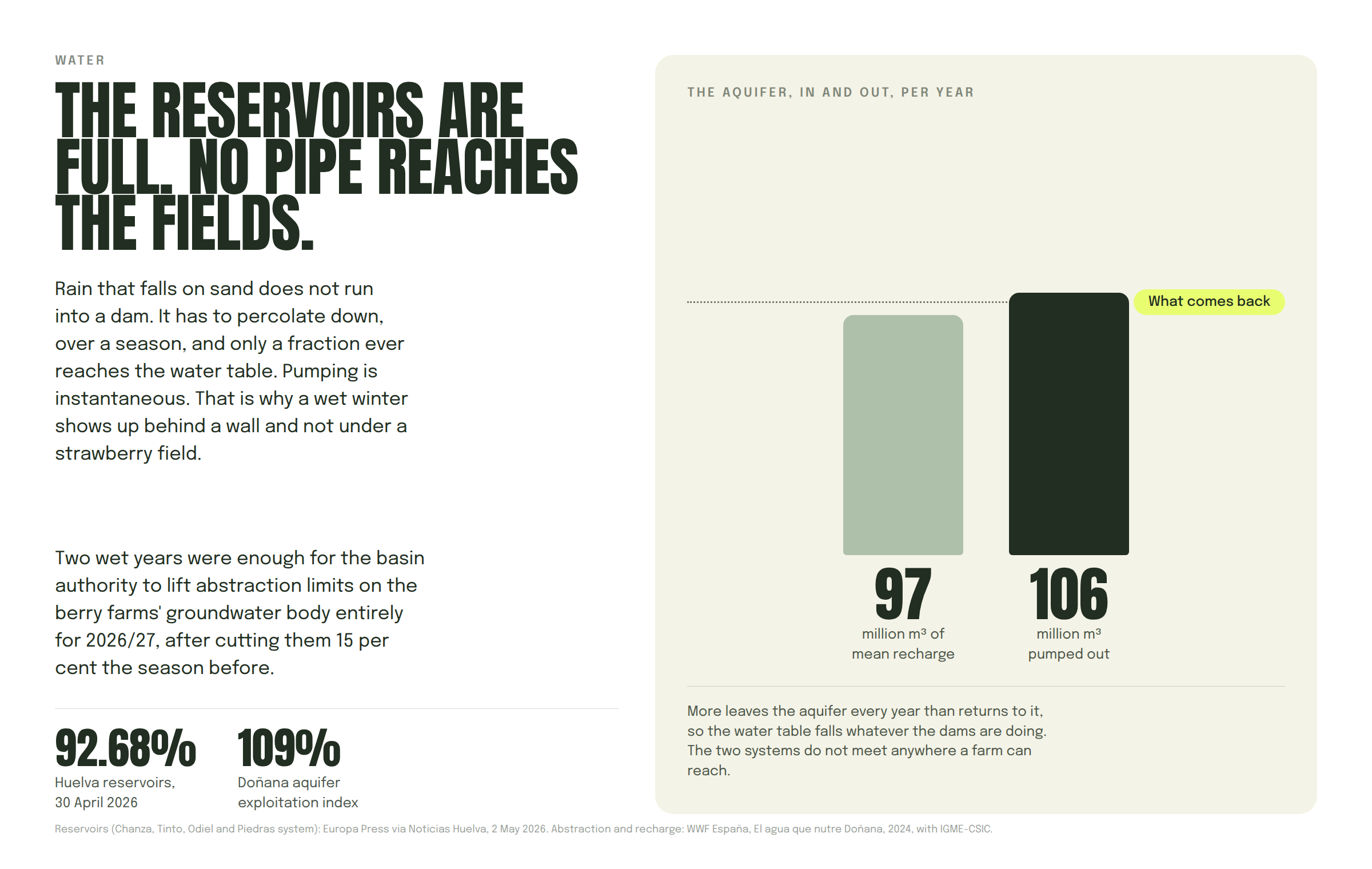
The first is surface water. Rain falls on the province, runs off, and is held behind walls in the Chanza, Tinto, Odiel and Piedras reservoirs. On 30 April 2026 those reservoirs held 1,035 million cubic metres against a capacity of 1,138, which is 92.68 per cent full and roughly 193 million cubic metres more than a year earlier. Anyone checking dam levels before signing a contract would stop reading there.
The second is the aquifer, and the berry farms in the Doñana ring pump from it. Rain that lands on sand does not run anywhere. It has to percolate down, slowly, and only a fraction of it ever reaches the water table. Pumping is instantaneous; recharge takes a season and delivers a fraction of what fell. WWF España, in a 2024 report co-authored with a hydrogeologist from the Spanish geological survey, put total abstraction at more than 106 million cubic metres a year against 97 million of mean recharge, an exploitation index above 109 per cent. A full reservoir does nothing for that number, because the two systems do not meet anywhere a farm can reach.
Which is why the wells mattered so much for so long. WWF counted close to a thousand illegal wells around the park in 2009, and by 2012 the Junta's own figure was a thousand against growers' own estimate of two thousand, with only about a third of the irrigated area properly permitted. The 2023 bill that would have legalised the situation covered around 1,900 hectares, roughly 15 per cent of the province's berry footprint. It was suspended in October 2023, never formally withdrawn, in exchange for central government money.
THE PIPE THAT IS NOT THERE
Enforcement since 2019 has been real. The basin authority counts 1,214 irregular abstractions handled, and the area under plastic outside authorised zones fell from around 700 hectares in late 2024 to roughly 547 by spring 2025 on the ministry's own numbers. WWF, measuring by satellite rather than by case file, still put illegal irrigation at around 1,180 hectares a year after the pact, and notes it has not been below a thousand since 2014. Both figures are published. They are counting different things, and no reconciliation exists.
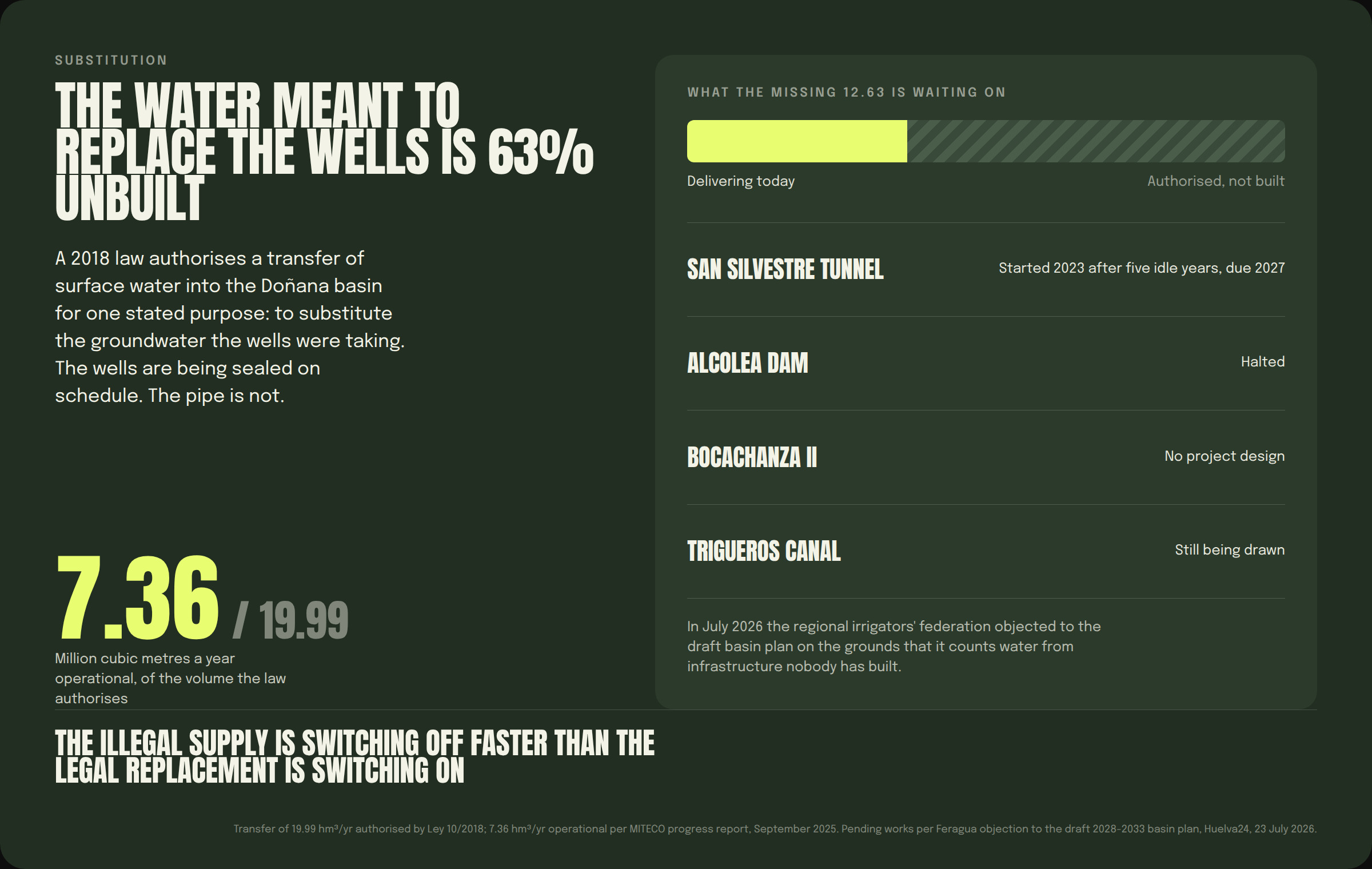
The part that matters commercially is what was supposed to replace the water. A 2018 law authorises the transfer of 19.99 million cubic metres a year from the Tinto, Odiel and Piedras demarcation into the Guadalquivir demarcation, for the specific purpose of substituting Doñana groundwater. That is the deal: the wells close, the pipe delivers, the fruit keeps growing.
Of those 19.99 million cubic metres, 7.36 are operational. The remaining 12.63, 63 per cent of the legal entitlement, wait on the duplication of the San Silvestre tunnel, a 70.6 million euro job that sat untouched for five years before works started in September 2023 and is now expected to finish in 2027. Behind it sit three more pieces that do not exist: the Alcolea dam is halted, Bocachanza II has no project design, the Trigueros canal is still being drawn. In July 2026 the regional irrigators' federation formally objected to the draft 2028 to 2033 river basin plan on the grounds that it counts water from infrastructure nobody has built, and asked for it not to be counted before 2033.
Meanwhile the buy-out that is supposed to shrink demand pays 70,000 euro a hectare to stop cultivating for thirty years, rising to 100,000 in the five northern municipalities. By September 2025, roughly halfway through the four-year framework, 81.28 million euro of the 393.22 million euro environmental budget had actually been executed, 20.67 per cent. The Junta only opened public consultation on the farmer aid rules in November 2025.
So the position in August 2026 is a region where the illegal supply is being switched off faster than the legal replacement is being switched on, and where two wet years have made the gap invisible. The 10 June decision to lift restrictions was correct on the hydrology in front of it. It was not a statement about 2029.
At Finches we spend our days on the distance between a signal and the desk where it would change a decision, so take this as our observation rather than a claim about anyone's procurement. All of the above was public before anyone opened a contract negotiation. It was public in four different places: a basin authority board minute, a ministry progress report in PDF, an irrigators' federation objection to a draft river basin plan, and a satellite study by an environmental NGO. No sourcing team has a job description that covers reading all four on the same morning, and none of them arrives labelled as a strawberry risk.
WHAT ACTUALLY MOVED THE NUMBERS
None of the water story is what hit the 2026 season. Storms did.
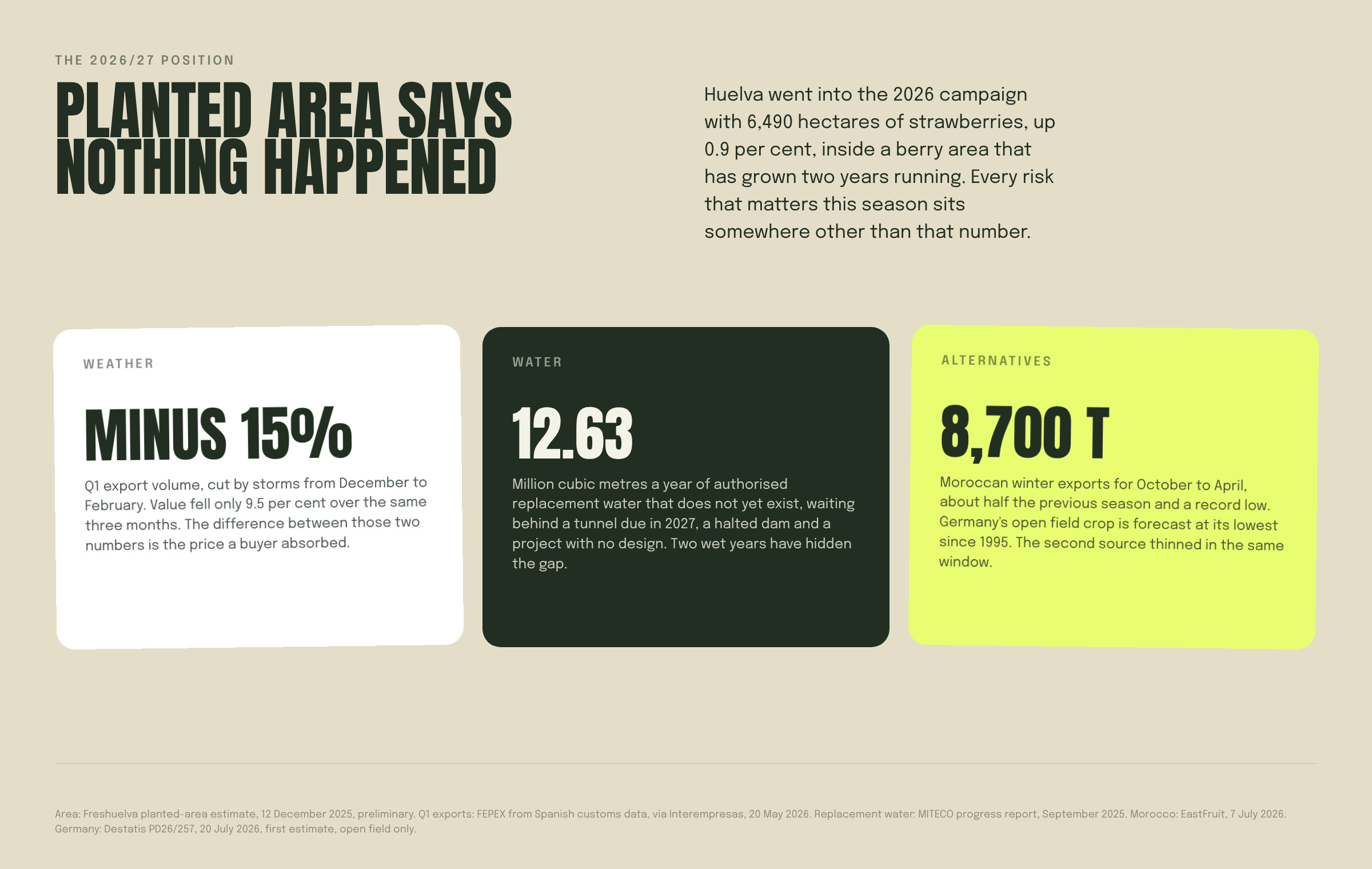
Between December 2025 and February 2026 successive weather systems ran over Huelva, damaging fruit and greenhouse structures. Spanish strawberry exports in the first quarter fell 15 per cent by volume, to 93,989 tonnes against 109,982 a year earlier. Export value over the same three months came to 418 million euro, down 9.5 per cent.
Hold those two percentages next to each other. Volume fell 15 per cent and value fell 9.5 per cent, and the difference is the price rise that somebody on the buying side absorbed. A shortfall in a field reaches a buyer as unit cost long before it reaches anyone as an empty shelf.
Then the crop caught up. By early May, production was running 17 per cent above the same point of 2025, and prices fell below the cost of picking. The full campaign closed at 204,035 tonnes of strawberries, down 3 per cent. The fruit was late, not missing, and a buying position built in February against a 15 per cent shortfall was holding the wrong risk by May.
The alternatives thinned in the same window. The German open field harvest was forecast on 20 July at 71,300 tonnes, down 11.3 per cent and the lowest since 1995, off 7,830 hectares. Moroccan fresh strawberry exports for October 2025 to April 2026 came in at 8,700 tonnes, about half the previous season, a record low and the fourth consecutive year of decline. Dutch glasshouse fruit runs year round with predictable calibre, at a cost per kilogram that keeps contracted volumes small.
AREA IS THE WRONG NUMBER TO WATCH
Anyone tracking Huelva through planted hectares will see nothing at all. Freshuelva's estimate for the 2026 campaign put strawberries at 6,490 hectares, up 0.9 per cent, inside a total berry area of 12,388 hectares, itself up 1 per cent. Area has grown in each of the last two campaigns. Whatever the well closures have done, they have not shown up here.
The movement is inside those hectares. In the 2025/26 variety survey, Red Sayra led the planted material at 13.5 per cent and Marisma followed at 13.2, while Fortuna, for years the reference variety of the region, fell to 1.1 per cent from 10.5 two seasons earlier. Calibre, firmness and shelf life are properties of a variety. A specification agreed against the old mix drifts out of alignment with the fruit in the box while the area statistic stays flat.
The regulatory calendar moves the same way, quietly and on its own clock. Formetanate's EU approval was set to expire on 30 September 2026, and any quality team building a 2027 supplier questionnaire in the spring was working to that date. On 28 July 2026 the Commission moved it to 30 September 2027. Nothing about the substance was resolved; the question was rescheduled, and every document written against the old date now points at the wrong year. The date that did not move is 1 January 2027, when new EU rules replace a 2002 directive and change how residues are sampled, how laboratories handle measurement uncertainty, and how a result is interpreted. The residue in the fruit is a fact about the fruit. Whether a given laboratory number counts as a deviation becomes a different question at the start of next year, with the fruit unchanged.
And the political clock runs above all of it. At its session in Busan in July 2026 the World Heritage Committee took Doñana up again, asked Spain to report by 1 February 2027, and used the language that precedes a listing as World Heritage in Danger. Recovery programmes for two of the three affected groundwater bodies are still awaiting approval.
Finches watches origins like Huelva continuously, so the calendar arrives before the negotiation does.
Notes on facts and sources
Compiled 14 August 2026. Figures marked preliminary are first estimates and will be revised.
Wells, enforcement and the Doñana pact
Three wells concealed under a concrete slab at El Pantanar, Rociana del Condado, sealed by the Guadalquivir basin authority in May 2026, irrigating 7.25 hectares of berries outside authorised zones, after a 2020 sanction was ignored: Agrodigital, 11 May 2026. https://www.agrodigital.com/2026/05/11/chg-clausura-pozos-ilegales-donana/
Close to a thousand illegal wells reported by WWF in 2009: Servimedia, 20 July 2009. https://www.servimedia.es/noticias/wwf-denuncia-donana-tiene-casi-mil-pozos-ilegales/1411385013
Junta figure of 1,000 illegal wells against growers' own estimate of 2,000, and roughly one third of irrigated area permitted: WWF España, El Robo del Agua, via iAgua, 6 March 2012. https://www.iagua.es/noticias/donana/12/03/06/el-robo-del-agua-en-donana-un-informe-de-wwf-15051
Around 1,900 hectares covered by the 2023 regularisation bill: WWF via COPE, 26 April 2023. https://www.cope.es/actualidad/sociedad/noticias/wwf-alerta-que-proposicion-ley-sobre-donana-permitiria-legalizar-cerca-1900-hectareas-cultivos-20230426_2677098
Bill suspended, not withdrawn, on 3 October 2023 in exchange for central government funding: eldiario.es, 3 October 2023. https://www.eldiario.es/andalucia/gobierno-junta-andalucia-enterrar-ley-regadios-donana-trabajar-alternativas-negociar_1_10567301.html
1,214 irregular abstractions handled since 2019; plastic crop area outside authorised zones at roughly 547 hectares in spring 2025; 81.28 million euro of a 393.22 million euro environmental budget executed, 20.67 per cent, as of September 2025: MITECO, Marco de Actuaciones para Doñana, Marco Medioambiental, informe de avances, published 14 October 2025. https://www.miteco.gob.es/content/dam/miteco/es/prensa/20251014_M1_AVAN.SEPT.25.pdf
Roughly 700 hectares outside legal irrigation zones and the 1,197 wells closed to December 2024, of which 476 were legal wells closed on surface-water substitution: Europa Press via iAgua, 8 January 2025. https://www.iagua.es/noticias/europa-press/precintados-diciembre-55-tomas-agua-riego-y-cerrados-1197-pozos-entorno-donana
Roughly 1,180 hectares of illegal irrigation one year after the pact, never below 1,000 hectares since 2014, nearly 80 per cent of it berries: WWF España via Público. https://www.publico.es/sociedad/donana-limite-casi-tres-lustros-anos-humedos-mil-hectareas-regadio-ilegal.html The basin authority's case-file count and WWF's satellite measurement are not reconciled with each other; both are reported here as published.
Doñana framework agreement of 27 November 2023, 1,434 million euro over 2023 to 2027; 70,000 euro per hectare to cease cultivation for 30 years, 100,000 in the five Corona Norte municipalities: Junta de Andalucía. https://www.juntadeandalucia.es/organismos/sostenibilidadymedioambiente/servicios/actualidad/noticias/detalle/465487.html
Farmer aid rules opened for public consultation in November 2025: Andalucía Información, 18 November 2025. https://www.andaluciainformacion.es/articulo/huelva/junta-somete-informacion-publicas-bases-ayudas-agricultores-donana/202511181027533169511.html
Water: reservoirs, aquifer and the transfer
Huelva reservoirs at 92.68 per cent of capacity (1,035.05 hm³ of 1,138 hm³) on 30 April 2026, against 842.46 hm³ a year earlier: Europa Press via Noticias Huelva, 2 May 2026. https://www.noticiashuelva.com/2026/05/02/los-embalses-de-huelva-se-encuentran-al-9268-de-su-capacidad-lo-que-representa-un-incremento-del-2286-respecto-al-ano-anterior/ This is the Chanza, Tinto, Odiel and Piedras system, not every reservoir in the province, and it is a 30 April snapshot; levels stood near 80 per cent on a wider basis in early August 2026.
Exploitation index above 109 per cent, more than 106 hm³ of abstraction against 97 hm³ of mean recharge: WWF España, El agua que nutre Doñana, 2024, co-authored with Carolina Guardiola-Albert of IGME-CSIC. https://wwfes.awsassets.panda.org/downloads/el-agua-que-nutre-donana.pdf
Three groundwater bodies of the Almonte-Marismas system declared at risk of failing good quantitative status, La Rocina also on chemical status: Guadalquivir basin authority resolution of 31 July 2020, published 24 August 2020, BOE-B-2020-26925. https://www.boe.es/boe/dias/2020/08/24/pdfs/BOE-B-2020-26925.pdf
La Rocina recovery programme, abstraction ceiling of 36.44 hm³ per year, in force from 20 August 2025 to at least 31 December 2027: BOE-B-2025-29917, published 19 August 2025. https://www.boe.es/diario_boe/txt.php?id=BOE-B-2025-29917 The 15 per cent reduction for 2025/26 was announced in July 2025 and formally agreed by the exploitation board on 9 September 2025.
No reduction for 2026/27, agreed by the La Rocina exploitation board on 10 June 2026 and subject to ratification by the basin authority governing board; non-regularised irrigated area reported at a historic low of around 300 hectares; 174 smart meters and 584 digitalised extraction points: Andalucía Información, 10 June 2026. https://www.andaluciainformacion.es/articulo/huelva/usuarios-rocina-podran-regar-restricciones-gracias-recarga-acuifero/202606101738523400217.html
Transfer of 19.99 hm³ per year authorised to substitute Doñana groundwater: Ley 10/2018 of 5 December 2018, BOE-A-2018-16675. https://www.boe.es/diario_boe/txt.php?id=BOE-A-2018-16675
Only 7.36 hm³ per year operational, 12.63 hm³ pending the San Silvestre tunnel duplication and associated works: MITECO progress report, September 2025 (link above).
San Silvestre tunnel, 70.6 million euro, works started September 2023 after five years of inaction, 30-month schedule: eldiario.es. https://www.eldiario.es/andalucia/huelva/arranca-anos-espera-tunel-san-silvestre-obra-clave-trasvasar-agua-donana-aliviar-acuifero_1_10514359.html
Feragua objection to the draft 2028 to 2033 Tinto-Odiel-Piedras plan on the grounds that it counts the Alcolea dam (halted), Bocachanza II (no project design) and the Trigueros canal (in design): Huelva24, 23 July 2026. https://www.huelva24.com/provincia/futuro-plan-tinto-odiel-piedras-bajo-lupa-20260723195446-nth.html
UNESCO World Heritage Committee 48th session, Busan, 19 to 29 July 2026, draft decision 48 COM 7B.83: reporting deadline 1 February 2027, danger-listing language, recovery programmes for two of the three affected groundwater bodies still pending approval. Draft decision text WHC/26/48.COM/7B, 5 June 2026. https://whc.unesco.org/document/226098 The adopted decision text has not yet been published individually by the World Heritage Centre; this is cited from the draft and from reporting out of the session.
Volume, value and origins
Andalusia at more than 96 per cent of Spanish strawberry production: Junta de Andalucía, Observatorio de Precios y Mercados, Datos básicos Fresa 2024/25.
Huelva at 98 per cent of Spain's berries and close to 30 per cent of the EU's: Freshuelva. https://freshuelva.es/la-provincia-de-huelva-produce-el-98-de-los-berries-de-espana-y-cerca-del-30-de-la-union-europea/ This figure covers berries collectively, not strawberries alone.
Q1 2026 Spanish strawberry exports of 93,989 tonnes, down 15 per cent from 109,982 tonnes, value 418 million euro, down 9.5 per cent, with successive storms from December to February given as the cause: FEPEX from Spanish customs data, via Interempresas, 20 May 2026. https://www.interempresas.net/Horticola/632453-Espana-exporta-mas-hortalizas-menos-frutas-primer-trimestre-que-descendio-1-por-ciento.html Storm attribution corroborated by Fruitnet. https://www.fruitnet.com/eurofruit/huelva-berry-exports-fall-as-storms-affect-production/272145.article
Production running 17 per cent above the previous year by early May 2026, with prices below cost: Junta de Andalucía Observatorio de Precios y Mercados via FreshPlaza. https://www.freshplaza.com/north-america/article/9840589/final-stretch-of-spanish-strawberry-season-has-been-terrible/
Full 2025/26 campaign strawberry production of 204,035 tonnes, down 3 per cent: Freshuelva via Interempresas, 14 July 2026. https://www.interempresas.net/Horticola/658570-borrascas-merman-campana-frutos-rojos-2025-2026-reduciendo-produccion-exportaciones.html
German open field strawberry harvest 2026 of 71,300 tonnes, down 11.3 per cent and the lowest since 1995, off 7,830 hectares, down 2.9 per cent: Destatis press release PD26/257, 20 July 2026, first estimate, open field only, preliminary. https://www.destatis.de/DE/Presse/Pressemitteilungen/2026/07/PD26_257_412.html
Moroccan fresh strawberry exports of 8,700 tonnes for October 2025 to April 2026, about half the previous season, a record low and the fourth consecutive season of decline: EastFruit, 7 July 2026. https://east-fruit.com/en/trending/morocco%E2%80%99s-fresh-strawberry-exports-collapse-to-a-record-low/ Trade analysis rather than Moroccan customs data.
Area, varieties and regulation
Huelva strawberry area of 6,490 hectares for the 2026 campaign, up 0.9 per cent, within 12,388 hectares of total berry area, up 1 per cent: Freshuelva via Interempresas, 12 December 2025, preliminary. https://www.interempresas.net/Horticola/617220-Freshuelva-preve-aumento-del-1-por-ciento-en-superficie-cultivada-de-berries-con-12388.html Berry area also rose 4 per cent for the 2025 campaign: FEPEX. https://www.fepex.es/noticias/detalle/incremento-4-superficie-berries-2025
Variety shares for 2025/26, Red Sayra 13.5 per cent, Marisma 13.2 per cent, Fortuna 1.1 per cent against 10.5 per cent in 2023/24: IFAPA with the Observatorio de Precios y Mercados, via Revista Mercados, 13 March 2026. https://revistamercados.com/red-sayra-se-convierte-en-la-variedad-de-fresa-lider-en-huelva/ Early plantings of the campaign.
Formetanate EU approval expiry of 30 September 2026: Commission Implementing Regulation (EU) 2025/99 of 21 January 2025. https://eur-lex.europa.eu/legal-content/EN/TXT/HTML/?uri=OJ:L_202500099 Moved to 30 September 2027 by Commission Implementing Regulation (EU) 2026/1826 of 28 July 2026. https://eur-lex.europa.eu/legal-content/EN/TXT/HTML/?uri=OJ:L_202601826
Sampling, analysis and interpretation rules applying from 1 January 2027 and repealing Directive 2002/63/EC: Commission Implementing Regulation (EU) 2026/765 of 1 April 2026. https://eur-lex.europa.eu/eli/reg_impl/2026/765/oj/eng
