
Supply Chains Are Too Slow to Act on the Risks They Already See
Every food manufacturer we talk to already knows their supply chain is exposed: Tariffs, weather, fertilizer shocks, a port strike halfway around the world, none of that is news anymore. The real damage often builds in the hours between the first sign of trouble and the first useful decision inside the business.
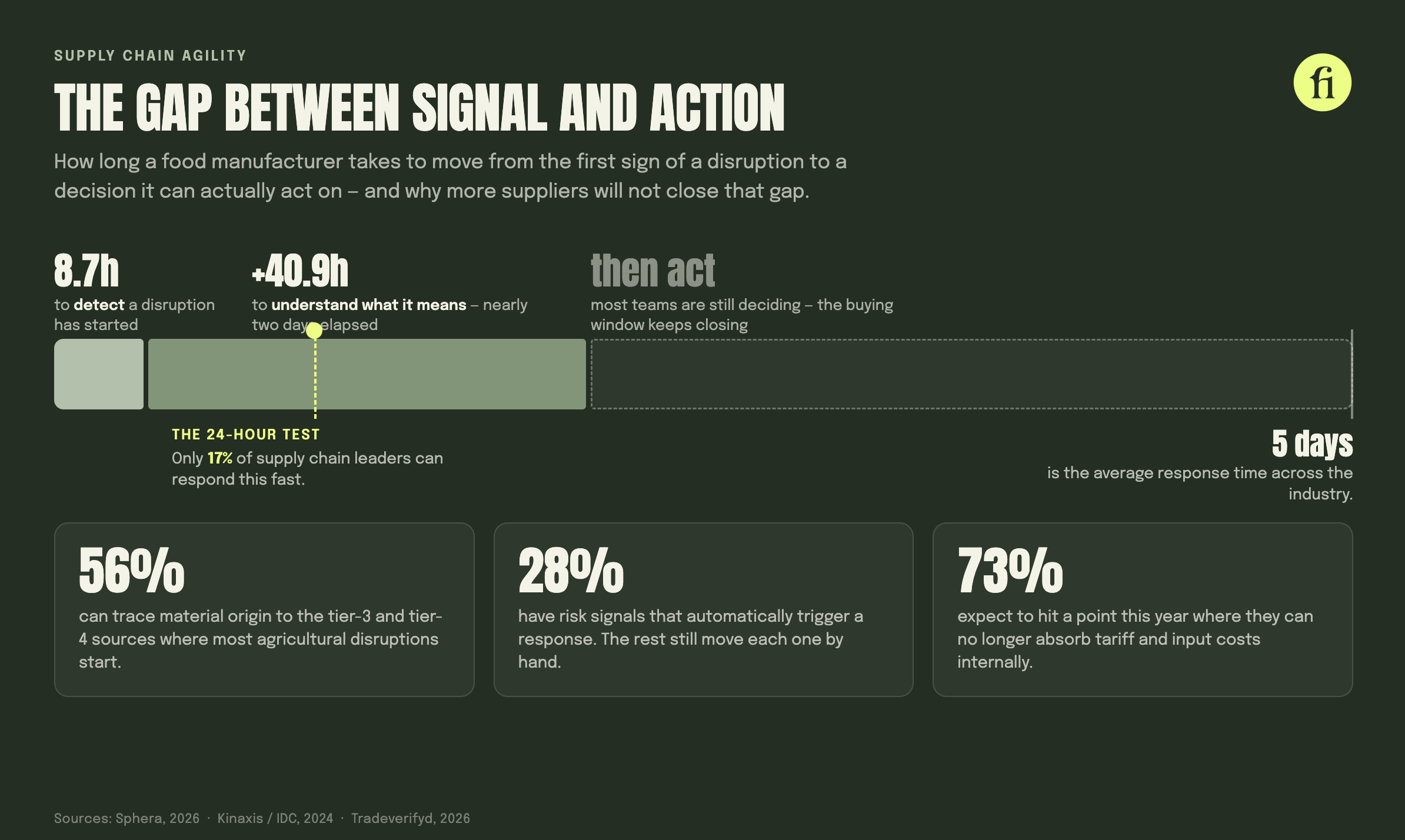
Recent research has started putting numbers around that delay. A recent Sphera study of 200 CFOs and COOs found that the average organization takes 8.7 hours just to detect that a disruption has started. After that, it takes another 40.9 hours, nearly two full days, to figure out what the disruption actually means for the business. Add it up and you've got the better part of two days where a company knows something happened but still has no idea what it means for the business. Sphera's CEO put it more bluntly than most vendors would: the gap between signal and action is where the revenue goes.
If you've ever sat in a Monday morning ops meeting trying to reconstruct why a shipment of a key ingredient didn't show up on Thursday, this will sound familiar. Nobody dropped the ball, exactly, the relevant information was probably sitting there three days before anyone connected it to the shipment. It just did not arrive in a usable form early enough for the production team to avoid a more expensive decision.
The 24-hour test almost nobody passes
Kinaxis and IDC ran a global survey of 1,800 supply chain leaders in 2023 and asked a simple question: can your organization respond to a disruption within 24 hours? Only 17% said yes. The average response time across the full sample was five days. Two-thirds of respondents said they weren't satisfied with how fast they could move. The frustration is clear: teams know they are moving too slowly, even when they cannot see an obvious way to speed up.
Five days might sound tolerable if you're shipping electronics components with a six-week lead time anyway. It is not tolerable if you're a food manufacturer working with perishables, seasonal harvest windows, or ingredients that come from a handful of growing regions with no real substitute. By the time a flour mill hears about a wheat shortfall five days late, the chance to secure alternative supply at a reasonable price is usually gone. Other buyers have already started calling the same suppliers.
The Gap in the Supply Chain Systems
Why agriculture adds more delay
Most supply chain software gets built for assembly-line thinking: parts, components, tier-1 suppliers you can call directly. But, agricultural inputs don't behave that way. A crop problem in Argentina or a fertilizer price spike from a shipping lane closure halfway across the world will not appear neatly in your ERP system. It usually arrives in fragments: a regional yield report, a trader’s update, a note from a cooperative, maybe a few more handoffs, before procurement ever sees it.
And that chain builds in delay before the information even becomes usable. When fertilizer costs spike, farmers respond by cutting application rates or switching to less input-intensive crops. That decision affects yield months later, and the price effect on food commodities typically shows up six to nine months after the original shock, according to analysis tracking the most recent fertilizer disruption. By the time the cost increase reaches a manufacturer's raw material invoice, the actual cause is old news to everyone except the people now paying for it.
In agricultural sourcing, late visibility can be almost as bad as no visibility. By the time the signal is clear, the buying window may already be gone. Tradeverifyd’s data points to the same problem: Only 56% of supply chain organizations can trace material origin down to tier-3 or tier-4 sources, the level where most agricultural disruptions actually originate. Worse, 93% of executives report high confidence in their overall oversight while naming those same tiers as their biggest blind spot. Teams can feel well informed while still having very little visibility into the part of the chain where the disruption usually starts. Adding another dashboard does not change how slowly the signal moves from the field to the people who need to act on it.
What faster reaction actually buys you
Fertilizer is a good example because the value of an early signal is easy to see. If your procurement team learns about a disruption to ammonia or urea exports within days, the response options are still wide: hedge forward contracts, diversify into a less-exposed growing region, adjust formulations before the cost actually lands on your books. If they learn about it six months later through a supplier price increase, the only options left are reactive ones, mostly absorbing the cost or passing it to customers. Tradeverifyd's 2026 data shows 73% of supply chain leaders expect to hit a point this year where they can no longer absorb tariff and input costs internally and have to pass them through. That ceiling exists for everyone. Companies have a better chance of avoiding that ceiling when they see the pressure building months before it reaches the invoice.
The workflow problem matters just as much: the Sphera study found that only 28% of organizations have risk signals that automatically trigger a response workflow. More than half are still running disruption response through manual or semi-integrated processes, meaning someone has to notice the signal, decide it matters, and then manually start the chain of actions that follows. Each handoff slows the response, and by the time the signal reaches the right person, it may not be any clearer than when it started.
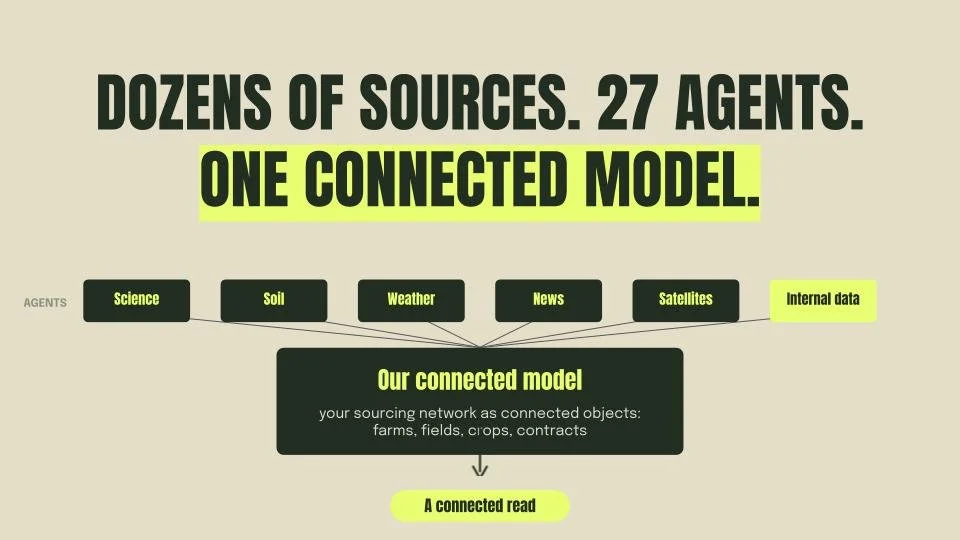
We've seen what this looks like on the ground with real ingredient categories. A buyer at a mid-size manufacturer doesn't need a satellite feed and a PhD in agronomy to make a better call on a sourcing decision. They need the few crop- and region-specific signals that actually change the sourcing decision, early enough to use them. The hardest part of building a system for this isn't filtering noise - it's recognizing connections. A weather pattern in one region, a soil report from another, a shift in news sentiment around a trade corridor: none of these mean much in isolation. A procurement team needs a model that reads them together, translates that complexity into what it means for a specific crop, region, and supplier relationship, and surfaces it before the buying window closes. That's what the agent architecture is designed to do at Finches: specialized agents reading the same sourcing network simultaneously, so the connection between a distant input shock and your next procurement decision doesn't get lost in the handoff.
Finches Agents Model
Diversification only helps if the warning arrives early enough
For a long time, supply chain resilience meant diversification: more suppliers, more regions, more buffer stock. That's still useful, but it's an expensive way to manage risk and it doesn't fix the underlying lag between signal and action. A company with twelve suppliers and no early warning system is still going to find out about a problem after the fact, just with more phone calls to make once they do.
In practice, the stronger teams are often not working with a dramatically larger supplier base. They have simply reduced the time it takes for a field-level change to become a procurement decision.
Diversification still belongs in the playbook. But without earlier signals, a broader supplier base can simply mean more calls to make after the problem has already spread. The fertilizer shock that hit urea and ammonia exports out of the Persian Gulf this year affected manufacturers regardless of how many suppliers they had on paper, because the exposure was structural, not a single point of failure. The companies that adjusted formulations or locked in alternate sourcing early were usually not working with a completely different supplier universe. They had seen the pressure building early enough to act before everyone else was reacting to the same problem.
For agricultural procurement teams, “how exposed are we?” is no longer the most useful question.The harder question is how many hours, or days, pass between a disruption starting somewhere in your supply chain and someone on your team finding out about it in a form they can actually act on. If that number is measured in days rather than hours, more suppliers and more spreadsheets will only go so far. The real gap is between the first useful warning and the first procurement decision.
Sources:
Sphera, Too Late to Act: How Supply Chain Risk Becomes Revenue Loss, reported via Supply Chain 24/7, May 2026
Kinaxis / IDC InfoBrief, Supply Chain Orchestration: Leveraging End-to-End Supply Chain Orchestration to Deliver Next Generation Supply Chain Management, Intelligence, and Responsiveness, April 2024
Tradeverifyd, 79 Supply Chain Statistics To Know in 2026
Alcott Global, The Fertilizer Cascade: The Supply Chain Risk Most Boards Are Missing, March 2026
