
At minus 5 degrees, a plum tree in full bloom loses nine flowers in ten. On the morning of Sunday, September 6, the station at Real del Padre in southern Mendoza recorded minus 6.6. Bowen, half an hour away, minus 6.5. La Marzolina, minus 6.0. The orchards were in flower, and four days earlier the same stations had measured 31 degrees above zero.
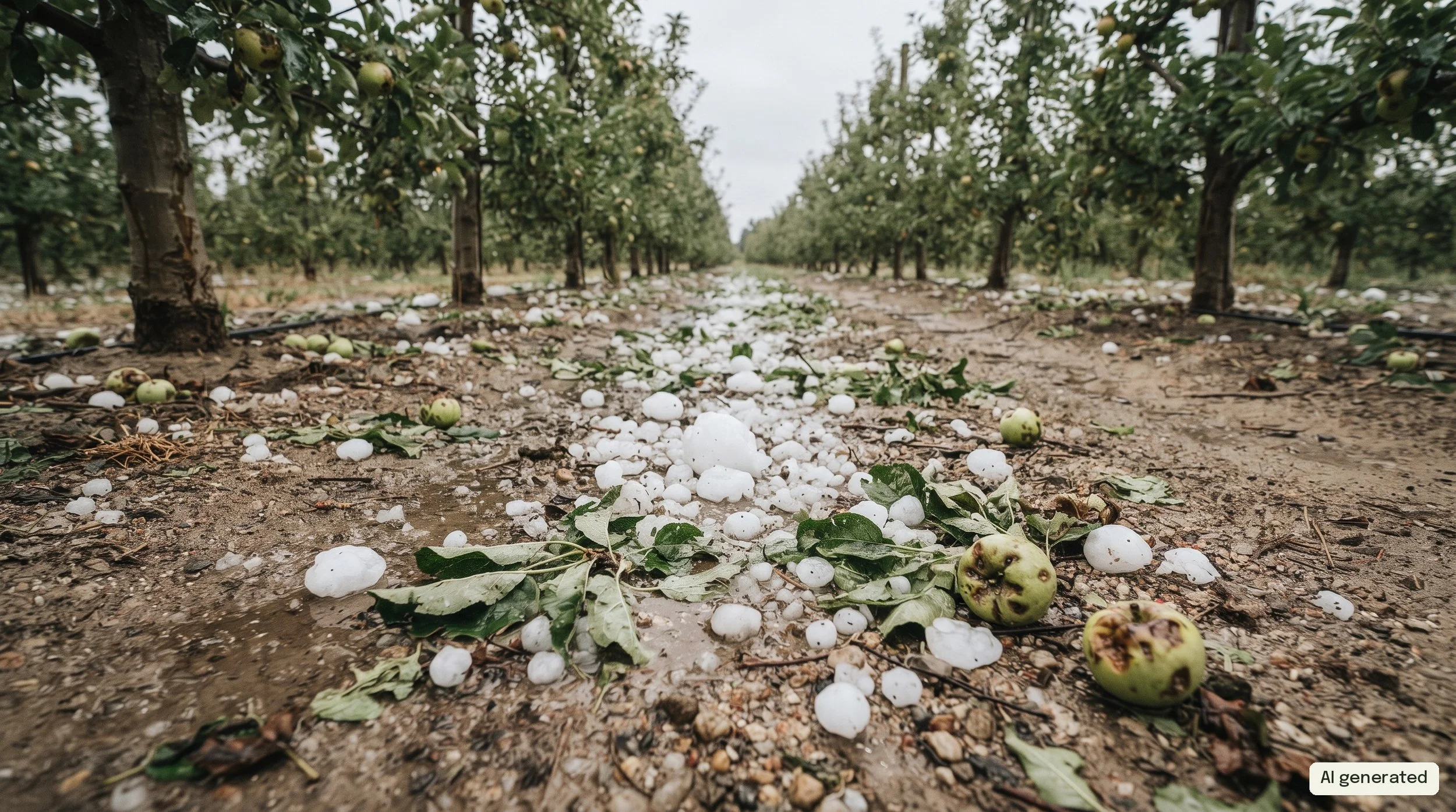
Whatever came through that night was still on the trees ten weeks later, on the afternoon of Monday, November 16, when hail came through Bowen again, and through La Marzolina and Real del Padre, and through Rivadavia and La Paz in the north, Ugarteche, and three districts of the Uco Valley. Hail scars fruit, and scarred fruit does not make processing grade. Growers have until December 1 to file the damage.
On December 2, the first MERCOSUR-European Union Business Forum opens at the convention center in Punta del Este, hosted by Uruguay and the EU, with agrifood as one of five sector panels. I will be there. The agenda runs on tariff lines, logistics corridors and investment frameworks, which is what a forum like this is for and what the two blocs have to settle between them. None of it tells a buyer in Hamburg what happened in Bowen on November 16.
Since May 1, 2026 the interim trade agreement between the EU and MERCOSUR has been applied provisionally, and duties are coming off the lines European manufacturers buy on. A quota transfers on a published date. Knowing how one particular valley fails takes years, and nothing in the agreement moves that across the Atlantic with the goods.
THE TARIFF MOVED ON MAY 1
European manufacturers are already buying more from these valleys, and this year they are doing it for two reasons at once. The first is that Europe is short. The EU apple crop for 2026/27 came in at just under 9.5 million metric tons, 15.6 percent below the previous season and the second smallest in a decade, with Poland at about 2.6 million metric tons, down roughly 30 percent after late frosts. Anyone contracting purée or concentrate has to find the volume somewhere.
The second reason is the tariff. The headline numbers of the EU-MERCOSUR agreement are about meat: 99,000 metric tons of beef at a reduced duty of 7.5 percent, 180,000 metric tons of poultry phased to duty-free over five years, safeguards the Commission can trigger if imports surge, and a 6.3 billion euro safety net for European farmers. That is the part debated in parliaments.
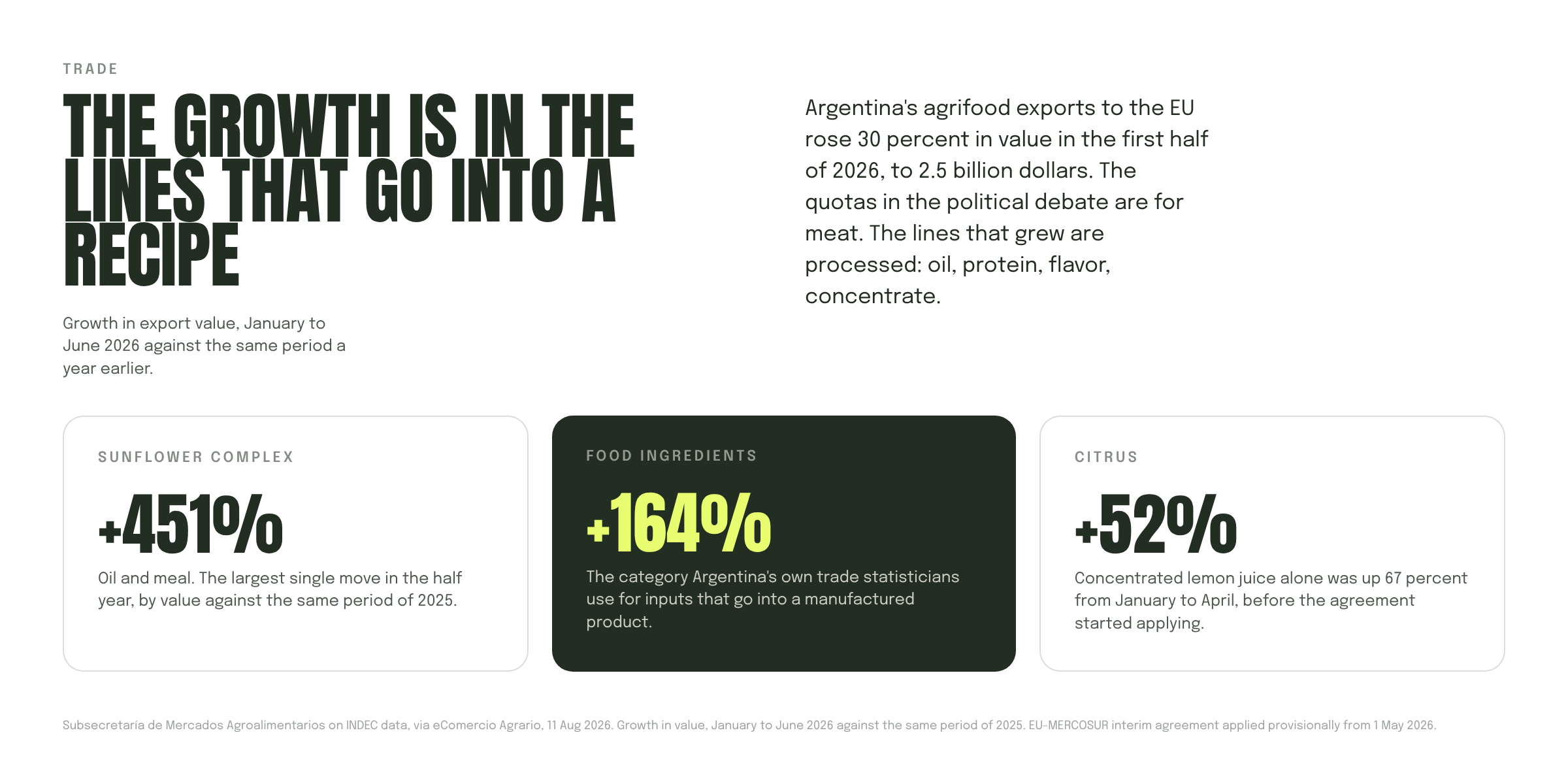
The part that reaches a food manufacturer sits elsewhere, and it has already arrived. Argentina’s agrifood exports to the EU in the first half of 2026 came to 2.5 billion dollars, up 30 percent in value and 14 percent in volume on the same period a year earlier, at an average of 608 dollars a metric ton. The growth sits in processed lines. By value, the sunflower complex grew 451 percent, pulses 167 percent, the category Argentina’s own trade statisticians label food ingredients 164 percent, honey 127 percent, citrus 52 percent. Concentrated lemon juice alone was up 67 percent in the first four months. Four of those six months fell before the agreement started applying at all.
Purée, concentrate, oil, protein, flavor: these are the inputs that go into a recipe, pass through a specification and carry a delivery date. Each of them comes from a specific valley with a specific way of failing, and the buyer switching to it is usually three suppliers removed from anyone who has stood in that valley.
A GOOD WATER YEAR IS NOT A GOOD YEAR
Mendoza is one of those valleys, and this season shows what it costs to read a valley from a distance.
The province is desert. Its production sits in four irrigated oases, and every liter they use is Andean snow that melted and came down a river into a canal system run by the provincial irrigation authority. There is no rainfed agriculture to fall back on. Each October that authority publishes a runoff forecast, and the document decides how much water is allocated to whom for the season ahead.
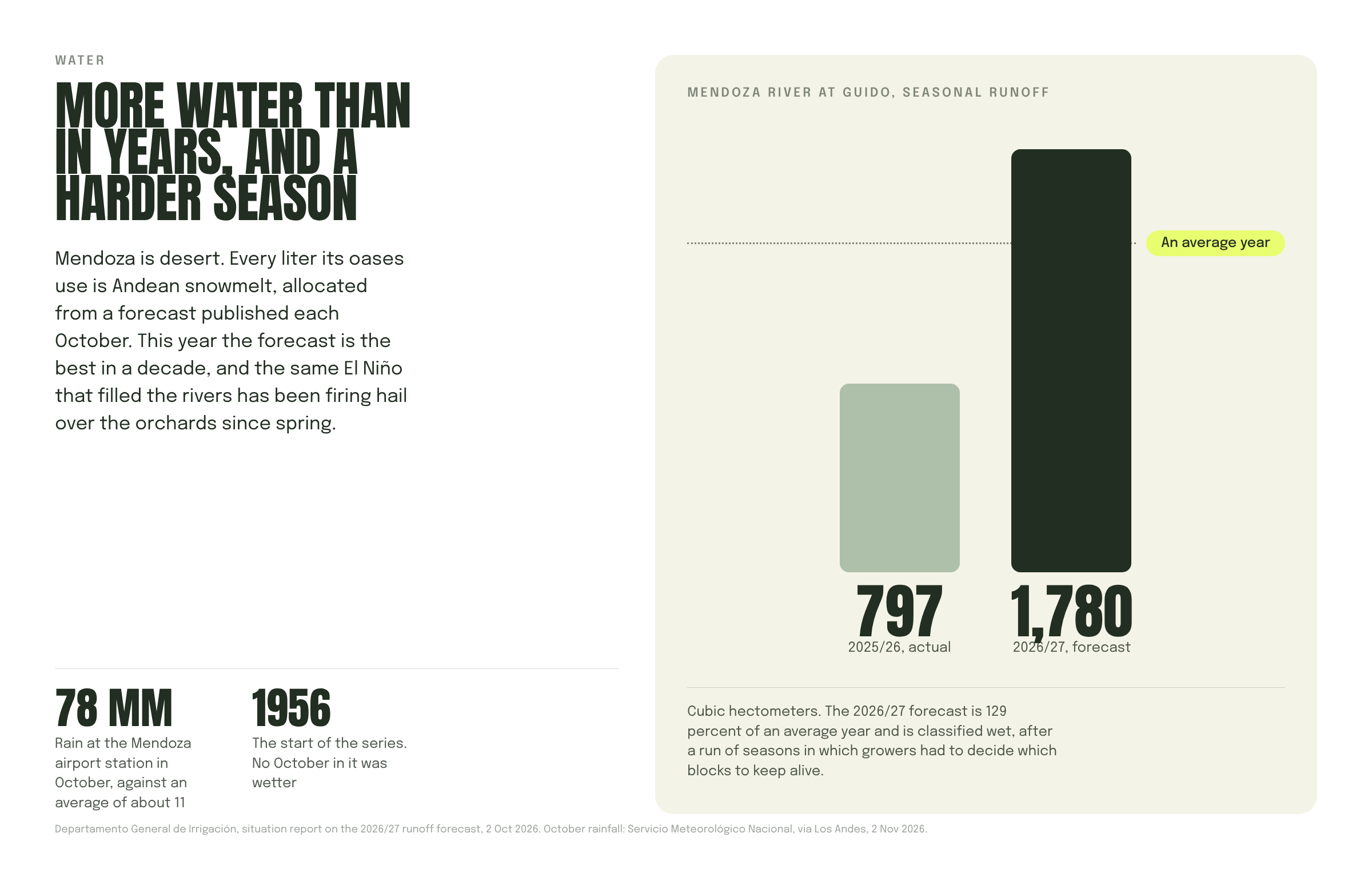
The forecast published on October 2, 2026 was the best in years. The Mendoza river at Guido is projected to carry 1,780 cubic hectometers, 129 percent of an average year. Last season it carried 797. The Tunuyán is forecast at 117 percent, the Diamante at 112, the Atuel at 100. After a run of drought seasons in which growers had to decide which blocks to keep alive, water is not the constraint this year.
A European buyer reading that would conclude the season looks good. In Mendoza nobody concluded that, because the snow and the storms have the same cause. This is a strong El Niño year, and the circulation that loaded the cordillera through the winter is the same one that has been firing convective storms over the oases since spring. October was the wettest the provincial capital has recorded since the series began in 1956: 78 millimeters at the airport station, against an October average of about 11, beating the previous record of 65 from 2001. San Rafael took 209 millimeters in the month, Malargüe 236.
The damage is physical and it is quick. A tree can carry a full load and still lose the season in an afternoon, because grade is what the fruit is paid on. The wounds hail opens are entry points for fungal infection, and sustained humidity through flowering and fruit set is exactly what fungal pathogens need. Growers across the province spent November spraying against shot hole and brown rot in stone fruit, early blight in tomato, downy mildew and botrytis in vines, in weather that keeps washing the spray off and keeps the canopy wet. The risk did not go away when the drought ended. It changed shape. Dry seasons cost volume through water allocation. Wet seasons cost volume and grade in single afternoons that nobody can forecast more than a few hours ahead.
The second thing that never appears on a spec sheet is how concentrated an origin is. Roughly 89 percent of Mendoza’s industrial plum production grows in the southern oasis, the one that froze in September and hailed in November. Another 7 percent is in the east. That is one weather system away from a short season for everyone who buys from it, and the provincial forecast for industrial plum had already been cut from 80,956 to 72,879 metric tons earlier in the year, after hail in December and a storm in San Rafael on January 6, before either the frost or the November hail happened.
What struck me, coming from Europe, is how openly that kind of information circulates in Argentina. Competing processors in Mendoza and San Juan fund agronomists who walk the fields, and they share what those agronomists find, through Tomate 2000, a program that has brought growers, industry and the national agricultural research institute together since the late 1990s and accounts for around two thirds of national processing tomato volume. It also runs a solidarity fund against hail damage. Risk information about the origin is treated as infrastructure rather than as an advantage one buyer holds over another. A tomato buyer in Argentina can give you the national planted area and the yield spread between provinces from memory. A European buyer of Argentine tomato paste usually cannot.
Take the water out and the residue stays
There is a second way a new origin goes wrong, and it has nothing to do with weather.
Every growing country allows its own set of pesticides, and the EU sets a maximum residue level for each one. Those limits are written for the raw fruit. Purée and concentrate are judged by taking that limit and applying a processing factor, the ratio between the residue concentration in the processed product and in the raw one. Above 1 means the step concentrated it. The Commission’s own guidance works through dried plums at 1.4 and olive oil at 5, where a 20 percent yield multiplies whatever sat on the olives by five. Annex VI, where specific concentration factors were meant to be listed, has never been issued, so this is settled product by product. Blending a non-compliant lot down to the limit is explicitly not a route. The limits themselves move. Regulation 2026/2289, in force since November 5, revised them for six active substances, deltamethrin and dodine among them, both used in pome fruit.
A buyer who takes on an origin takes on its spray program. Someone who has bought from the same Spanish or Polish supplier for fifteen years knows which actives show up in a lab result and which growers are careful. In the first season out of a new valley, that knowledge does not exist yet, and the first time it gets tested is on a shipment that is already on the water.
How the news travels in Buenos Aires
Earlier this month I spent two days at Argentina Alimenta in Buenos Aires, asking manufacturers how they find out that something has gone wrong in a growing region.
The answers were consistent, and at first they were surprising. One company that grows part of its own raw material said they hear early because their growers call them. Another said that assessing risk in the field is the job of the people out there, the “chicos del campo”. A third is supplied by forty farms in a single province and knows the state of all forty. One processor described working around a disease problem this season by harvesting earlier than planned and adjusting the process behind it. Asked where the information would come from if the growers did not call, most of them had no answer, because the question had not come up before.
This is early warning that works, and it stops at the edge of the relationship. It does not travel to the company in Europe that will buy that same purée under a new tariff line next year, and it does not travel to the second and third origins the same company is about to add. A call from a grower you have known for fifteen years is the best signal in this industry and the least portable.
When a buyer takes on an origin where nobody in the company has a fifteen-year relationship, the signal has to be assembled from traces that are already public and simply never read together. A provincial irrigation authority publishing a runoff forecast on October 2. A station network recording minus 6.6 degrees during flowering. A damage registry opening on November 17 with a filing deadline of December 1. Local agricultural press reporting a disease outbreak three weeks before it shows up in a shipment. Each of those is weak on its own and specific once it is read against your own origins, suppliers, varieties and contracts. That is the work Finches Intelligence does, and where a customer or its partners do have people in those regions, what they see on a visit goes into the same picture through the mobile app instead of staying in a notebook.
On December 2 we will spend the day in Punta del Este on quotas, corridors and investment frameworks, and that is the work the forum exists for. The quota phases in over five years. Learning what a valley does takes longer.
In Bowen, the filing deadline for the November hail is the day before the forum opens.
I will be at the forum in Punta del Este on December 2. If you are going too and want to talk about how your own origins are read, you can book a time here: https://meetings-eu1.hubspot.com/catharina-van-delden

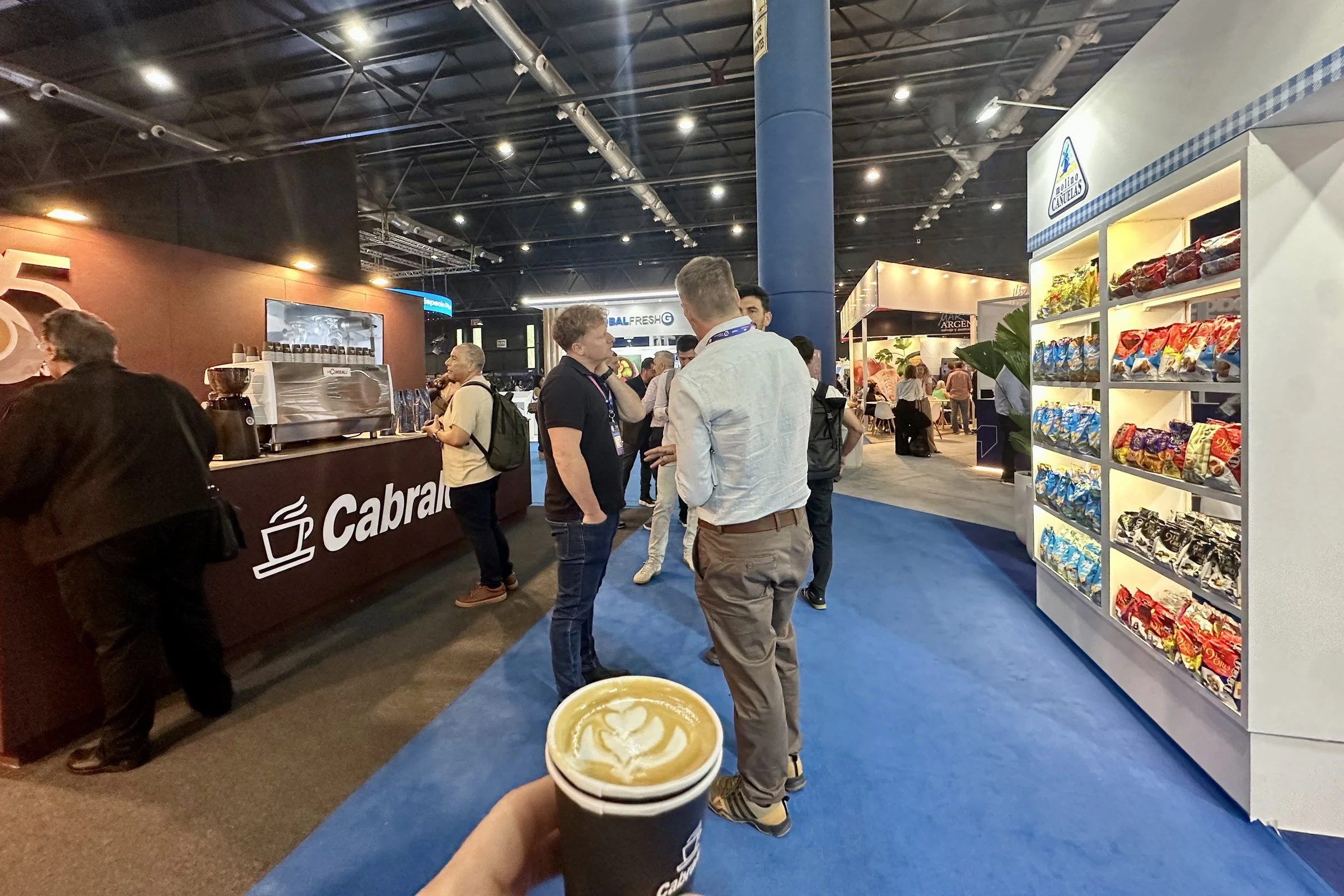
Catharina van Delden, co-founder of Finches, at Argentina Alimenta in Buenos Aires, November 2026.
NOTES ON FACTS AND SOURCES
Frost, September 2026. Minimum temperatures of minus 6.6 at Real del Padre, minus 6.5 at Bowen, minus 6.0 at La Marzolina, minus 5.5 at Villa Atuel and El Ceibo, minus 5.1 at La Escandinava and minus 3.9 at La Llave and Monte Comán on the mornings of September 6 and 7, 2026, measured by the AEMSA automatic station network; 31 degrees on September 3; warning issued by the provincial Dirección de Contingencias Climáticas: FreshPlaza, September 2026, sourced from masp.lmneuquen.com. The same report gives the share of provincial production in the southern oasis at about 89 percent and the eastern oasis at about 7 percent, and the industrial plum forecast revised from 80,956 to 72,879 metric tons after hail in December and the storm of January 6 in San Rafael, per the Dirección de Agricultura de Mendoza.
Hail, November 2026. Storms on the afternoon of Monday, November 16 across Rivadavia, La Paz and Luján de Cuyo in the north and east; Tunuyán, Tupungato and San Carlos in the Uco Valley; General Alvear including Bowen and La Marzolina, and San Rafael including Villa Atuel and Real del Padre, in the south. Damage filing open from November 17, ten working days, to December 1, 2026, through the Dirección de Contingencias Climáticas of the provincial Ministerio de Producción: Diario Uno, November 17, 2026. The filing procedure itself, open to growers with damage above 10 percent of the crop, free of charge, with on-site assessment by an official perito tasador and a certificate that underpins a declaration under provincial law 9083 and national law 26.509: Gobierno de Mendoza, Contingencias Climáticas, riesgo agrícola, accessed November 25, 2026.
Runoff forecast. Departamento General de Irrigación, situation report on the 2026/27 runoff forecast, October 2, 2026: Mendoza river at Guido 1,780 hm3, 129 percent of an average year, classified wet, against 797 hm3 actual in 2025/26; Tunuyán 990 hm3, 117 percent, against 535; Diamante 1,090 hm3, 112 percent, against 548; Atuel 1,080 hm3, 100 percent, classified normal, against 633.
October rainfall. 78 millimeters at the Mendoza airport station against an October average of about 11, the highest in a series that begins in 1956, previous record 65 millimeters in 2001; 209 millimeters in San Rafael and 236 in Malargüe for the month: Servicio Meteorológico Nacional, via Los Andes, November 2, 2026. In the same report, Maximiliano Viale of Conicet cautions against expressing the month as a multiple of the average, which is why no multiple appears above.
Processing tomato. National production close to 400,000 metric tons in 2026 against 620,250 metric tons in 2025, area about 5,120 hectares, average yield 91 metric tons per hectare in Mendoza and above 120 in San Juan, with the Tomate 2000 program accounting for 68 to 69 percent of national volume: Tomato News, June 5, 2026, citing WPTC and Tomate 2000, at https://tomatonews.com/argentina-2026-processing-tomato-season-and-outlook/. The same report gives the program’s own average yield at a record 106 metric tons per hectare and describes its solidarity fund against hail damage. The program’s own website, tomate2000.org.ar, does not resolve as of November 25, 2026, so the Tomato News report is the link used in the text. The program’s origin as a joint effort of growers, industry and INTA from the late 1990s: Alimentos Argentinos, Argentine Ministry of Agriculture.
Trade agreement. Provisional application of the EU-MERCOSUR interim trade agreement from May 1, 2026, with formal entry into force pending European Parliament consent; 99,000 metric tons of beef at a 7.5 percent duty, 180,000 metric tons of poultry duty-free phased over five years, 60,000 metric tons of rice and 45,000 metric tons of honey on the same phase-in, safeguard provisions and a 6.3 billion euro safety net: European Commission, EU-MERCOSUR trade agreement pages, accessed November 25, 2026.
Argentine exports to the EU. 2.5 billion dollars in January to June 2026, up 30 percent in value and 14 percent in volume at 4.1 million metric tons, averaging 608 dollars a metric ton; growth by value of 451 percent in the sunflower complex, 167 percent in pulses, 164 percent in food ingredients, 127 percent in apiculture products and 52 percent in citrus, with concentrated lemon juice up 67.1 percent from January to April: eComercio Agrario, August 11, 2026, from Argentina’s Subsecretaría de Mercados Agroalimentarios on INDEC data.
European crop. EU apple production for 2026/27 forecast at just under 9.5 million metric tons, 15.6 percent below the final 2025/26 figure and the second smallest crop in ten years, with Poland at about 2.6 million metric tons, down about 30 percent: World Apple and Pear Association, presented by secretary general Philippe Binard at Prognosfruit in Konstanz, via Fruitnet, 2026.
Residues in processed product. Where no limit is set for a processed product, the limit of the raw commodity applies, converted with a processing factor calculated as the ratio of residue concentrations; a factor above 1 means concentration; worked examples of dried plums at 1.4, raisins at 1.1 and olive oil at 5 from a 20 percent yield; Annex VI of Regulation (EC) No 396/2005, which would hold specific concentration and dilution factors, has not been issued; blending a non-compliant lot to dilute it is not permitted: European Commission, information note on Article 20 of Regulation (EC) No 396/2005, SANTE-2021-10704. Commission Regulation (EU) 2026/2289 of 15 October 2026 amended Annex II of that regulation for acequinocyl, deltamethrin, dodine, maleic hydrazide, pinoxaden and prothioconazole, applying from November 5, 2026: EUR-Lex.
Business forum. First MERCOSUR-European Union Business Forum, December 2, 2026, convention center in Punta del Este, hosted by the government of Uruguay in the MERCOSUR pro tempore presidency together with the European Union under Global Gateway, with support from the IDB, CAF, the EIB and Uruguay XXI; sector panels including agrifood; held ahead of the first EU-MERCOSUR Council under the interim trade agreement: European Commission, International Partnerships.
Trade fair conversations. Argentina Alimenta, Buenos Aires, November 2026. The companies are not named, the descriptions are deliberately unspecific, and none of them has reviewed this text.
