
Why the Supply Chain Is Breaking and How a Decoupled Data Architecture Can Fix It

Carlo and Steffi met virtually in October 2025, AI brought them together in this picture.
Steffi: Carlo, you’ve spent years analyzing how data and AI reshape industries. Why is food and agriculture still playing catch-up?
Carlo: It’s not that the sector doesn’t care about data; it’s that it inherited a fragmented system. Farming used to be built on local intuition: people knew what “five days of rain followed by two of sun” meant for a specific crop. That knowledge evaporated when agriculture scaled up and became industrial.
Now you have massive operations using external equipment providers, digital dashboards, and weather APIs — but none of it talks to each other. We’ve replaced wisdom with spreadsheets. And the result is that operational data from farms — the stuff that really matters — is often missing, messy, or locked away.
Steffi: Where does ESG and sustainability tech fit into this picture?
Carlo: ESG tools exploded in number, but many are still compliance bolt-ons. A lot of the big platforms grew by acquisition: from the outside they look like unified solutions, inside they’re stitched together products with incompatible data models.
So companies end up exactly where they started: collecting data in siloed systems, then manually reconciling everything in Excel. For food buyers dealing with local climate and water risk, that’s not just annoying - it’s dangerous. You can’t manage real-world volatility with spreadsheet archaeology.
What I like about Finches is that you start from reality: the data is messy. You don’t ask the customer for a perfect dataset. You take the chaos - PDFs, photos, voice notes - and use AI to turn it into structured, reusable information. That’s a shift from reporting to intelligence.
Steffi: So the problem isn’t the data itself, it’s the architecture?
Carlo: Exactly. Most large food buyers use legacy systems that were never designed to handle volatility or cross-functional risk data. Climate data, water availability, pest outbreaks — they all live in silos.
To make sense of it, companies still rely on manual work in Excel. But if you’re a global buyer of agricultural goods, that’s no longer tenable. Climate risk isn’t a theoretical scenario; it’s a financial event.
Take hazelnuts. When a pest outbreak hits Turkey, Ferrero loses a big chunk of the its supply. That disruption ripples straight to the consumer shelf. Prices spike. Inflation climbs. That’s the real cost of data blindness.
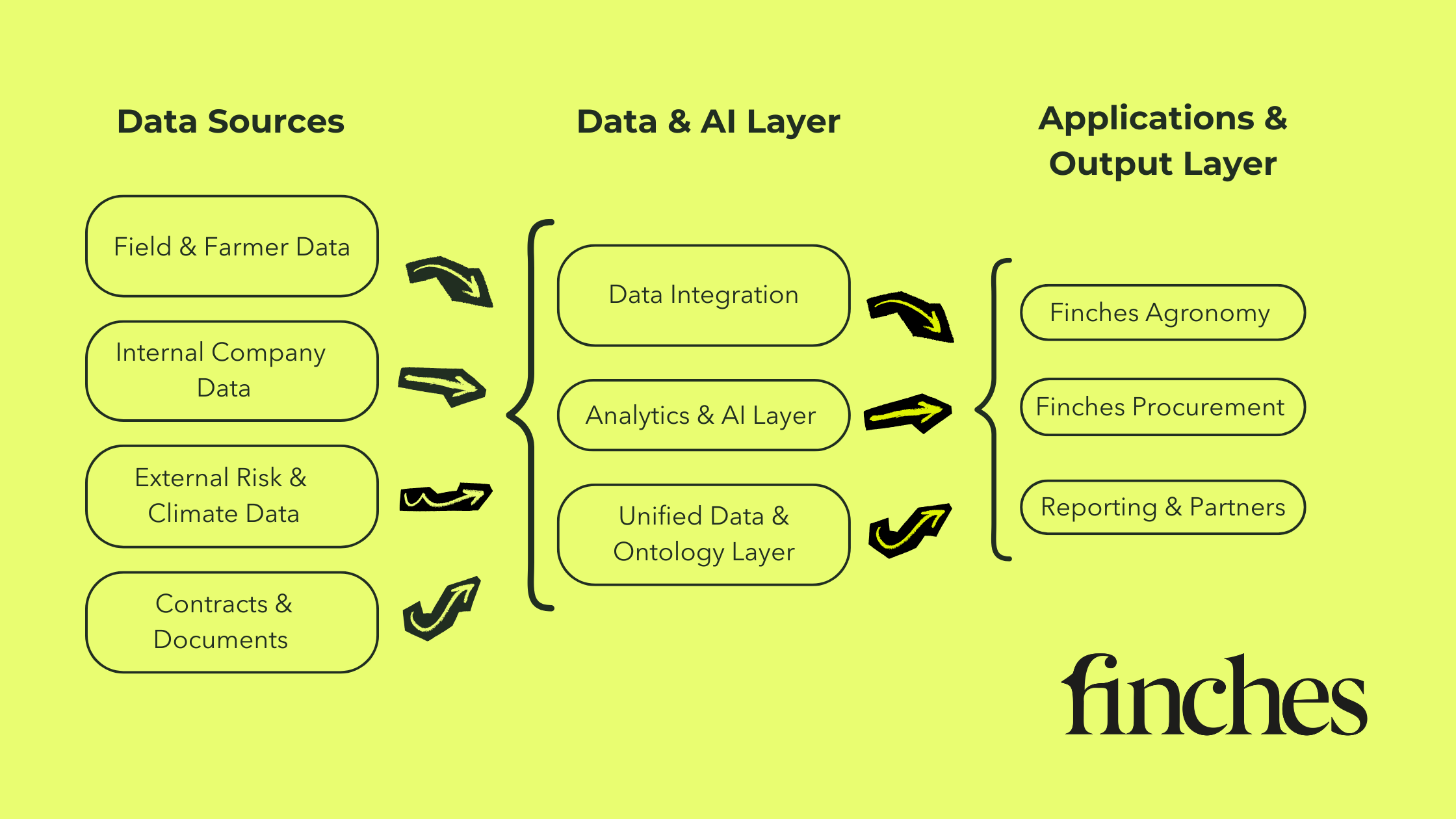
Diagram of Finches’ data platform showing data sources flowing through a data and AI layer into agronomy, procurement, and reporting applications.
Steffi: You’ve described this as moving from “application-centric” to “data-centric” architectures. What does that mean in practice?
Carlo: It means decoupling the data from the app. Right now, most corporate data lives inside systems like SAP or Oracle. That’s a dead end — the data can’t evolve faster than the software vendor’s roadmap.
Instead, you need a decoupled data architecture: the data layer, the ontology (the logic connecting it all), and the application layer sitting on top. Once that’s in place, you can plug in partners, APIs, even new regulations without breaking your system.
That’s the future. Flexible, living data models that reflect the business reality, not the limitations of legacy code.
Steffi: Where does AI and especially Large Language Models fit into that picture?
Carlo: LLMs are the bridge between humans and messy data. Think of the agronomist managing a farm: someone who knows when to water, when to fertilize, and when to pray it doesn’t hail. Their decisions used to be guided by experience, but climate change has made that playbook unreliable.
With GenAI, that person can ask the system: “Should I irrigate tomorrow?” and get an answer grounded in hyper-local data. LLMs turn the interface conversational, visual, adaptive.
For companies like Finches, they’re indispensable — not as gimmicks, but as engines for understanding unstructured input. Photos of damaged crops, WhatsApp voice notes from farmers, text updates from suppliers — all of that becomes data you can act on.
It’s not about replacing humans. It’s about making them 10x more capable in the field.
Steffi: So resilience starts with data that’s decoupled, local, and alive. What’s your advice to the food giants reading this?
Carlo: Stop waiting for regulation to force your hand. ESG reporting won’t save your supply chain – but a solid data foundation will.
Start by building a data model that reflects your real-world value chain, not your org chart. Make it flexible. Make it open. Use AI to translate complexity into clarity.
And yes – decouple your data from your applications. That’s how you future-proof the business.
The companies that win the next decade won’t just be sustainable. They’ll be data-native.
Steffi: That’s a great note to end on. Thanks, Carlo - for the honesty and the optimism.
Carlo: My pleasure. The food system won’t be saved by prettier reports. It’ll be saved by better data, used well - and I’m glad Finches is building exactly that.
