
How GenAI Is Rewriting the Startup Playbook: Insights from Road to DevFest 2025
In today’s volatile markets, where a single data delay can mean the difference between growth and collapse, speed and resilience have become the new currency of survival. At Road to DevFest 2025 in Google’s Munich office, our Co-founder and CTO, Steffi Glenn, joined industry innovators to explore how Generative AI is redefining efficiency, creativity, and operational resilience across startups and enterprises alike. Drawing from Finches’ experience as an AI-native SaaS platform serving agricultural supply chains, Steffi shared how GenAI is empowering lean, data-driven growth, transforming unstructured information into actionable insights, and emphasizing that true innovation still depends on human critical thinking and strong platform foundations. Below, we break down her key takeaways on how AI is shaping the future of supply resilience and sustainable scaling.
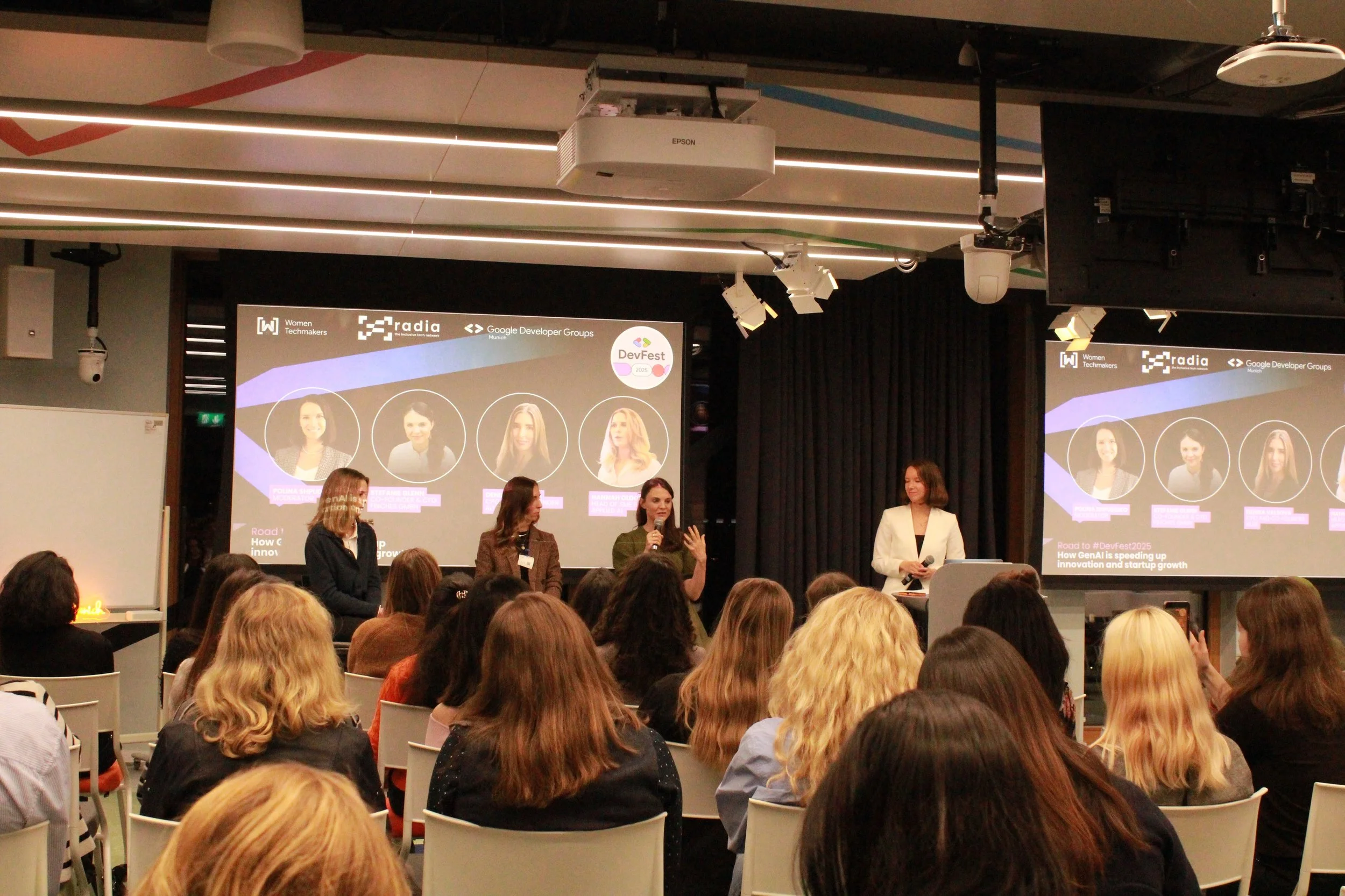
Finches co-founder Steffi at Road to DevFest 2025
That was the energy pulsing through Google’s Munich office last Friday, where innovators and founders gathered for Road to #DevFest 2025 to explore how Generative AI is accelerating innovation and startup growth. Our Co-founder and CTO, Steffi -a seasoned data leader and architect behind our AI-powered supply resilience platform- joined the panel to discuss how GenAI is redefining what efficiency and creativity look like in today’s digital infrastructure. The event was hosted by Google Developer Groups Munich and Women Tech Makers, in collaboration with Radia.
Drawing on her experience leading an AI-native SaaS company serving agricultural supply chains, Steffi highlighted a powerful shift: AI is no longer just a productivity tool; it’s an operational multiplier transforming how businesses build resilience, manage risk, and scale sustainably.
Below are the key takeaways from Steffi’s session - insights into how we’re leveraging AI to deliver smarter, more resilient solutions for agricultural buyers while driving faster, data-driven growth.
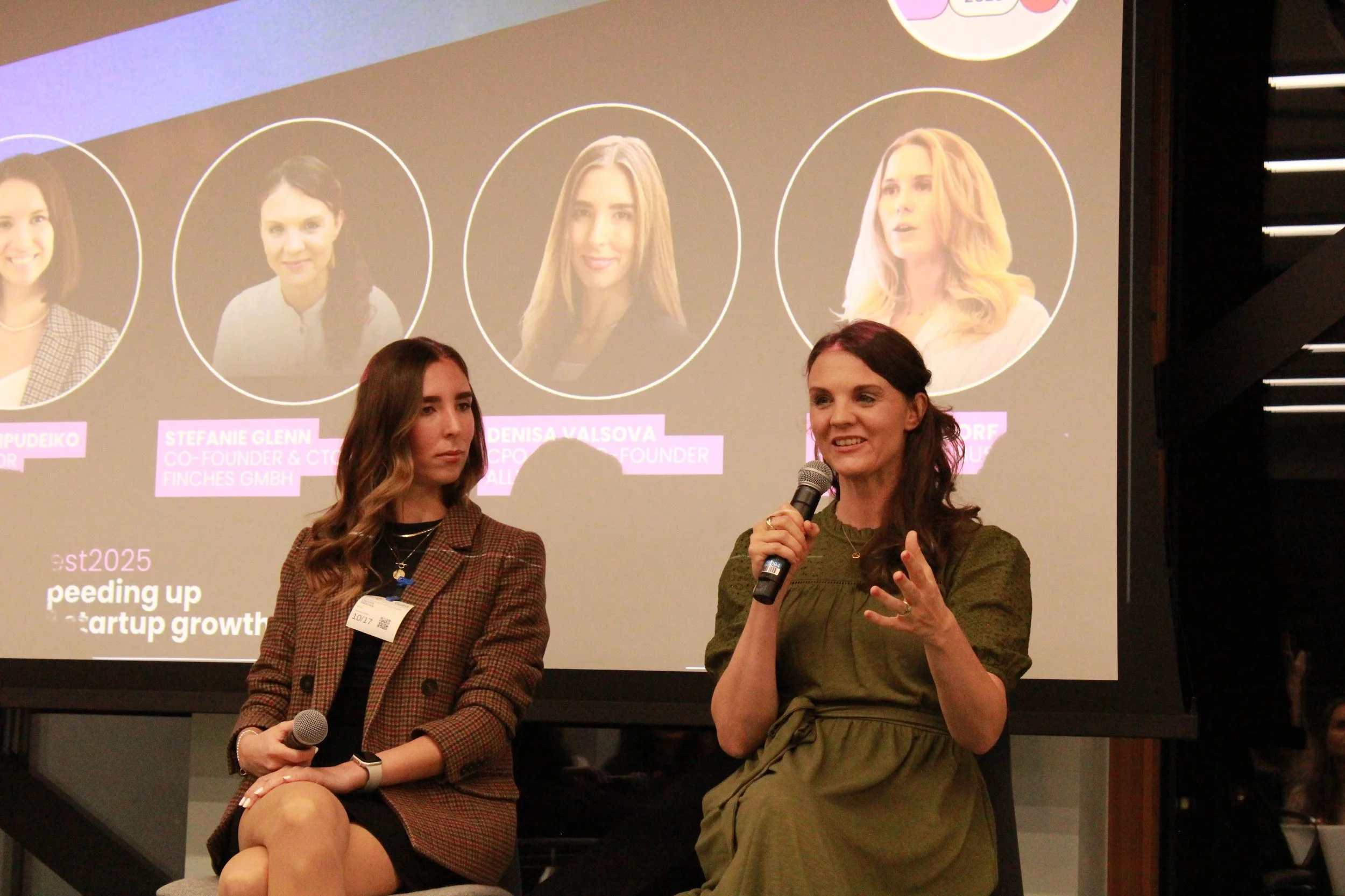
Our co-founder Steffi is discussing how GenAI is redefining what efficiency and creativity look like in today’s digital infrastructure
The End of Bloated Teams: How GenAI Empowers Lean, AI-Assisted Growth
In the GenAI era, efficiency is no longer optional. What once took startups weeks or months can now be completed in hours with the right AI infrastructure. During the panel, our co-founder Steffi shared how Finches operates a "small but mighty team" of just six employees, yet performs with the agility of much larger companies.
The key to this efficiency lies in how Finches uses GenAI tools. They are treated as an "army of assistants" that supports creativity rather than replaces it. This AI-powered team structure helps Finches deliver data-driven supply chain solutions for agricultural buyers while staying lean, adaptive, and innovative.
Doing More with Less: Scaling Through GenAI Efficiency
Doing Less with More: The team operates at a high level of efficiency because every member leverages GenAI tools in daily work. What would normally require several departments can now be achieved by a small, focused team. For instance, there is no need for a dedicated marketing department yet; all website content can be created with AI support, maintaining both speed and consistency.
The Human Mandate: Despite this reliance on AI, the tools are designed to support, not replace, human creativity. During onboarding, new team members are reminded that they are hired for their unique ideas, not to simply relay prompts to an LLM. This balance between lean, human-driven creativity and mechanical AI efficiency ensures that while content creation is fast, the brand’s identity remains consistent. Human designers define the look, color scheme, and logo, and those elements guide all AI-generated content.

A robotic hand reaching upward toward a glowing network of connected points and lines, symbolizing artificial intelligence and digital connectivity on a blue background.
Unlocking the Iceberg: The Analytical Power GenAI Brings to Supply
For buyers of agricultural goods, timely and accurate data is the ultimate competitive edge. Steffi Glenn explained that AI’s greatest strength is not just generating text but acting as a powerful analytical tool.
Cracking Unstructured Data: At Finches, LLMs are embedded deeply in the product to unlock unstructured data that was previously difficult to process. Turning raw, disorganized information into actionable insights is central to building a supply resilience platform.
The 10-Minute Market Insight: The analytical power of Generative AI continues to surprise. After spending weeks collecting complex market data - competitors, company sizes, key players - the results remained incomplete. When the team used Google Gemini Deep Research, the entire analysis was completed in ten minutes with a depth that traditional methods could not achieve.
Beyond Vibe Coding: Why Critical Thinking Still Builds the Foundation
In today’s landscape of GenAI-powered software development, speed is no longer the challenge - clarity is. Generative AI (GenAI) can now transform early-stage ideas into Minimum Viable Products (MVPs) within hours, helping even non-technical teams visualize concepts faster than ever. But as Steffi Glenn pointed out during the panel, moving fast means little if your foundation can’t hold. For regulated industries like agriculture, agritech, and supply chain management, that foundation is compliance, precision, and human oversight.
The Production Barrier: An MVP is only a visual prototype. It does not meet the strict technical, IT compliance, or data privacy regulations required in a live production environment. The gap between an MVP and a market-ready product defines the difference between innovation and operational risk.
A Critique of “Vibe Coding”: Steffi cautioned against the rise of “vibe coding,” where developers rely too heavily on AI-generated code without understanding its logic. GenAI can accelerate creation, but true reliability demands critical engineering. The idea may be the tip of the iceberg; building the structure beneath it still requires human problem-solving.
What Makes a Good Developer: The strength of a developer lies not in the number of programming languages they know but in their ability to think critically and analytically. The best engineers understand the end-to-end picture, connecting technical precision with business goals. No Large Language Model (LLM) can replicate that type of reasoning.
While LLMs now support debugging, data processing, and boilerplate code, genuine creativity and 10x thinking still belong to humans. For companies building AI-powered SaaS platforms, critical thinking remains the foundation of every sustainable innovation.

The Platform Is the Priority
For companies building technology to manage complex agricultural supply chains, like Finches, agility is everything. During her panel talk, Steffi emphasized a crucial truth: Large Language Models (LLMs) evolve rapidly. They are interchangeable tools that will continue to change and improve. Relying on a single model or vendor is not sustainable for long-term innovation in GenAI-powered systems.
Steffi explained that what truly determines scalability and resilience is not the LLM itself but the AI platform architecture supporting it. A future-proof SaaS solution must be flexible enough to adapt as new models and compliance standards emerge.
Three principles define a resilient GenAI platform:
Interchangeability: The ability to switch between LLMs easily, maintaining functionality as technologies evolve.
Compliance: Out-of-the-box alignment with industry regulations, IT standards, and data privacy requirementscritical to agritech and supply chain software.
Coherent Ecosystem: Seamless integration of data and AI in a unified, secure environment that enables accurate, real-time decision-making.
The success of Finches depends on this foundation. Solving challenges such as integrating unstructured data streams, ensuring compliance, and maintaining transparency for agricultural buyers requires a platform-first approach - one built for adaptability and continuous innovation.
A big thank you to the Google Developer Groups Munich and Radia community for hosting Road to DevFest 2025 and creating a space where founders, engineers, and innovators could exchange ideas on how Generative AI is transforming the startup ecosystem! The event’s thoughtful organization, open discussions, and collaborative energy made it a true reflection of what drives progress in tech: curiosity, creativity, and shared learning.
FAQ
1) How does GenAI help agricultural buyers manage supply chain risk?
GenAI aggregates supplier data, prices, certifications, and news, then flags anomalies and exposure in near real time. Buyers see early signals on delays, quality issues, or compliance gaps and can switch suppliers or renegotiate faster.
2) What’s the difference between an AI-built MVP and a production system?
An MVP is a demo that proves the concept. A production system must meet uptime targets, security and data privacy requirements, auditability, scalability, and integration with existing ERPs or procurement tools.
3) Are LLMs interchangeable for agritech platforms?
Yes, if the platform is designed for model interchangeability. The key is an architecture that abstracts the LLM, supports rapid switching, monitors quality, and logs outputs for compliance.
4) How can AI analyze unstructured supplier data?
LLMs and embeddings normalize PDFs, emails, certificates, specs, and invoices, then map entities like product, origin, volume, and dates. The result is structured records that power risk scoring and decisions.
5) What guardrails are needed for data privacy in agri SaaS?
Role-based access, data minimization, regional data residency, encryption in transit and at rest, audit logs, human review for high-impact actions, and vendor due diligence against relevant standards.
