
From an 8am voice note to a 4pm sourcing decision: introducing the Finches platform

Our first enterprise partners are live, the team is growing, and working closely with customers has sharpened our thinking considerably. We want to share where the product stands today - what is already shipping, what is coming next, and why we are building in this order.
In 2023, Fusarium blight moved through Nigeria's ginger-growing regions and wiped out roughly 95% of the harvest. A tea company that had sourced Nigerian ginger for years lost its entire supply for one of its core SKUs and discontinued the product. The company had own agronomists. It had supplier relationships built over a long time. What it lacked was a way for the early blight signals its field teams were seeing to reach the sourcing desk before the loss was already locked in, and that gap between field observation and procurement decision is what Finches was built to close.
Three numbers, every planning cycle
Every sourcing and agronomy team is defending three things each season: whether there is enough volume, whether it will meet specification, and what a difficult season costs.
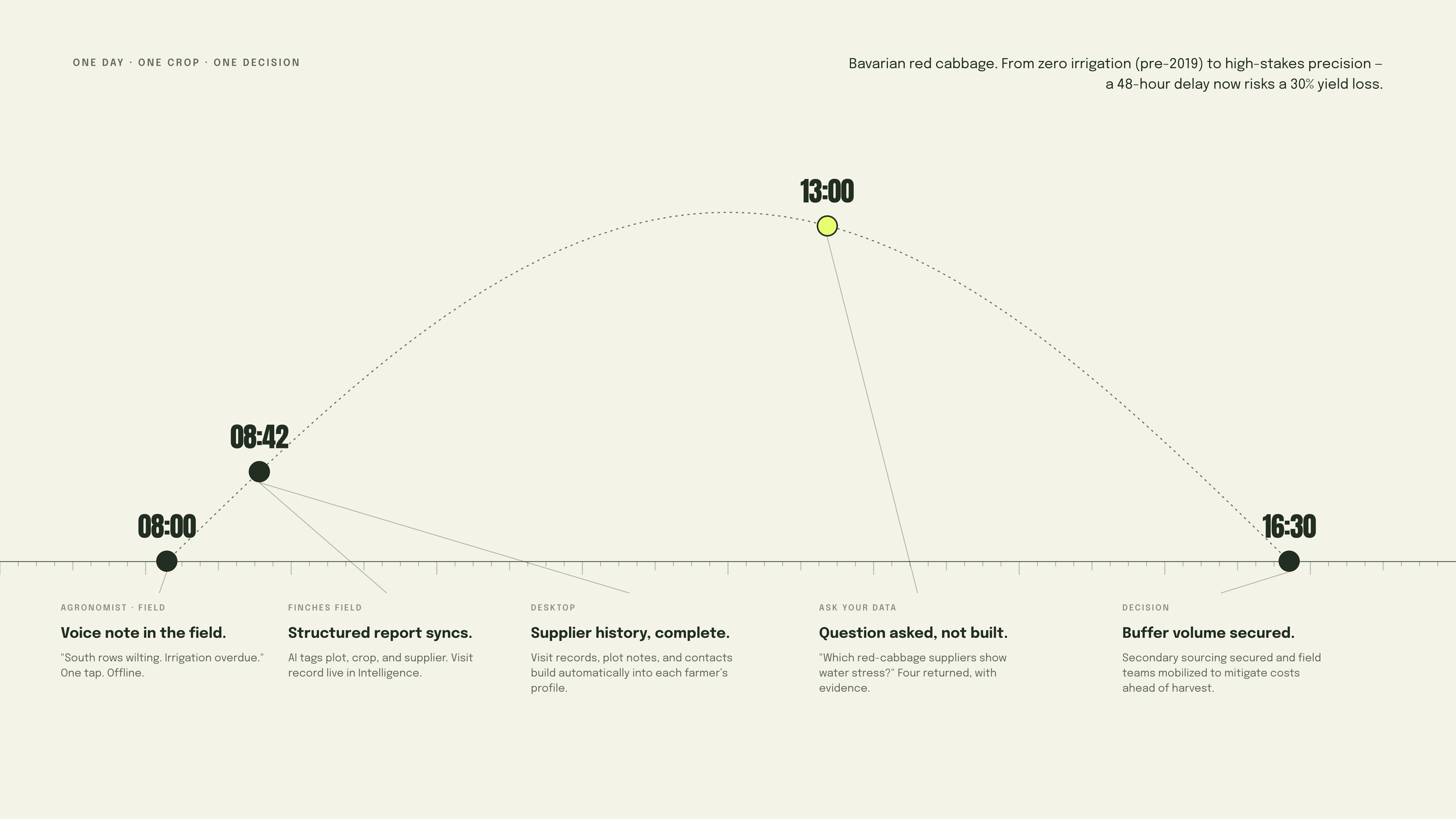
The 2023 ginger harvest is what volume risk looks like when it runs to its conclusion: not a partial shortfall but a full SKU discontinuation. A baby food producer holding carrots to a near-zero nitrate threshold discovered what one heavy rainstorm can do to a batch when the crop pushed past the limit, the batch was written off, and the factory sat idle. In Bavaria, red cabbage that needed no irrigation before 2019 now carries a hard deadline on every dry spell, where a 48-hour delay costs roughly 30% of the harvest.
None of this sits at the margins of agricultural sourcing any longer, and the data to anticipate most of it already exists in the observations agronomists make during farm visits, in voice notes recorded before connectivity drops, in photos taken between rows, in weather forecasts that nobody has yet mapped to a specific supplier's plots. The trouble is that most organisations have no reliable way to get that data from the field to the people making procurement decisions before it is too late.
A day in the life of a Finches customer
08:00 - Finches Field Mobile: the observation
A field agent is walking a ginger plot in Nigeria and notices unusual yellowing on a cluster of leaves two rows in. She opens the Finches Field mobile app, records a voice note describing what she can see, takes a photograph, and moves on. The observation took under a minute; the app structures it automatically, tagging the plot, the crop, and the supplier, and queues a visit report for when she next picks up signal. There is no spreadsheet waiting for her back at the office, no form to fill out on a patchy connection, no notes to transcribe at the end of the day. Field teams using Finches recover up to 15 hours of weekly documentation time that previously went into exactly that kind of manual work.
08:42 - Finches Field Desktop: one source of truth
When her phone reconnects, the report syncs and lands in the desktop platform alongside every previous visit to that farm, that plot, that supplier. The sourcing director looking at the platform does not wade through a folder of PDFs or wait for the weekly summary email. She sees a live map of the full supplier base with drill-down into any farm, any crop, any agronomist's history. Most sourcing organisations are not short of field presence; the problem is that the intelligence field visits generate tends to dissolve into WhatsApp threads and personal notebooks before it reaches anyone in a position to act on it.
13:00 - Finches Intelligence: the full picture
By midday, something else has surfaced. Finches Intelligence has been running against external data sources overnight and flagged a critical alert: Fusarium blight signals across four ginger suppliers in the same Nigerian region, first reported 24 hours earlier, affecting plots the field agent visited that morning. The sourcing director did not actively search for this. The platform cross-references external disease data, weather signals, and regulatory alerts against the actual supplier relationships in the system and surfaces them as specific, supplier-level risks rather than generic regional warnings.
She queries the platform in plain language: which ginger suppliers are showing blight risk and how many plots are affected? The answer comes back in seconds, with the visit reports, voice notes, and external signals all cited as sources. The risk feed organises incoming signals into categories, so the team can focus on what needs a decision rather than working through every alert that comes in.
16:30 - The decision, and what comes next
By late afternoon the sourcing director has identified the exposure, contacted alternative suppliers, and started reallocating volume before the harvest loss is confirmed. An observation made in a remote plot that morning, cross-referenced with external disease signals the platform was already tracking, gave the team enough lead time to act. That is the movement Finches makes possible: not faster reporting but decisions taken while there is still something to decide.
The next layer Finches is building toward takes this further. Agentic sourcing, where the platform initiates the response rather than surfacing it, rerouting volumes when a supply corridor closes, triggering sourcing playbooks, drafting supplier communications, with every action auditable and every decision sitting with the team that approves it. That layer is in development, and the intelligence feeding it is being built in every farm visit the platform captures today. today.
The platform, layer by layer
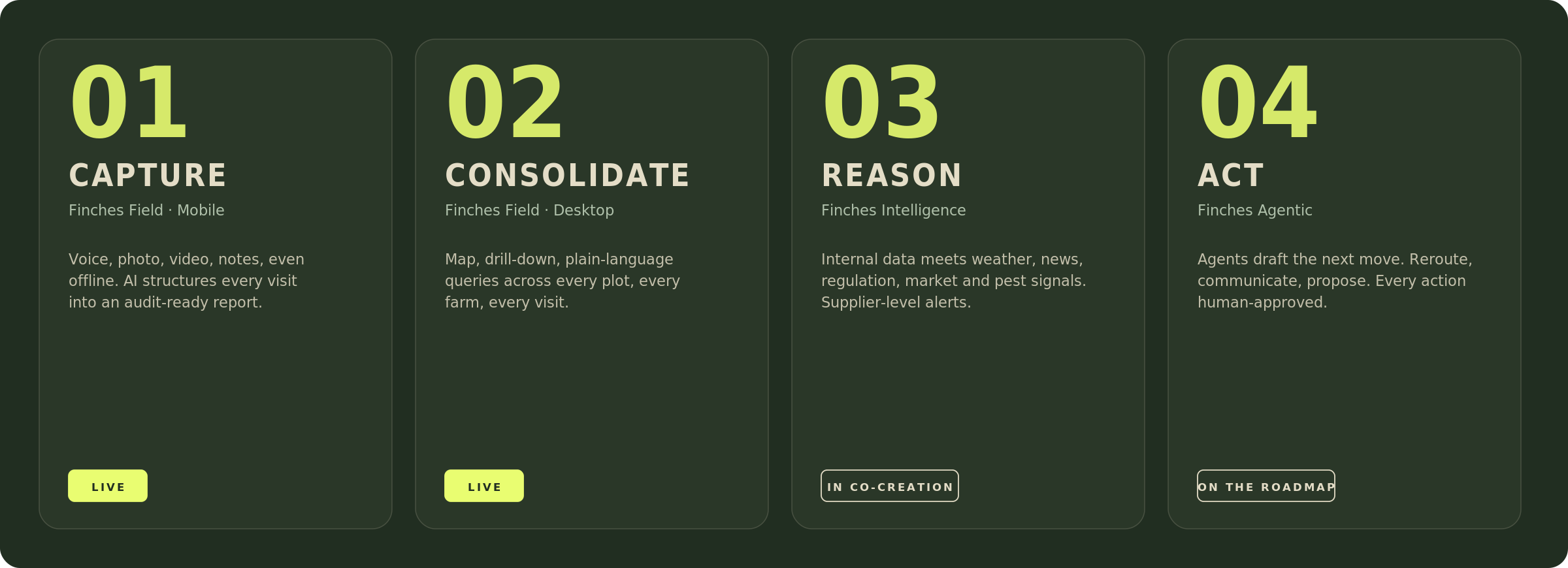
Finches runs as four layers, each one feeding the next.
Finches Field Mobile is where intelligence begins. Voice, photo, and video capture works offline and structures each observation into a searchable, audit-ready visit report automatically. Live on iOS and Android.
Finches Field Desktop consolidates everything field teams capture into a single source of truth: a map of every farm, every plot, and every visit across the full supplier base, queryable in plain language without needing a data team or a pre-built dashboard. Live now.
Finches Intelligence connects internal field data to the external world, mapping weather events, regulatory changes, pest outbreak alerts, and news signals to specific suppliers and crops rather than delivering them as generic regional feeds. In co-creation with enterprise partners, with risk alerts already active.
Finches Agentic Sourcing will handle the execution side: rerouting volumes, triggering sourcing playbooks, and drafting supplier communications, with every action auditable and every decision requiring team approval.
Why the timing matters
Agricultural sourcing has always carried exposure to weather, disease, and geopolitical disruption, but the frequency and scale of those disruptions has shifted in ways that are difficult to plan around using the tools most teams currently have. Procurement leaders are also under more scrutiny than they were five years ago, with boards expecting evidenced risk management rather than the seasonal intuition and supplier trust that used to be enough. The tooling to connect field-level observation to procurement decision-making at enterprise scale has not existed until now, and Finches is building that category starting with the part of the problem no existing tool has addressed: getting reliable, structured intelligence out of the field in the first place.
The team
Finches was founded in Munich in May 2025 by Catharina van Delden and Dr. Stefanie Glenn. Catharina is a second-time founder who built innosabi into a European market leader before exiting in 2021 and who also runs a pecan farm in Uruguay, giving her a view of agricultural supply chains from both the enterprise software side and the farm gate. Stefanie brings a PhD and deep enterprise software and AI experience from Palantir and Google.
See what your fields are telling you
In most supply bases, the observation that could prevent the next supply failure has probably already been made by someone standing in a field. Whether it reaches the sourcing desk in time is, for most organisations, still largely a matter of luck. Finches is built to close that gap. It's live, and it deploys in days.
